Hands on history: Rowan students unearth Revolutionary War stories at Red Bank Battlefield
Hands on history: Rowan students unearth Revolutionary War stories at Red Bank Battlefield
July 2, 2026
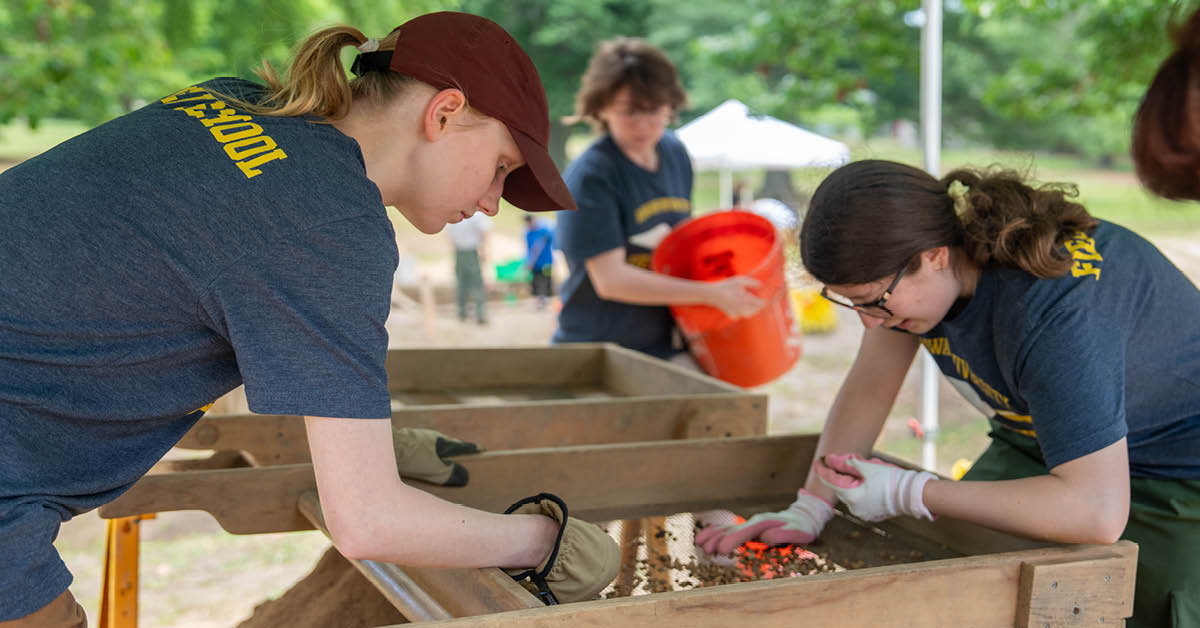
Students enrolled in Ric Edelman College's Field School class sift through dirt at Red Bank Battlefield Park in Gloucester County
For students in Rowan University’s Field School, history isn’t something found only in textbooks; it’s waiting in soil beneath their feet.
Held at Gloucester County’s historic Red Bank Battlefield Park, the summer course transforms one of South Jersey’s most significant Revolutionary War sites into a living laboratory where students step into archaeology and public history while contributing to ongoing research.
Now in its fifth year, the Ric Edelman College program combines traditional classroom assignments and guest lectures with field work and public engagement, giving students a rare opportunity to experience firsthand how historians and archaeologists interpret history.
The class’s setting carries particular significance as the nation celebrates America’s 250th, the anniversary of the signing of the Declaration of Independence this July 4.
Red Bank Battlefield was the site of the Battle of Red Bank on October 22, 1777, when 500 American soldiers successfully defended Fort Mercer against an assault from 2,000 Hessian soldiers. Historians consider the engagement a highly significant victory in the Revolutionary War, where American troops maintained control of a critical stretch of the Delaware River.
“To me, this is the pinnacle of classes…it’s hands-on, in the dirt and fun, and I will also now carry a new perspective into other classes that I take,” said history education major Makye Swayer-Smith.
An intern at the park this past spring, Sawyer-Smith learned the history of the Whittal House, the family that lived on the property during the Revolutionary War, and provided tours and helped with school groups visiting the park. He also helped catalog some of the finds from previous Field School classes. The firsthand experience made enrolling a no brainer.
“When you are picking up an artifact and learning more about it, you see how many connections you can make to something the size of your fingernail…it makes me want to look deeper into things and into other topics,” said Sawyer-Smith.
Learn more about the Field School experience below
Digging for discovery
Each Wednesday during the summer term, students gather under a field tent and spend the morning learning from Rowan faculty and guest speakers before heading into the trenches to excavate. Working in teams, they rotate between digging, measuring, excavating and sifting the soil for artifacts. The discoveries range from Revolutionary War-era materials to evidence of Native American occupation.
This summer’s finds include Revolutionary War musket balls, Native American pottery fragments and stone flakes used in toolmaking. Each piece helps tell the story of the land and the people who occupied it over time.
The class is also introduced to the public-facing side of history through community dig days, where visitors are invited to visit the site, ask questions and even participate in excavations with the team. The experience teaches students how archaeologists communicate findings and engage with audiences beyond the university.
Reshaping the record
The course is led by professor Wade Catts and Dr. Jen Janofsky, professor of public history and director of Red Bank Battlefield Park. Janofsky has helped transform the battlefield into both a teaching site and an active research center where students can participate in projects that are reshaping historians’ understanding of the past. That work gained international attention in 2022 when archaeologists and volunteers uncovered a mass grave containing the remains of 15 Hessian soldiers who died during the Battle of Red Bank. Since then, Janofsky and a team of historians, archaeologists, forensic anthropologists and scientists have worked to identify the soldiers and reconstruct their lives through archaeological evidence, historical records and DNA analysis.
At the park, Janofsky says learning and discovery go hand in hand.
“Through archaeology we are actively revising Red Bank’s story with the help of students and the community” Janofsky said. “That is what makes this project so special and so unique. Where else can you get this experience?”
Finding a future in the past
After taking introduction to archaeology in the spring semester, first-year student Bella Dickerson was eager to apply what she learned in the field.
“In this course, you’re experiencing history and archaeology in a whole new way,” said Dickerson. “Helping to build the artifact database and expand our knowledge of the history of the site and the battlefield has been the best part for me.”
Dickerson, who plans to pursue graduate studies and eventually teach at the college level, says the Field School has deepened her understanding of how historians interpret the past, lessons she will take into her own classroom someday.
As the nation reflects on its founding during America250, Rowan students are helping uncover the stories that keep that history alive—one artifact at a time.