America’s 250th: Rowan historians reflect on the Revolution and New Jersey’s role
America’s 250th: Rowan historians reflect on the Revolution and New Jersey’s role
June 26, 2026
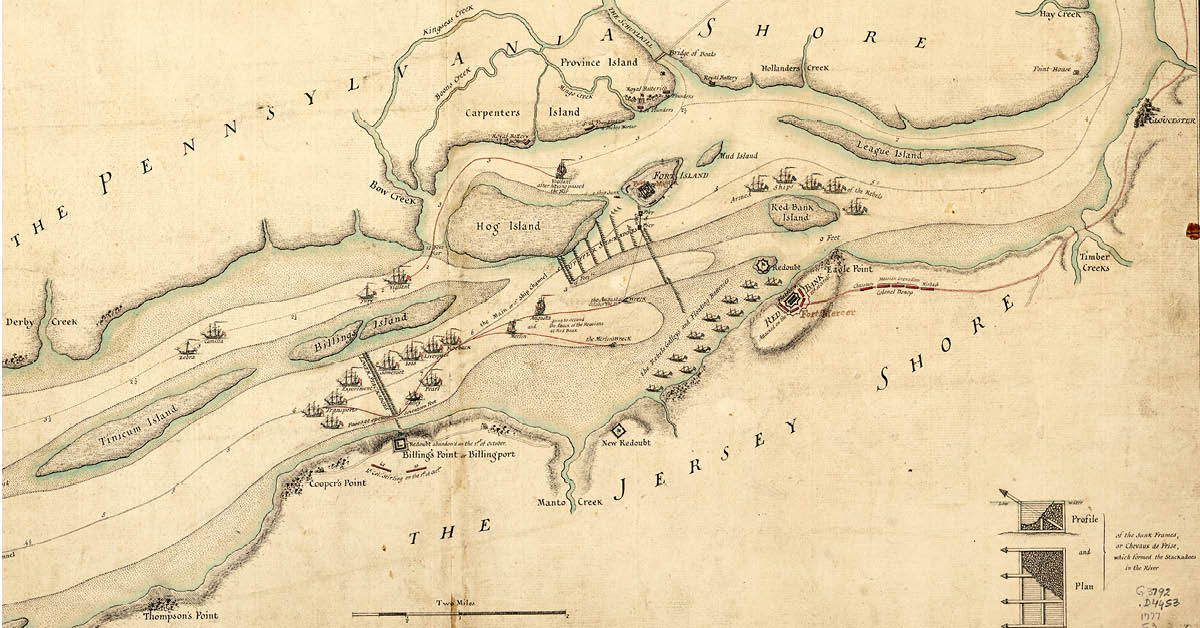
Faden, William. The course of Delaware River from Philadelphia to Chester, exhibiting the several works erected by the rebels to defend its passage, with the attacks made upon them by His Majesty's land & sea forces. [1777] Map. Retrieved from the Library of Congress, <www.loc.gov/item/gm71000679/>
As the United States marks the 250th anniversary of the Declaration of Independence, Americans are reflecting on the people, events and ideals that shaped the country’s founding.While many Americans associate the Revolution with a handful of familiar moments – from the Boston Tea Party to the signing in Independence Hall – the path to independence was far more complicated than a single day in Philadelphia. To explore the Revolution’s origins, enduring legacy and New Jersey’s pivotal role in the fight, Rowan Today spoke with historians and Rowan professors Bill Carrigan and Jen Janofsky, who offered insight highlighting the road to independence, New Jersey’s pivotal role and why the nation’s 250th birthday offers an opportunity to reflect on both the achievements and contradictions of America’s founding.
The country is counting down to America’s 250th anniversary on July 4, 2026. What events led to the Declaration of Independence
Bill: Key events for me include:
- The end of the Seven Years War - this took away the danger of the French for the colonists making them less in need of the British Army. It also left Britain in great debt which then led to the idea of the Stamp ACt which united colonists as nothing before because they saw it as a new type of tax and a new type of meddling in their internal affairs.
- The Stamp Act & the Boston Tea Party - Colonial unity in response to the Stamp Act was in danger of eroding over cheap tea, which led Samuel Adams and other radicals to dump tea in the harbor and prompted an angry Parliament to respond with the Coercive Acts, greatly limiting representative government in the colonies. This played into the Patriots hands, as they had been warning of an evil British government eager to take away colonial freedoms.
- Lexington & Concord and the Capture for Fort Ticonderoga - These killings started the war and made reconciliation harder. Capturing the Fort was an early military victory that gave rebels confidence and provided them with the artillery they used to chase the British out of Boston (another early victory!)
- Thomas Paine’s Common Sense - This publication was a bold and radical renunciation of monarchy and refutation of arguments for reconciliation with Britain. It was written in a clear and compelling manner and reached a huge audience, convincing many to take the plunge to not just armed rebellion but the pursuit of independence.
What was life like for ordinary colonists before the Revolution? How did ordinary colonists experience the growing tensions leading up to the revolution?
Bill: This question is debated by historians. Some argue conflicts with Parliament mattered very little to the poorest of the colonists, the day laborers, indentured servants and enslaved. Others argue that many ordinary individuals, especially artisans and craftspeople, seized on the Revolution to transform and democratize American culture.
Jen: I think most people today assume everyone in Colonial America was a Patriot and that is far from the truth. Many people wished the tension would just go away and they could resume their normal daily life. This is particularly true once the Revolution begins.
At Red Bank, the Quaker Whitall family desperately tried to avoid the war but it literally landed in their backyard. The Battle of Red Bank destroyed their farm and their livelihood. First Patriot troops plundered their home and then British troops. The family submitted a bill to the state legislature to recover damages but they never received a dime. This certainly didn’t feel victorious in 1783 when the war ended.
Who are the overlooked figures of the American Revolution? Are there any moments or fun facts you think deserve more attention?
Bill: The “Forage War” in New Jersey that deprived the British of supplies and increased the cost of the war by forcing them to import more food, making the cost of the long war frustrating and helping Benjamin Franklin negotiate a peace treaty. Franklin’s skill in negotiating both the French Alliance and the Treaty of Paris are not generally appreciated either. Also, Washington’s deference to Congress and his refusal to become a dictator, king or “president for life.”
If I had to pick one from the early period, perhaps George Washington’s overturning of his decision to ban Black troops in January 1776. This was the beginning of a slow evolution in his thinking about Black people and slavery that would culminate with his freeing of all his slaves in his will.
Jen: The diversity of participants: Indigenous, enslaved, free Black men, women. The Battle of Red Bank is a very powerful moment in the Revolution because of the fully integrated Rhode Island Regiment. Indigenous and Black soliders fought side by side in one of the bigger upset victories of the Revolution. This is the great contradiction of the Revolution: they were fighting for liberty in a country that did not extend that to them.
For a fun fact – 17-year-old John Burlingame fought with the Rhode Island Regiment at the Battle of Red Bank. He documented the horrific violence of the battle through his powder horn – it’s an incredible piece of material culture that speaks to the trauma he experienced. Too often, we think of these battlefields as sterile landscapes when in reality they saw tremendous pain and suffering.
What happened after July 4, 1776? What are some key events that helped shape the United States after the signing of the Declaration of Independence?
Bill: A series of military defeats in New York and New Jersey marked by George Washington’s skill in retreating and British mistakes; the Battles of Trenton and Princeton, the campaign for the Delaware – including the Battle of Red Bank – that delayed and divided the British, the surrender at Saratoga, the Battle of Monmouth and the long up and down campaign in the South that climaxed with the victory at Yorktown.
Washington’s decision not to be kind and to oppose the officer-led coup d’etat planned at Newburgh and his resignation of his command, also. Most Americans think of the United States beginning with the Presidency of George Washington, but that was not until March 1789 – more than a dozen years after July 4, 1776.
Jen: The “10 Crucial Days,” which Bill referenced, are really pivotal in the early Revolution. Things were not going well for Washington and he needed to clock some victories. Washington was an incredible retreater which is not to knock him – he kept the British on the run - but it’s why the victories at Trenton and Princeton are so important. If we had not won, it’s entirely possible Washington’s army would have fallen apart. It’s why Washington crossing the Delaware is such a significant moment – he is on the offensive in a very bold, but risky strategy that paid off.
Did everyone support American independence? Were there Americans who opposed independence after 1776? What happened to them?
Bill: The Loyalists varied greatly and included wealthy landowners, enslaved Blacks hoping for freedom and Native Americans believing British victory would more likely protect their lands and way of life than the rapacious settlers. They suffered greatly, often losing their property. None lost more than the Native Americans. Blacks who aided the British perhaps fared the best as the British refused to return them to their owners and helped them leave the U.S. and settle in other parts of the British empire as free people.
Jen: In many ways, the American Revolution is a civil war. People weren’t just fighting the Crown, they were fighting their neighbors. At Red Bank, two Loyalists guides led the Hessian forces to Fort Mercer. One was Dick Ellis, an enslaved man owned by New Jersey militia leader Joseph Ellis. I think it speaks volumes that Dick Ellis chose to side with the Hessians. He was captured by the Rhode Island Regiment and hung at Red Bank for his actions.
What was New Jersey’s role in the American Revolution?
Bill: New Jersey is appropriately called both the “Crossroads of the Revolution” and sometimes the “Cockpit of the Revoltuion.” No state played host to George Washington’s Continental Army more than New Jersey. The state witnessed four of the most important battles of the Revolution (Trenton, Princeton, Red Bank and Monmouth). Moreover, and arguably more important, the state witnessed what has been called a near constant “forage war” over the farms of the interior. Washington and the Patriots sought to deny the crops of New Jersey to the British Army, which was based in New York City from mid-1776 to their withdrawal in 1783.
This led to hundreds of small skirmishes and clashes and the result was to largely deny the British these resources, forcing them to import more food from abroad to feed their soldiers and their Loyalist allies. This helped wear down British patience with the long-enduring conflict and played a key role in their decision to acknowledge American independence and end the war.
What should Americans today understand about the nation’s 250th birthday?
Bill: American should understand that independence was not equal to establishing a working representative government and that many, even among the founders, believed the American states would struggle in their attempt to implement democracy and would revert to something like a monarchy. The post-war years were critical in this regard and the government that began in 1789 was not sure thing in 1776 or 1783.
Jen: Like the Philadelphia Museum of the American Revolution argues, the Revolution is an ongoing “experiment” in freedom and liberty. The founding fathers knew they didn’t “nail it.” They argued, compromised and designed a system that could grow with the country. Despite its flaws, the American Revolution inspired countless revolutions around the world and continues to inspire people to advocate for these American ideals of liberty and freedom.
If someone is looking to learn more about the Revolution, where would you direct them? Where can you visit in New Jersey?
Bill: Ken Burn’s new documentary is well worth watching! And, of corse, Red Bank!
Jen: 2026 is going to be a big year for Red Bank! Red Bank Battlefield Park encompasses 44 acres and includes fantastic videos of the Delaware River and the city of Philadelphia. Touring the Whitall House is the place to begin your park experience. You can learn about the Quaker Whitall family caught in the crosshairs of the Revolution and how their peaceful farm became a bloody battlefield. Your next stop is the battlefield where interpretive signage explains the history of the battle and its participants. The 1906 monument anchored the creation of the park, but there is also the 1829 monument – one of the top 5 oldest Revolutionary War monuments in the country!
There are also several events through the summer and fall including Family History Day in August, Colonial Tea at the Whittal House in September and the October Battle Reenactment.