Rowan awards first doctorate in data science
Rowan awards first doctorate in data science
May 14, 2026
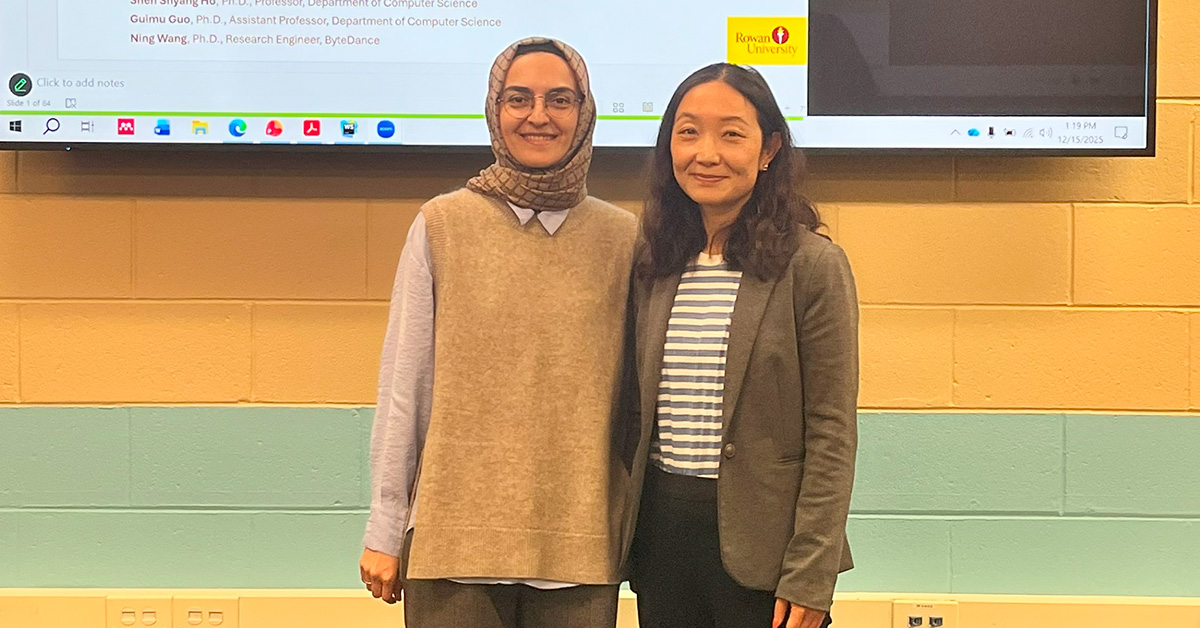
Gulsum Alicioglu, Ph.D., (left) stands with her advisor, Bo Sun, Ph.D., after successfully defending her dissertation in December.
Rowan University has graduated its first Ph.D. in data science, marking another milestone in its rise toward R1 status as a public research institution.
Gulsum Alicioglu of Ankara, Turkey, successfully defended her dissertation, “A Visual Exploration Framework for Explainable Deep Reinforcement Learning.”
While Rowan celebrated its newest Ph.D.s with a recognition ceremony on May 8, Alicioglu was already back in her home country, where she recently started a new job as an artificial intelligence engineer for Turkey’s defense industry.
“The Ph.D. in the United States helped me a lot,” Alicioglu said. She is the first in her family to earn a doctoral degree and the first to study internationally.
A former industrial engineer, research assistant and faculty member at Gazi University, Alicioglu applied to Rowan’s electrical and computer engineering doctoral program after spotting an announcement on her school’s website shared by Gokhan Alkanat, Rowan University’s associate provost for international education.
She moved to the United States nearly seven years ago, pursuing a doctoral degree under the direction of her advisor, Dr. Bo Sun, associate professor of computer science.
At Sun’s advice, she switched from electrical and computer engineering to the College of Science & Mathematics' new data science program when it launched.
At the start of her studies, Alicioglu developed AI models to predict injury severity related to traffic and transportation, aiming to support accident prevention systems. But because AI has black-box nature, the algorithm's decision-making process is difficult to interpret for researchers and the public, so they couldn’t trust its predictions, especially for safety-critical systems such as healthcare or autonomous vehicles.
She decided to research explainable AI to help users understand what happens inside AI’s black box. She developed simplified visual analytics to allow end users to easily understand AI decision-making processes. Her work also allows experts to find and correct errors by examining the training details and statistics used by the AI agent to arrive at its decision.
“Many people tend to place strong trust in AI-driven decisions,” Alicioglu said. “With our studies, we show AI’s good decisions but also mistakes … it’s not perfect.”
Immediately after successfully defending her dissertation in December, Alicioglu and her husband, Metin Karaman, celebrated alongside Rowan faculty. She thanked the Department of Computer Science and Professor Shen-Shyang Ho for supporting her work. The department had given her a travel grant to attend a 2025 conference in Florida.
But she was most appreciative of Sun’s guidance.
“I'm so grateful that I worked with her,” Alicioglu said. “She's not only my academic mentor but also my life mentor. She was extremely supportive. When I doubted myself or I felt down, she pushed me and she encouraged me to continue.”
Sun called her former student “a hard-working young woman.”
“Her pioneering work in transparent AI will undoubtedly pave the way for a more seamless and trustworthy human-AI interaction,” Sun said.