Sending less, understanding more: Rowan researcher rethinks how wireless devices communicate
Sending less, understanding more: Rowan researcher rethinks how wireless devices communicate
November 23, 2026
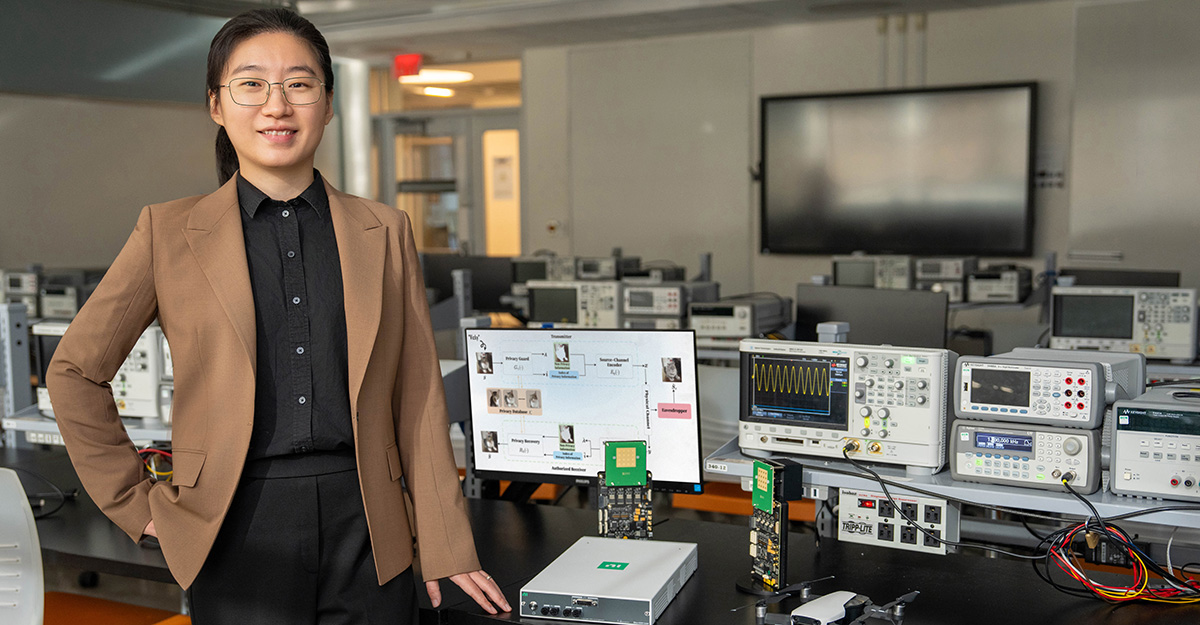
Qianqian Zhang, Ph.D., is working to address the privacy challenges of data transmission.
When we text a photo to a friend, the wireless network systematically transmits every pixel and reconstructs the image at the other end. The process works today but might be a problem in the near future. With data volumes increasing, 6G wireless networks will need to squeeze more information into limited bandwidths.
It’s one of the problems that Qianqian Zhang, Ph.D., an assistant professor of electrical and computer engineering in the Henry M. Rowan College of Engineering, is researching with support from a new two-year, $199,865 Engineering Research Initiation grant from the National Science Foundation. The federally funded grant opportunity is designed to help investigators establish independent research programs.
When transmitting data, it might be more efficient to shed extra baggage and carry only the essential information across the finish line. This bare-boned version, called semantic information, comprises only the data needed to complete a task. When transmitting images from an intersection for example, drivers only need to know if and when a pedestrian is crossing. They do not need the person’s gender or facial characteristics.
“You first identify the purpose of the communication, and then just keep the core information, so that you can save bandwidth,” Zhang said. “What matters in this case is how this person’s movement could pose a risk.”
However, relying on semantic information could cause potential problems. Zhang is working to address the privacy challenges associated with semantic data transmission. When data is stripped down to the core minimum, it’s easier for cyberattackers to piece the information together. The challenge Zhang will address is to develop intelligent systems that transmit semantic information without compromising privacy.
Another challenge for semantic communications is that having a vision-language model identify and remove privacy-sensitive information before transmitting data requires immense computing power, something edge devices like autonomous vehicles or drones might lack. Zhang is researching the concept of cooperation among edge devices, where different devices process and transmit different pieces of information so the net computing strain on each is decreased.
Formerly an R&D engineer in the satellite communications industry, Zhang learned that developing algorithms alone was not enough.
“You also have to consider the hardware and validate how the algorithms perform in the system,” Zhang said.
She brings this practical and application-focused perspective to her research at Rowan University, where she leads the Advanced and Intelligent Wireless Laboratory.
Zhang’s broader research spans wireless and mobile networks, next-generation communication systems, and machine learning for networking, security, and privacy applications. With the federal funding support, Zhang plans to validate her semantic communications algorithms with experiments using wireless devices and unmanned aerial vehicles.
This project is supported by the U.S. National Science Foundation under Award No. 2553344. Any opinions, findings and conclusions or recommendations expressed are those of the author(s) and do not necessarily reflect the views of the U.S. National Science Foundation.