NSF grant supports Rowan research on freeze-thaw impacts beneath roads, buildings
NSF grant supports Rowan research on freeze-thaw impacts beneath roads, buildings
November 25, 2026
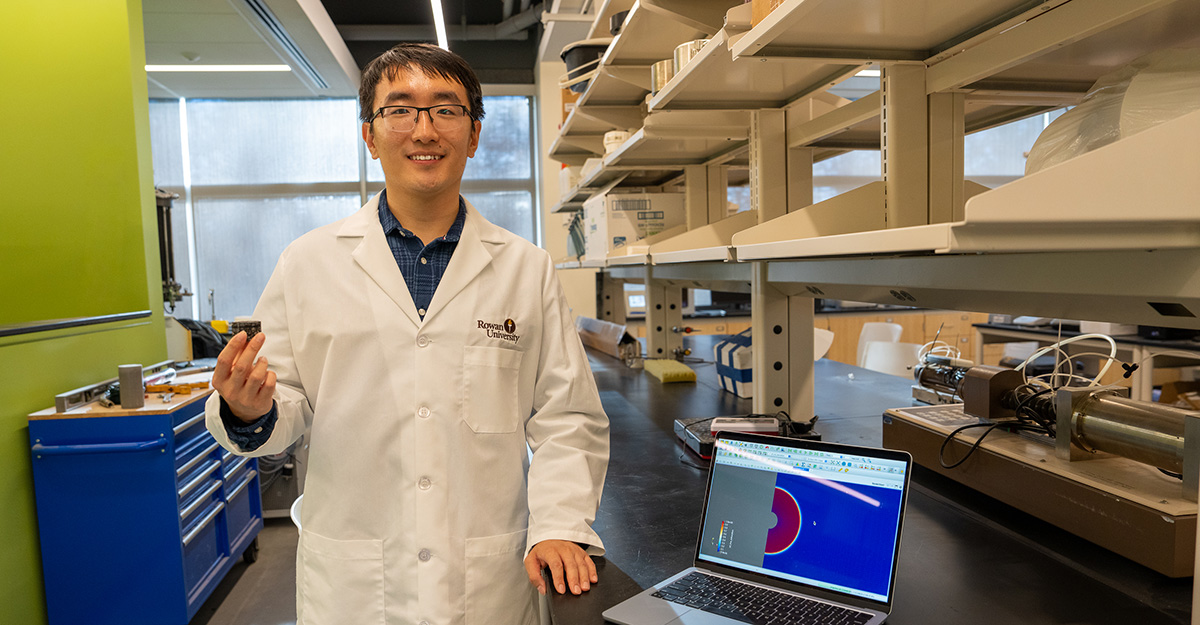
Yingxiao Liu, Ph.D., is studying freeze-thaw soil behavior and develop tools for safer infrastructure.
Each spring, many New Jersey motorists likely notice new cracks and bumps in the road.
“This is because when the water in soil freezes, it can form ice that pushes the ground upward,” said Yingxiao Liu, Ph.D., an assistant professor of civil and environmental engineering in the Henry M. Rowan College of Engineering. Similar damage can threaten airport runways, pipelines and building foundations.
Liu has received a two-year, $199,999 Engineering Research Initiation grant from the National Science Foundation (Award No. 2552946) to study how soil behaves when it freezes and thaws and how those changes actually affect the safety and durability of infrastructure. The Engineering Research Initiation award supports early-career investigators pursuing innovative engineering research.
During the winter, ice in the ground can cause soil to expand. When it melts in the spring, the ground may get weaker. Current engineering methods cannot always accurately predict soil behavior in these conditions. Liu and his team hope to develop new experimental and computational tools that can better predict these changes and help engineers design safer, longer-lasting infrastructure.
“Even the strongest structures can have problems if the ground underneath them doesn't behave as expected,” Liu said. “That's why understanding and predicting how soil responds to freezing and thawing is so important.”
The project has two components: experiments in the lab and a computational model. First, Liu and undergraduate student researchers will collect soil samples from around Rowan University and beyond, freeze them in the lab and record their melting rates, changes in soil microstructure and mechanical responses under controlled thermal and loading conditions.
“Students may take soil for granted and later realize that soil is not just dirt,” Liu said. “There is water inside. It can freeze. It can deform. This piques the students’ interest.”
Then, Liu and graduate students will build software models to help predict how the soil will behave decades in the future.
“We cannot bring an entire highway in our lab and watch it go through 30 years of winters,” Liu said. “But with a reliable computer model, we can explore how that highway might behave over decades under different weather and loading conditions. Eventually, we want to take what we learn from a very tiny sample of soil in the lab and use it to understand what's happening beneath an entire road or buildings over decades.”
Access to accurate predictive tools is especially crucial when climate change creates challenges for buildings, roadways and other infrastructure.
The goal, Liu said, is to garner a better understanding of how soil freezes and thaws so engineers can design and maintain safer and more resilient structures above ground.
This material is based upon work supported by the National Science Foundation under Award No. 2552946. Any opinions, findings, and conclusions or recommendations expressed in this material are those of the author(s) and do not necessarily reflect the views of the National Science Foundation.