Studying greenhouse gases from New Jersey wetlands to Antarctica
Studying greenhouse gases from New Jersey wetlands to Antarctica
November 19, 2026
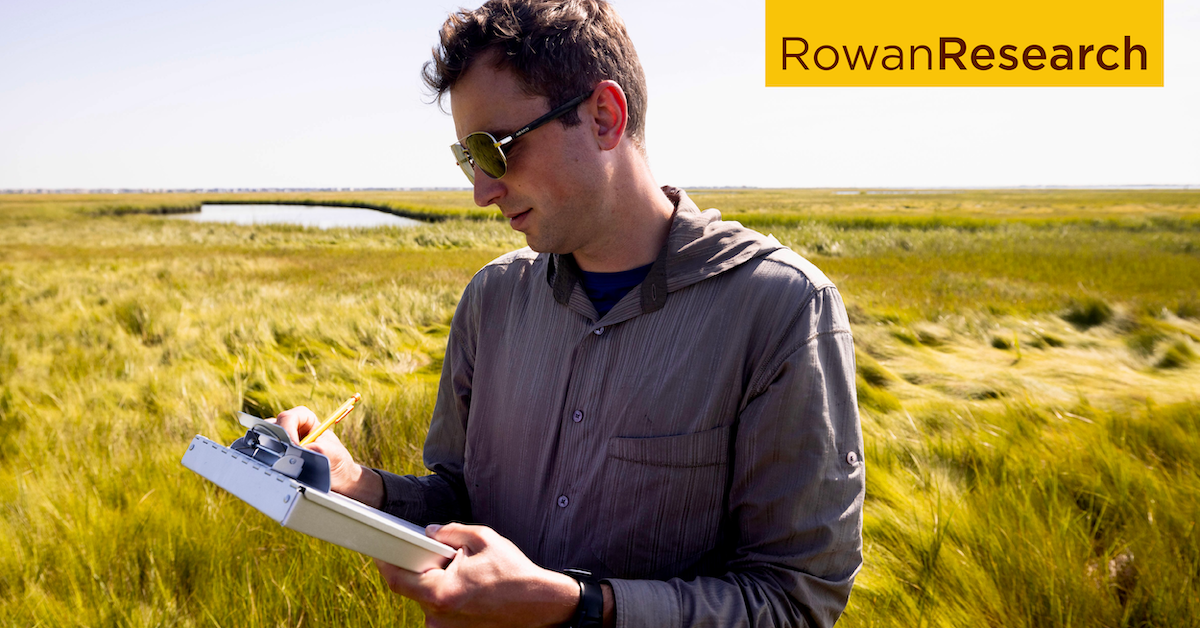
Charles Schutte records field observations in a New Jersey tidal marsh, where he studies nitrogen, carbon and greenhouse gas cycling in aquatic ecosystems.
Charles Schutte, Ph.D.
Aquatic biogeochemist
Areas of expertise:
Biogeochemistry, elemental cycling, greenhouse gases, microbial processes, aquatic environments
An aquatic biogeochemist in the School of Earth & Environment, Charles Schutte, Ph.D., researches nitrogen, carbon and greenhouse gas cycling, in particular the ways in which gases affect the environment and influence climate change.
With the support of a grant from the New Jersey Department of Environmental Protection, Schutte, an associate professor in the Department of Environmental Science, is working on a four-year research project that will incorporate often-ignored measurements of the different components that cause tidal wetland ecosystems to have a net cooling or warming effect.
“I’d love to see that this type of restoration is working, and that it's burying more carbon than any warming effect that it might have,” Schutte said, “but even if that's not the case, this information can help us make decisions about investing in wetlands restoration.”
Previously, he and a team of scientists published work about a remote section of Antarctica that simulated a mission to Mars. Conducted in one of the planet’s harshest climates, Don Juan Pond, the saltiest body of water on Earth, the research sought to test the idea that nitrous oxide, a gas that is abundant in Earth’s atmosphere because it is produced by living things, would also indicate the presence of life on another planet if it were found there.
In this extremely cold climate similar to conditions on Mars, “we studied the production of nitrous oxide in the absence of microbial life,” said Schutte. “We argue that just the presence of nitrous oxide alone (on another planet) is not enough to demonstrate that yes, for sure, there is life on the planet.”
More often focused closer to home on the ways in which greenhouse gases like nitrous oxide, methane and carbon dioxide are warming Earth’s climate, Schutte investigates the effect of nitrogen, removed from the atmosphere and applied as fertilizer to crops, on bodies of water it ultimately runs off into.
“This extra nitrogen ends up in estuaries and coastal oceans where it can cause algae blooms and fish kills,” he said. “I’m interested in processes that remove bioavailable forms of nitrogen from ecosystems and return it to the atmosphere as gas.”
Rowan University researchers are passionate about what they do. Find more at Meet Our Researchers.