The ones who said 'yes'
The ones who said 'yes'
October 8, 2026
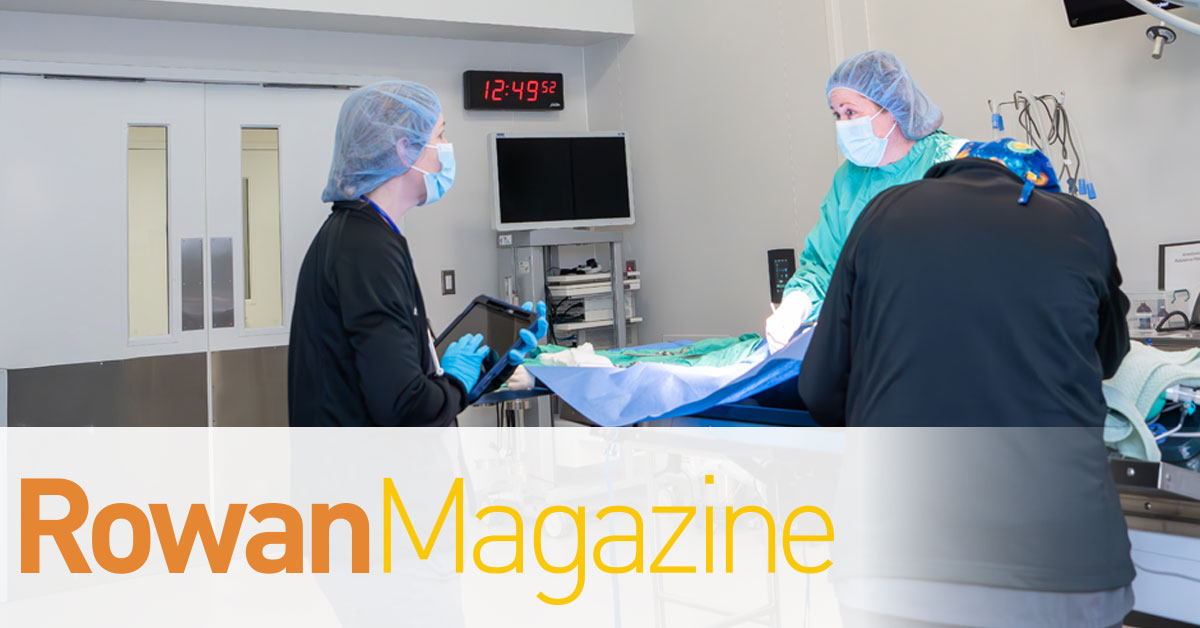
In the dog days of summer 2025, anticipation electrified Rowan’s West Campus. As construction crews moved out of the impressive, new structure, students from around the country assembled at Shreiber School of Veterinary Medicine.
Faculty and staff lined the walkway leading into the 167,000 square-foot building to greet the 75 members of the Class of 2029, the first class of New Jersey’s first veterinary school. Within a few weeks, the school’s teaching hospital opened to provide primary care, urgent care and specialty services to the public, from family pets to large and exotic animals.
For the students, the reality of their opportunity at Shreiber resonated, especially in the early days. During the inaugural Welcome Week stethoscope ceremony, they received the instrument they would use during the next four years.
“It was almost the opposite of graduation,” said student Caliann Moore, reflecting on the moment she heard her name called, crossed the stage and shook hands with Shreiber School Founding Dean Matthew Edson. “A solid beginning point that made everything feel more real.”
While ceremonies and formalities signaled early milestones, it was the quieter moments that revealed the budding culture and community at Shreiber School. The palpable jitters in crowded study rooms on the Sunday before an exam as students compared notes and learned from each other. A visit from Shadow, Edson’s golden retriever and the unofficial class mascot. The giggles shared between professor and students over Cheese, the doodle of a cow on the skill lab’s white board, where they scribble a new joke or pun each week.
From lighthearted serendipities to more serious endeavors, students, faculty and staff knew their success must be collective. They were acutely aware they were not simply starting a veterinary school—they were helping shape one.
Maya Quinn found her classmates came together determined to create an environment of inclusion, encouragement and a shared sense of purpose. “We recognize that we are not each other’s competition. We are each other’s future colleagues,” said Quinn.
She also noted school leaders seeking feedback to improve the overall student experience, starting impromptu conversations and installing suggestion boxes throughout the building.
Moore, too, found the faculty eager to help students succeed as they moved through the challenging curriculum. She recalled classmates suggesting videos to accompany anatomy lab presentations to reinforce the lectures and learning. By the next class period—and each one that followed—their professor had a video to pair with the presentation.
Ready on day one
Amina Mason, a student from Philadelphia, was excited about hands-on experiences built into the first-year curriculum.
“Large animals, turtles, exotics, dogs, cats... it feels like I’ve already encountered plenty of species in year one,” said Mason. “That exposure is so key as we prepare for the future. It made me feel more secure.”
Combining research, evidence-based approaches and hands-on training, the Shreiber curriculum is designed to develop veterinarians prepared for the rigors of the profession and to care for patients across the spectrum of veterinary medicine. Clinical experiences begin early with rotations between lectures, observations and hands-on experiences through more than 70 partnerships with wildlife refuges, farms, zoos, animal shelters and more
throughout the region.
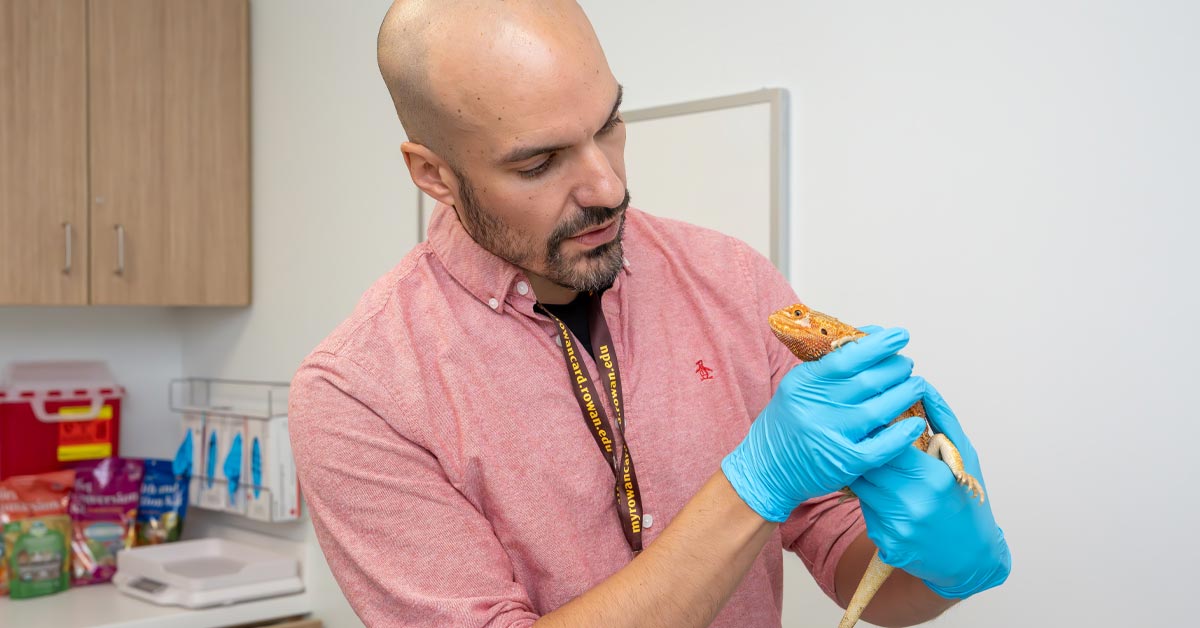
“Our program is designed to ensure our graduates leave with the experience and preparation to confidently enter practice and make an impact on day one,” said Edson.
With its focus on experiential learning, the curriculum helps ensure the school delivers on the state’s investment in it. The southern New Jersey legislative delegation championed its development, which helped secure a state investment of $75 million toward construction of the $150 million academic and clinical facility. As New Jersey’s only veterinary school, it creates an in-state pathway for aspiring veterinarians, helping to keep trained professionals in New Jersey while attracting students from across the country.
“Shreiber School represents the very best of Rowan’s mission,” said President Ali A. Houshmand. “We are preparing the next generation of veterinary professionals while expanding access to care, supporting New Jersey’s agricultural and animal care industries and strengthening the economic vitality of our state. Shreiber School is more than an academic program; it is an investment in New Jersey’s future.”
Serving communities, inspiring futures
While students report to classes during fall and spring semesters, providing professional care for animals is a year-round commitment at Rowan. In fact, practitioners were hard at work fulfilling the school’s mission of service and community engagement long before students enrolled.
Kirsten White, DVM, and her team started hosting vaccination clinics for companion animals on board the veterinary school’s mobile Shelter Medicine & Community Engagement Unit.
The school teamed up with the American College of Veterinary Ophthalmologists for the annual National Service Animal Eye Exam event. Most recently, veterinary ophthalmologist Laura Mancuso provided free eye exams for working animals and service dogs.
The Large Animal Field Service Team began making field calls before classes began and soon was taking veterinary students on location to deliver care to horses, cows and other large animals.
Moore, born and raised in Gloucester County, said engaging with people on farm calls throughout South Jersey has been rewarding. “The fact that Shreiber School is local makes people excited. We are changing veterinary medicine in our area,” Moore said.
Beyond providing veterinary care to underserved urban and rural areas, the school also emphasizes the importance of STEM education while priming New Jersey’s veterinary student pipeline. One of Shreiber’s education outreach programs is PAWS Farm Educational Center in Mount Laurel. Year-round, it provides programming for grades pre-K through 12, including weekend events and summer camp sessions, helping to foster career exploration and fuel interest in veterinary medicine.
No foot, no horse
The 18th century proverb “no foot, no horse” points to a long-recognized link between hoof health and overall equine well-being. Yet scientific research has not kept pace.
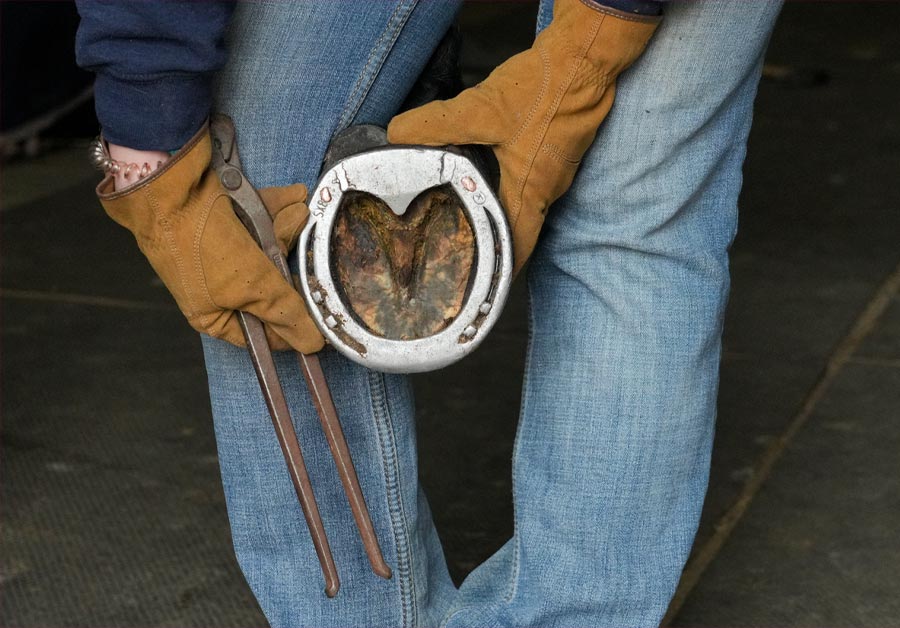
Shreiber School of Veterinary Medicine is changing that, led by Patrick Reilly, an assistant professor and expert farrier with 35 years of blacksmithing and equine foot management experience.
As advances in transportation replaced the horse’s role in American life, scientific studies in farriery—the shoeing and managing of horses’ feet—stalled. For over a century, farriers were not part of veterinary education, leading to limited research where it matters most: the hoof.
With just 157 studies in 50 years, farriery research lags far behind other equine studies. Shreiber School is working to rebuild that foundation through hands-on training and research that merges traditional craft with technology.
Reilly’s research focuses on laminitis, a disease in which the horse’s hoof becomes unstable. The painful condition is the second leading cause of death among horses.
Through a Morris Animal Foundation grant and in collaboration with the University of Calgary, Reilly is using artificial intelligence to monitor gait symmetry and identify subtle changes in movement. A group of researchers across North America will use smartphone video to evaluate gait changes after trimming and shoeing, building a database to identify early signs of lameness to improve care.
Reilly is also collaborating with the Horseracing Integrity and Safety Authority to improve horseshoe specifications and inspections. With the help of Rowan engineering students, he is developing a diagnostic platform horses can stand on to accurately assess horseshoes safely and consistently.
“We fault people in farriery for being non-academic and not having accredited degrees,” said Reilly, “but we also have zero institutions in the U.S. that offer farriery as an accredited degree.” It’s both a gap and an opportunity to build a profession grounded in research and education. Anchored at Shreiber School, Reilly aims to create a global hub for equine foot research and training.
Celebrating the start
To commemorate the school’s opening, the Rowan community gathered for an official ribbon-cutting ceremony in October 2025. The school’s benefactor and namesake joined a standing-room-only crowd and greeted students and guests.
Business leader and longtime Rowan friend Gerald B. Shreiber pledged $30 million to support the school and student scholarships, helping addressaffordability in veterinary education. He passed away a few days after the inaugural class finished its first year.
The ribbon-cutting also signaled the opening of the teaching hospital. Another regional first, it provides services to the public with a team of primary care, emergency and specialty veterinarians including ophthalmology, exotics, cardiology, neurology and dentistry/oral surgery. Connected to the academic facilities, the hospital provides core experiential learning opportunities, bolstered by an open-door policy for students.
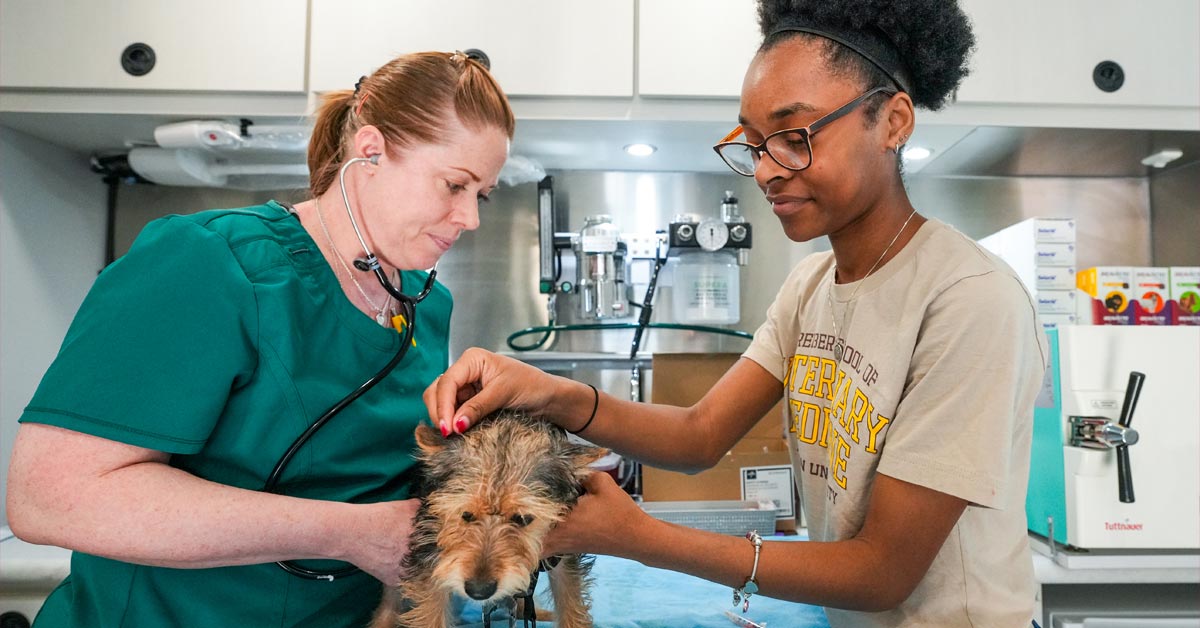
Mason, who plans to pursue specialty veterinary medicine after completing her D.V.M., took full advantage. During her first year, she shadowed Shreiber’s cardiology, exotics and ophthalmology specialties, even making it inside an operating room to watch cataract surgery on a dog.
“Before vet school, I felt like asking to shadow a specialist was like asking for their kidney...but they personally invited us to come down and see what they do,” said Mason.
Farewell to a friend
At the brief ceremony when veterinary students unveiled the donors’ portrait early this year, Gerry and Melanie Shreiber beamed with emotion in the front row. It was one of the last visits Gerry Shreiber, who passed away in May, would make to the University where he invested generously, not just with financial gifts, but by acting on his sense of purpose and kindness.
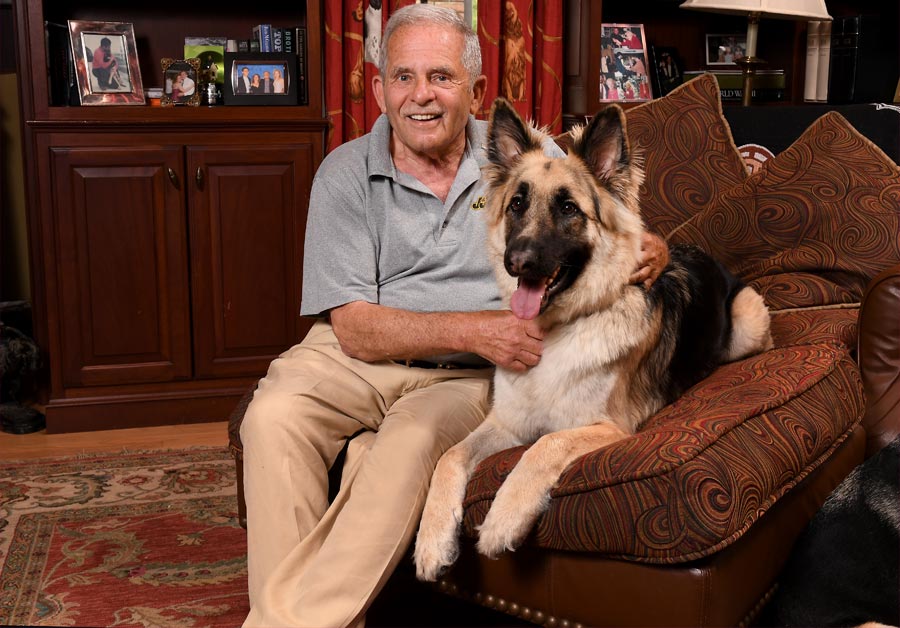
Shreiber, the legendary entrepreneur and lifelong friend of animals, supported business scholarships at Rowan, as well as the University’s pet therapy program. He gave of his time to meet students and share his experience with them, warmly encouraging and astutely advising.
In 2023, the University awarded him an honorary doctorate in veterinary medicine.
“Gerry’s legacy will live on in everyone educated because of his generosity,” said President Ali Houshmand. “Our world is better because of Gerry Shreiber.”
We said ‘yes’
Representing 16 states, and with more than a third of students identifying as first-generation, the school’s students come from diverse backgrounds and have different reasons for attending but share a common goal.
“The people who are here are willing to take a chance on something,” said Moore of her fellow classmates and Shreiber faculty and staff. “We said ‘yes’ without even seeing a building...that brings together a certain kind of people.”
In a year full of “firsts,” students accompanied faculty on farm calls throughout South Jersey for routine wellness exams on horses and other large animals such as goats and dairy cows. Others shadowed specialists in the hospital, observing diagnostic procedures and treatment. They volunteered to bring care to underserved areas. Each experience exposed students to the breadth of the profession while reinforcing classroom instruction.
During the final two weeks of each academic semester, students participated in focused electives on topics including animal welfare, research, specialty rotations in the hospital, and honeybee medicine. Moore likes to think of them as “side quests” and used her electives as an opportunity to supplement the traditional coursework.
The most popular elective according to students was the veterinary business and practice management class taught by Edson. Students learned what it takes to operate a veterinary practice, like hiring staff, filing taxes, purchasing equipment, and maintaining regulatory compliance. As a certified veterinary practice manager and the founder and owner of Rancocas Veterinary Associates, Edson teaches from his many years as a practitioner and business owner and it resonates with students.
“He’s unique in that he has not been in academia since day one,” said Moore, noting that Edson will often drop into study rooms and give a crash course in whatever students are working on. “As an administrator, he’s not locked away in an office you never see.”
Affirming One Health
Through those experiences, Moore and her classmates began to see the broader role veterinarians play in society. That perspective is grounded in the One Health concept, a globally recognized approach that recognizes the interconnection of human, animal and environmental health. It is reflected in everything: the school’s community outreach, its academic offerings and its expanding research portfolio.
And all the while, those hands-on opportunities continued. During the inaugural Veterinary Summer Scholars Program, selected students paired with faculty mentors and conducted hypothesis-driven research across a variety of topics from microplastics to lead exposure in bald eagles. The program culminated with presentations at the National Veterinary Summer Scholars Symposium in North Carolina.
“One of the greatest investments we can make in the future of veterinary medicine is providing aspiring veterinarians with opportunities to discover,” said Omar Tliba, associate dean for research and graduate studies at Shreiber School. “By engaging our D.V.M. students in research early in their education, we are preparing veterinarians who will not only provide exceptional patient care but also drive discoveries that advance animal and human health.”
Few universities are better positioned to lead and continue that work. The School’s second cohort began in August with 90 students in the D.V.M. program and 10 in the master’s degree track. With the veterinary school, two medical schools and strong programs in engineering, science and mathematics, Rowan’s professionals and aspiring practitioners are addressing complex challenges that affect communities locally and globally, from mosquito-
borne diseases to avian influenza.
The Shreiber school’s first cohort, its faculty and staff established the school’s foundation in collaboration, service and innovation. Because the Class of 2029 enrolled in a program without precedent, they will graduate as trailblazers for all who follow—encouraging more to say ‘yes.’
This feature story appeared in the Fall 2026 edition of Rowan Magazine.
Explore the full issue.