Rowan engineers develop new way to monitor 3D printed concrete during construction
Rowan engineers develop new way to monitor 3D printed concrete during construction
October 13, 2026
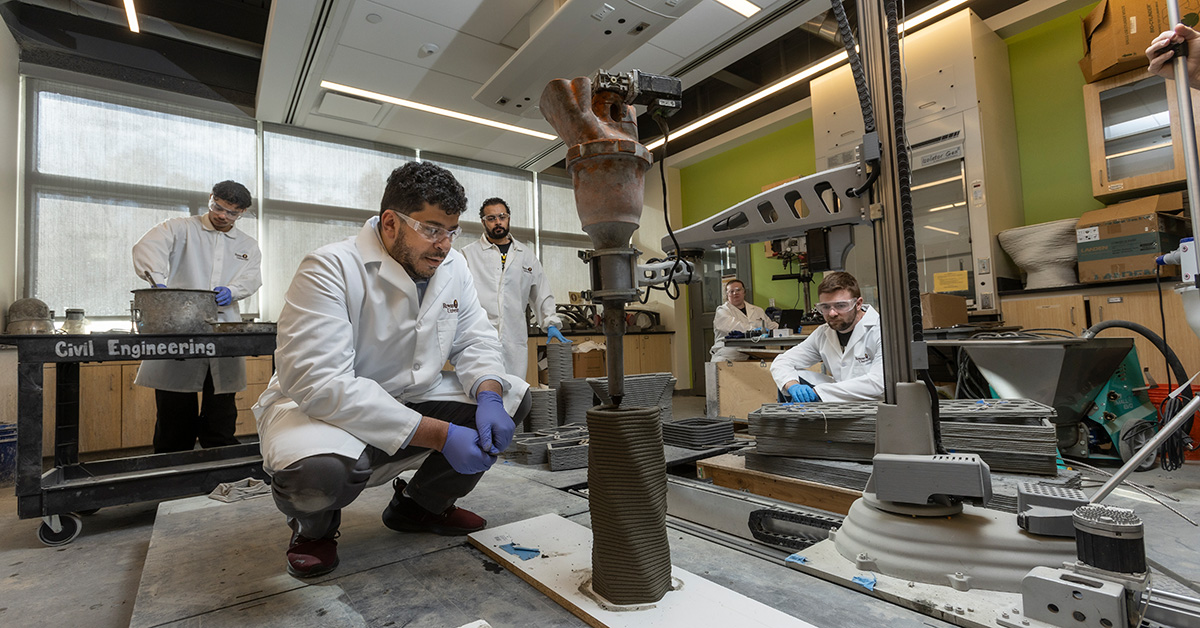
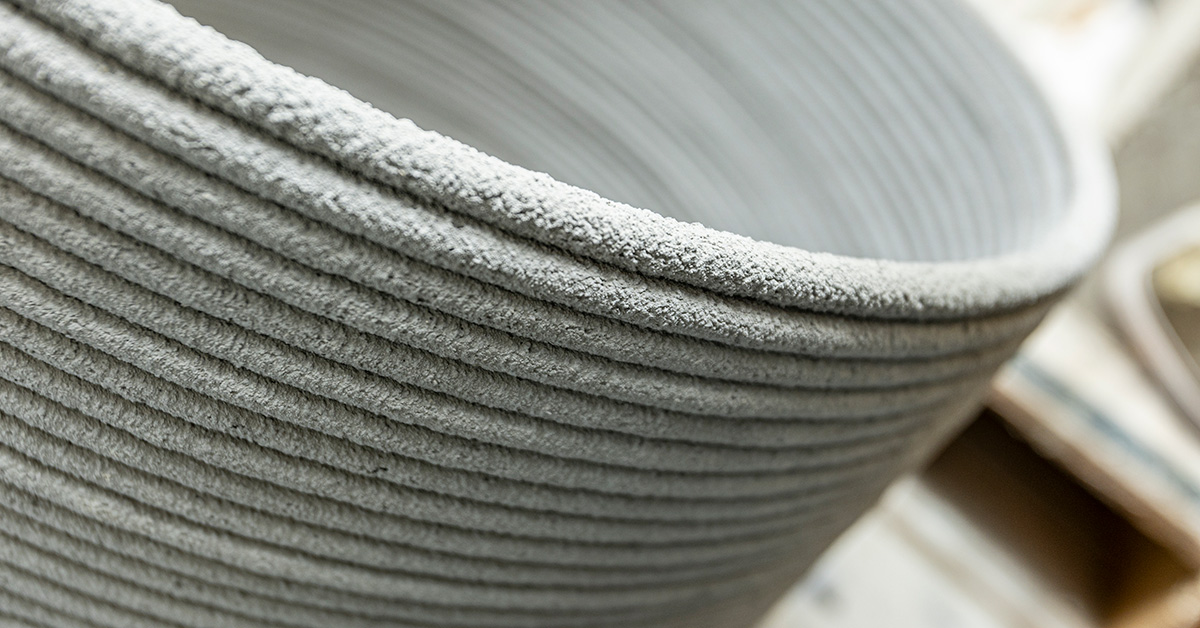
Islam Mantawy monitors a 3D printed concrete structure as it builds in the lab. Below, the rough surface of 3D printed concrete allows researchers to track changes over time.
 A Rowan University team of engineers has developed a new way to measure how 3D printed concrete deforms during printing and curing, revealing how lower layers respond to the weight and pressure of newly deposited material. The approach could help researchers and manufacturers better understand how printed concrete behaves during construction and what factors affect the quality of finished structures.
Around the world, concrete additive manufacturing is increasingly used to speed construction. Rather than pouring concrete into forms, builders can use industrial-scale 3D printers to extrude the paste-like material layer by layer to create walls and foundations.
Researchers have looked for ways to monitor what happens to concrete during the earliest stages of printing, when newly deposited layers are still deforming, curing and bearing the weight of additional material. Understanding that process could advance research aimed at improving the quality, durability and efficiency of 3D printed concrete construction.
Led by Islam Mantawy, Ph.D., and Behrad Koohbor, Ph.D., researchers in the Henry M. Rowan College of Engineering developed and tested a new method for reconstructing how concrete changes throughout the printing process. That’s important because multiple factors, from temperature and humidity to the material’s chemical composition, can affect how a printed structure behaves as it cures. Understanding those factors and their precise effects could help engineers identify potential problems earlier and improve future concrete printing processes.
“The idea is we need to avoid any premature failure,” said Mantawy, an assistant professor in the Department of Civil & Environmental Engineering and head of the Additive and Robotic Construction Laboratory. “If you're building an 8-foot-tall wall and the bottom layer starts to crack and collapse, the entire structure can fail before you reach the final layer. What was supposed to be a faster, more efficient construction method becomes slower and less efficient because you have to start over from scratch.”
They started with a long-established imaging technique called digital image correlation (DIC) that measures how materials and structures deform under force. Using a reference image of an existing object, researchers use cameras to take thousands of images as the material and structures respond to external stimuli such as mechanical forces, temperature change and humidity.
In concrete printing, however, there is no reference image because the structure is being created as the process unfolds.
The team used DIC “in reverse time,” starting with images of the completed structure and working backward through thousands of images captured during printing and curing. With those images, the team was able to construct a mathematical approach to validate the reverse-time DIC method and for explaining what happens as concrete deforms, shrinks and cures, even during the first moments after a layer is printed.
Published in the journal Experimental Mechanics, the paper demonstrates that images of a fully cured 3D printed structure can be analyzed in reverse order, using the natural surface roughness of the concrete as a tracking pattern, to reveal how the structure deformed throughout printing and curing.
Beyond concrete printing, the researchers say DIC “in reverse time” could be useful in other additive manufacturing processes where conventional quality control methods are limited because a structure does not yet exist when production begins.
“We are literally writing the history of the process, but we start from the end and go back,” said Koohbor, an associate professor in the Department of Mechanical Engineering and affiliated faculty with Rowan’s Advanced Materials & Manufacturing Institute.
The researchers see the work as an early step toward smarter, more autonomous forms of additive manufacturing.
“Without knowing what’s happening inside the structure, you won’t be able to achieve self-operating 3D printing,” Mantawy said. “It’s a way to have an eye on the structure as it evolves.”
The research was supported in part by a U.S. Department of Education Graduate Assistance in Areas of National Need grant (P200A210109), through Rowan's Center for Research & Education in Advanced Transportation Engineering Systems. Rowan engineering students Nicholas Pagliocca, Anthony Mackin, Aly Ahmed, Jenna Migliorino contributed to the research.