History professor receives prestigious fellowship to study integrity, resilience of Chinese historian
History professor receives prestigious fellowship to study integrity, resilience of Chinese historian
October 15, 2026
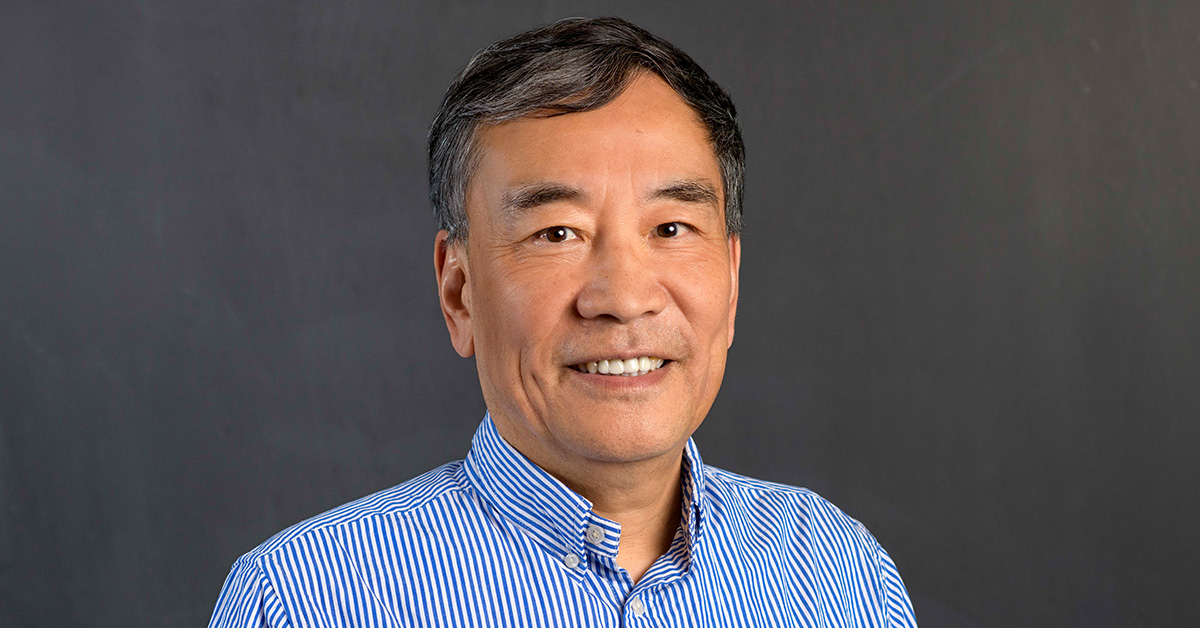
For a second time in his academic career, Q. Edward Wang, Ph.D., has been awarded a fellowship at the Institute for Advanced Study (IAS), a prestigious membership facilitating theoretical research and intellectual inquiry. A Rowan University professor of history who specializes in historiography or how history is written, Wang is spending the 2026-27 academic year at Princeton University preparing his next book project, “Gu Jiegang’s Last Thirty Years, 1950–1980: An Intellectual Biography.”
Analyzing Gu Jiegang’s later years
With focused research time and access to the IAS scholarly community, Wang will examine the final decades of one of modern China’s most influential historians, Gu Jiegang. A revered 20th century scholar, Jiegang revolutionized Chinese historiography until he faced political pressure and censorship after the founding of the People’s Republic of China in 1949.
“While his reputation was secured in the republican era, his intellectual trajectory through the Maoist decades and into the early reform period—arguably the most turbulent years for Chinese intellectuals—has yet to receive sustained scholarly treatment,” said Wang. “My project seeks to fill this gap. It will be the first intellectual biography in English devoted to Gu’s later life, reconstructing his scholarly, personal and emotional worlds under communist rule.”
Wang will study the “Gu Jiegang Quanji” (Collected Works of Gu Jiegang), a 62-volume set released in 2011, to retell the later part of Jiegang’s life. The set includes detailed diaries, private correspondences, reading notes and unpublished manuscripts.
“This biography will focus on the People’s Republic of China decades, asking how an acclaimed historian navigated, adapted and, at times, compromised under a regime that relentlessly subjected intellectuals to campaigns of political discipline and thought reform,” said Wang.
Additionally, he will examine Jiegang’s work using the history of emotions to capture the human dimensions of his experience.
“I approach emotions as historically conditioned responses that reveal both personal resilience and the pressures of sociopolitical conformity,” said Wang. “Through Gu’s diaries and letters, I will reconstruct how he persevered in his research, managed an unfriendly intellectual climate that dismissed his earlier work, and navigated strained family relationships, particularly with his third wife.”
Research within an international community of scholars
Each year, IAS welcomes more than 250 of the most promising post-doctoral researchers and distinguished scholars from around the world to advance fundamental discovery as part of an interdisciplinary and collaborative environment. Visiting scholars are selected through a highly competitive process for their bold ideas, innovative methods and deep research questions, according to IAS. Past faculty include Albert Einstein, Erwin Panofsky, John von Neumann, Hetty Goldman, George Kennan and J. Robert Oppenheimer.
Established in 1930, research at IAS today is conducted across four schools—Historical Studies, Mathematics, Natural Sciences and Social Science.
“IAS offers the ideal environment for bringing it to completion,” said Wang about his research. “Proximity to Princeton’s Gest and Firestone libraries provides access to unparalleled resources, not only in East Asian studies but also across the full breadth of historical scholarship, enabling me to place Gu’s experiences within a truly cross-cultural perspective.”
At the conclusion of his fellowship, Wang intends to complete two thematic chapters of “Gu Jiegang’s Last Thirty Years, 1950–1980: An Intellectual Biography” that will serve as the foundation for a full monograph.
Wang has previously written “Staple to Superfood: A Global History of the Sweet Potato” (Columbia University Press, 2025); “Chopsticks: A Cultural and Culinary History” (Cambridge University Press, 2015), which won Choice’s “Outstanding Academic Title” and appeared in Chinese, Japanese and Korean; “A Global History of Modern Historiography” (coauthored with Georg Iggers, Pearson/Longman, 2008; revised edition in 2017); “Mirroring the Past: The Writing and Use of History in Imperial China” (coauthored with On-cho Ng, University of Hawaii Press, 2005); and “Inventing China through History: The May Fourth Approach to Historiography” (SUNY Press, 2001).