CREATES marks another five years studying pavements for NJDOT
CREATES marks another five years studying pavements for NJDOT
October 8, 2026
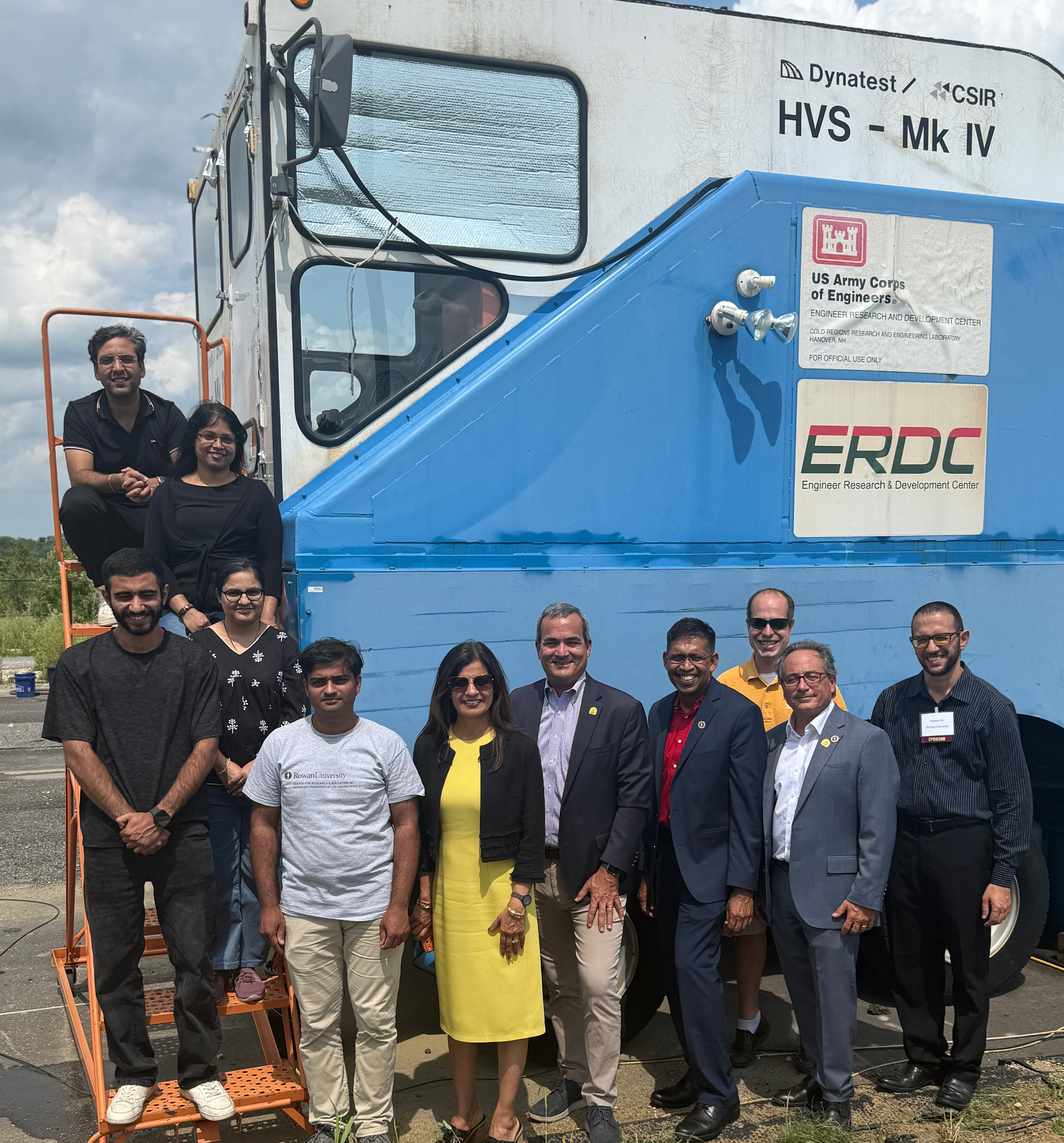
Pictured from center to right: New Jersey Department of Transportation Commissioner Priya Jain stands with Rowan University Chancellor Tony Lowman, CREATES Director Yusuf Mehta, Henry M. Rowan College of Engineering Dean Giuseppe Palmese, CREATES Associate Director Ayman Ali and members of the CREATES research team during the commissioner's 2026 visit.
Over the last five years, the Center for Research & Education in Advanced Transportation Engineering Systems (CREATES), part of Rowan University’s Henry M. Rowan College of Engineering, has partnered with the New Jersey Department of Transportation (NJDOT) to advance the department’s research priorities through the Pavement Support Program. The center serves as an important and unique workforce development partner for the state agency, a top employer of the center’s graduates. Now, CREATES will continue its work as the partnership has been extended another five years.
Since the start of the partnership, CREATES has performed over 50 research projects into innovative, sustainable materials for longer-lasting pavements. More recently, the scope of projects has expanded to support roadway maintenance in the state. The various research projects have included literature review, lab testing and guidance.
Led by founders Yusuf Mehta, Ph.D., director, and Ayman Ali, Ph.D., associate director, CREATES is the only academic research center in the Northeast with the tools to conduct accelerated pavement testing, making Rowan an attractive academic partner. One of the marquee pieces of equipment includes a Heavy Vehicle Simulator, which can simulate decades of heavy traffic conditions within a few months.
“That allows us to implement new technologies relatively quickly,” Mehta said. If new pavement mixes perform well under lab settings, CREATES can provide NJDOT with guidance on how to scale in the construction phase and carry out these new innovations.
For example, CREATES developed a new, cost-effective material for pavement microsurfacing, tested its performance in the lab and is now applying the material to New Jersey roadways to further test its performance in a real-world application. CREATES also updated the Falling Weight Deflectometer (FWD) testing manual so NJDOT and contractors follow consistent procedures for evaluating the condition of pavements.
“We partnered with NJDOT to update their FWD testing manual; the goal was to make it more easily implementable in the field utilizing the most up-to-date testing procedures,” Ali said. “NJDOT is in the process of implementing the manual.”
CREATES is actively testing new porous pavement mixtures for heavy volume traffic roadways.
“We're refining the mixture at this point, based on the findings from our full-scale testing,” Ali added.
Beyond materials and innovative pavement technologies, CREATES also works on how NJDOT manages its pavement network. Surya Teja Swarna, Ph.D., a licensed professional engineer and an assistant research professor at CREATES who leads the center's asset management and data integration research, said his team consolidated the department's pavement databases and built the models NJDOT uses to understand how roads will age.
“The data used to reside in separate systems, making it challenging to evaluate the entire pavement network through a unified view,” Swarna said. “Now, the department can assess the network comprehensively and direct resources where they will provide the greatest benefit.”
That work has grown into decision support. CREATES helps NJDOT set performance targets, compare investment options over the full life cycle of a pavement and account for risks such as flooding and poor drainage that shorten the life of a road.
“If we know a road floods every few years, it shouldn't be treated like a road that never does. We're giving the department additional tools to incorporate those risks into long-term planning,” Swarna said.
The center is also developing a low-cost pavement management system for local agencies. Using artificial intelligence, municipalities and counties can assess pavement conditions from smartphone images instead of buying survey equipment that has long been out of reach for smaller budgets.
“A small town should have access to data-driven tools that help prioritize roadway investments. With a phone and our models, they can document what they have and make the case for funding," Swarna said.
The partnership is highly collaborative, with new ideas and areas of focus often generated from current research. They might be studying a pavement mix design, but other questions arise that they can look into in the future.
Both graduate and undergraduate students contribute to the research, working on programming, pavement management and in the lab. In addition, several research assistants and full-time staff lend their expertise. The collaboration provides a pipeline for students to work at NJDOT after graduation.
“We're prepping those students to be ready for the market, whether for the government or for the industry,” Ali said.
Looking ahead to the coming years, CREATES will continue to study new pavement technologies, sustainable construction materials and examine skid resistance and safety on the roadways for NJDOT.
The goal, Mehta said, is for Rowan to study and solve real-world problems with practical solutions that can be applied to other agencies nationwide. Not only does the CREATES research team manufacture new materials, but they also provide guidance for engineers and contractors to use and implement them.