A global perspective: Rowan-Virtua SOM student explores cardiac care in Egypt
A global perspective: Rowan-Virtua SOM student explores cardiac care in Egypt
October 13, 2026
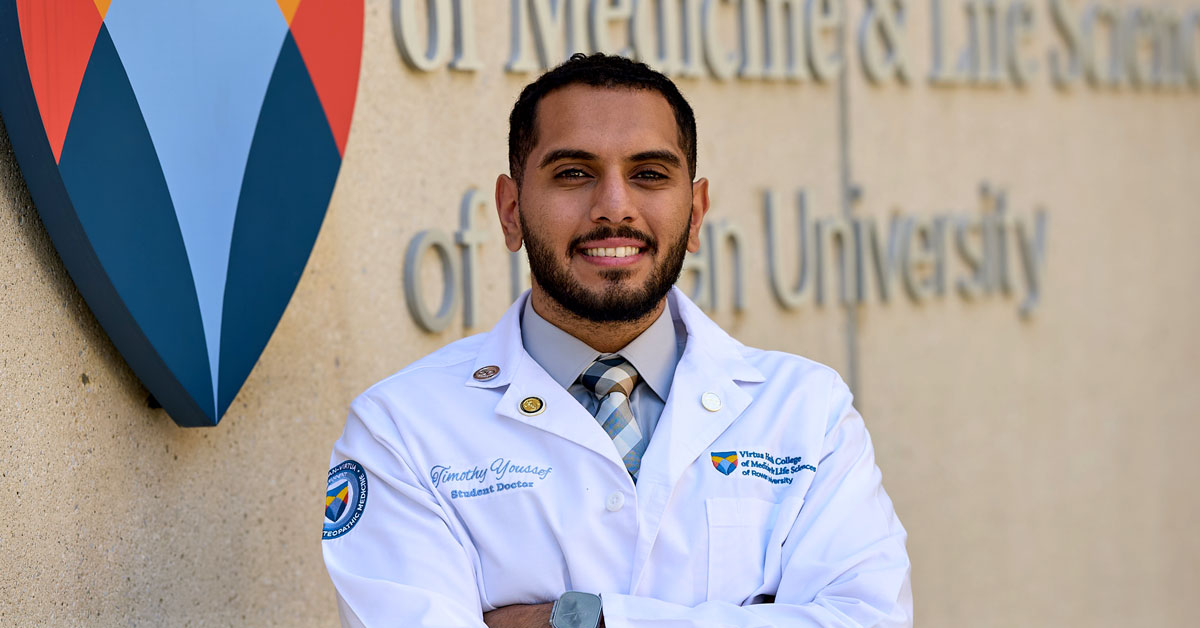
This summer, Timothy Youssef traveled more than 5,000 miles to one of Africa’s leading cardiac centers. The experience was more than an opportunity to learn about medicine; it was a homecoming, a glimpse at the work he hopes to do as a physician, and a chance to meet one of his role models in medicine.
Youssef, a second-year student at Rowan-Virtua School of Osteopathic Medicine (SOM), spent several weeks at the Magdi Yacoub Heart Foundation’s Aswan Heart Center in Egypt, where he gained firsthand experience with an international team providing specialized cardiac care to patients regardless of their ability to pay.
But his journey to Egypt didn’t come to fruition without its share of challenges, and the inspiration for the trip itself was born before he ever entered medical school.
Following an early inspiration
Youssef has long admired Sir Magdi Yacoub, the renowned Egyptian-British heart surgeon whose career has included pioneering work in cardiac surgery and the creation of a foundation dedicated to advancing cardiovascular care, research and training.
As a child, Youssef remembers watching documentaries about Yacoub and being impressed by his accomplishments. The surgeon’s example inspired Youssef’s interest in medicine and surgery, but it wasn’t until he completed the cardiovascular curriculum during his first year at Rowan-Virtua SOM that he began seriously considering cardiac surgery as a career.
“I thought, wow, this is very interesting. I would love to learn more and find a way to learn from [Yacoub’s] legacy,” Youssef said.
That interest led Youssef to explore opportunities with the Magdi Yacoub Heart Foundation and eventually connect with physicians here in the U.S. who were interested in learning from the Aswan Heart Center’s model of delivering highly specialized cardiac care in an environment where resources must be used carefully.
Youssef agreed to participate in a clinical and research observership for which he would travel to Aswan to observe the center’s clinical operations and better understand how its teams deliver complex cardiac care while carefully managing resources. The goal was to bring those observations back to physicians in the United States, where they could help inform cost analyses and discussions about how elements of the center’s model might be used to deliver high-quality care more efficiently and potentially reduce costs for patients.
Youssef also saw the experience as an opportunity to strengthen connections between Rowan and medical partners in Egypt and potentially open doors for future research collaborations, clinical observerships and other opportunities for Rowan students.
First, however, he had to find a way to get there.
For months, Youssef sought financial support for the four-week experience, estimating that travel, housing, and living expenses would cost about $4,000; he needed $2,000 to close the gap. He approached multiple people and programs before eventually connecting with Rowan-Virtua SOM Vice Chancellor Richard T. Jermyn, who helped him connect with the appropriate team to secure the remaining funds for his travel and accommodations.
Learning from a different model of cardiac care
Once in Aswan, Youssef immersed himself in the daily rhythm of the Heart Center. His days began around 7 a.m., when he joined the team for rounds in adult and pediatric intensive care units, clinics and surgical services.
The experience allowed him to see firsthand how the center’s approach to patient care worked in practice and to observe a patient’s journey through multiple stages of care, something medical students do not always get to experience.
“You were able to follow a patient from the moment they came to the clinic and first got diagnosed, through admission, surgery and postoperative care in the ICU,” Youssef explained. “I learned so much from that experience.”
He was particularly struck by the foundation’s model of providing care at no cost to patients. Youssef learned that many patients travel to the center from distant parts of Egypt and elsewhere in Africa for treatment, with the foundation helping cover transportation and accommodations in addition to medical care.
“I think the system has the biggest impact here because they don’t focus on the cost first,” he said. “The physicians there just genuinely want to give the patient the best medical care.”
Meeting a medical role model
The most memorable moment of the trip came unexpectedly.
Youssef had hoped for months to meet Yacoub, but the surgeon’s international travel schedule meant he might not even be in Egypt during Youssef’s visit. When Yacoub’s daughter told him there might be an opportunity to meet in Cairo, Youssef booked a flight from Aswan the next day without knowing whether the meeting would actually happen.
He arrived at a Cairo hotel and waited in the lobby. Eventually, the 90-year-old surgeon he had admired for years walked downstairs.
“I was starstruck,” Youssef said.
What Youssef expected might have been a brief introduction turned into a roughly 30-minute conversation about cardiac surgery, Yacoub’s work, and the foundation’s mission. Youssef had brought along his well-worn copy of a book about Yacoub, which the surgeon signed for him.
Afterward, Youssef toured the foundation’s new cardiac center in Cairo, another ambitious project designed to expand access to specialized cardiovascular care.
The encounter, combined with his weeks in Aswan, helped clarify a career goal that was still taking shape when he first entered medical school. Youssef knew he was interested in surgery but had not settled on a specialty. Now, he hopes to pursue cardiothoracic surgery and make global surgery a key focus of his career.
Opening the door for others
Youssef now serves as Co-Chair of the Thoracic Surgery Medical Student Association’s Global Surgery Committee, where he oversees collaboration, mentorship, and advocacy efforts to advance global surgery. Since returning to the U.S., he has continued to reach out to the Magdi Yacoub Heart Foundation in hopes of creating opportunities for other medical students to have an experience like his.
For Youssef, it’s a way to carry forward the same inspiration that first led him to Egypt and perhaps give other aspiring physicians an opportunity to discover what kind of impact they want to make.
“The whole idea is: How do I give my experience to everyone else?” Youssef said. “It was truly transformative: what I learned, what I benefited from, what I saw. I want everyone else to see it because I know they will be inspired too.”