What chameleons can teach us about being human
What chameleons can teach us about being human
September 30, 2026
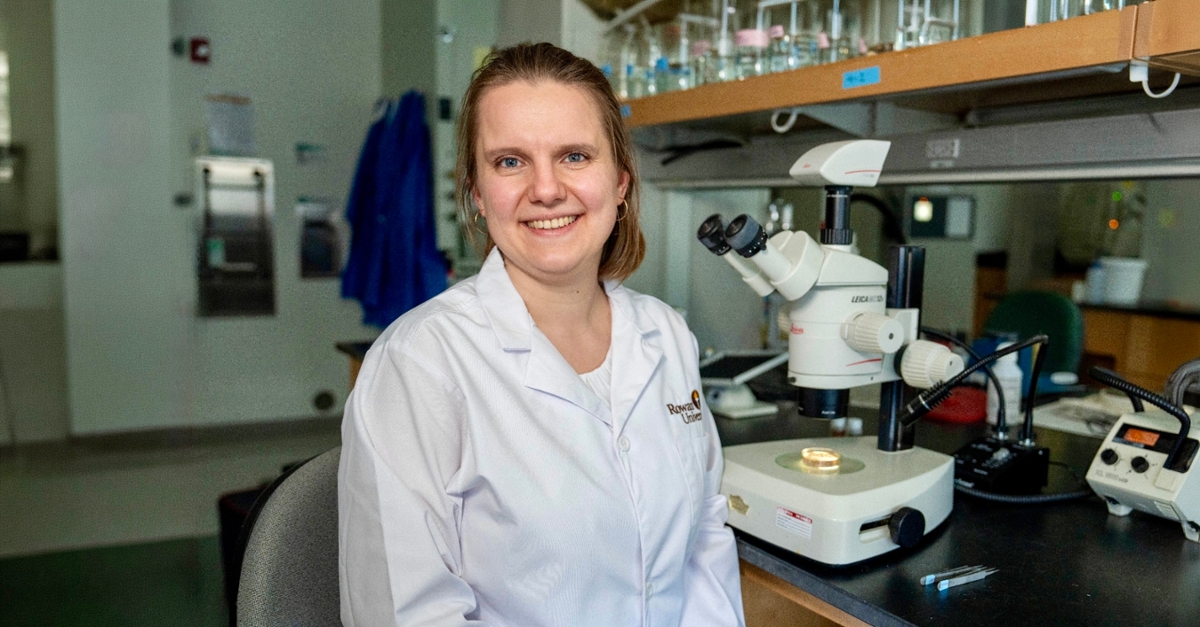
Natasha Shylo co-authored a study published in Nature Communications showing that veiled chameleon embryos share surprising similarities with human embryos during the earliest stages of development.
Before most people know they're pregnant, an embryo has already begun organizing itself into the structures that will shape a developing body. Scientists have few opportunities to study those earliest stages of human development, making many of life's first steps difficult to observe directly.
New research suggests that an unexpected animal, the veiled chameleon, may offer scientists a new model for studying human development.
Despite being separated by 300 million years of evolution, veiled chameleon embryos share surprising similarities with human embryos, according to a study published in Nature Communications and co-authored by Natasha Shylo, assistant professor of biological and biomedical sciences at Rowan University's College of Science & Mathematics. The research team also included scientists from the Stowers Institute for Medical Research, the University of Oxford, the University of Cambridge and the University of Kansas Medical Center.
The findings could help researchers better understand one of biology's most fundamental questions: how a single fertilized cell develops into a complex organism.
"By understanding how embryos develop normally, we can also better understand what happens when development goes wrong," Shylo said. "Those early developmental processes are connected to questions about infertility, early pregnancy loss and how complex organisms form in the first place."
Surprising similarities
Before joining Rowan, Shylo studied veiled chameleon development as a postdoctoral researcher at the Stowers Institute for Medical Research in Kansas City, Missouri. During that time, co-author Antonia Weberling, a developmental biologist at the University of Oxford, reached out to collaborate.
Weberling studies early embryonic development and stem cells across a variety of species. Chameleons were of particular interest because their embryos are still at a very early stage when eggs are laid. In many other reptiles, development is much further along by that point, making those stages more difficult to study.
After reviewing images of developing chameleon embryos that Shylo captured at Stowers, Weberling noticed something unexpected.
"Are you sure you sent me chameleon embryos?" Shylo recalled Weberling asking. "This looks exactly like a human embryo."
Weberling's reaction to the embryos' unexpected similarities sparked a closer look at how they develop.
Scientists had long believed that mammals were unique in forming an internal cavity that helps organize the developing embryo before gastrulation, a critical stage when the embryo begins establishing its body plan and organizing the tissues that will eventually become organs and other major structures.
The new research showed that veiled chameleons do it as well.
Different paths
While both human and chameleon embryos ultimately form similar internal cavities, they take different routes to get there.
In human embryos, cells organize around a central space as the cavity develops. In chameleons, the embryo begins as a flat sheet of cells that folds inward and gradually closes, much like a drawstring bag being pulled shut.
Despite those differences, both embryos arrive at remarkably similar structures. The finding suggests that evolution can sometimes produce similar outcomes through different biological processes. It also raises new questions about how early development evolved across species.
For Shylo, the findings are a reminder that important discoveries can emerge from unexpected places. She plans to continue investigating some of the earliest and most mysterious stages of human development.
Information about animal care and research oversight is available on the Rowan University Institutional Animal Care and Use Committee (IACUC) webpage.