Rowan faculty bring immersive learning to life with new VR experiences
Rowan faculty bring immersive learning to life with new VR experiences
September 30, 2026
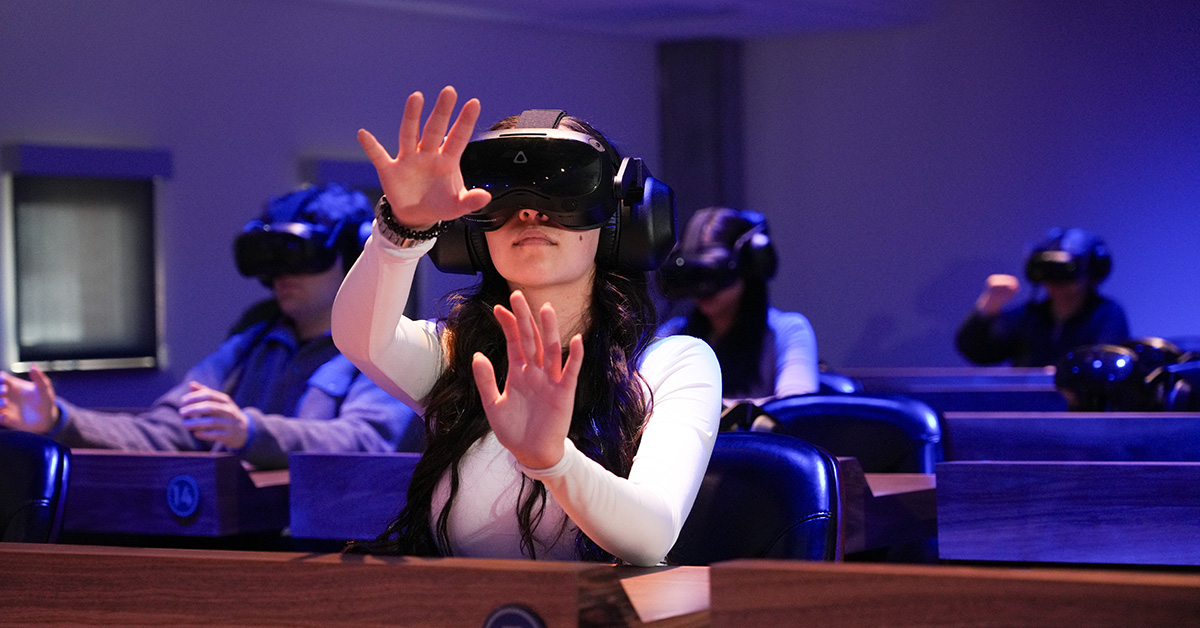
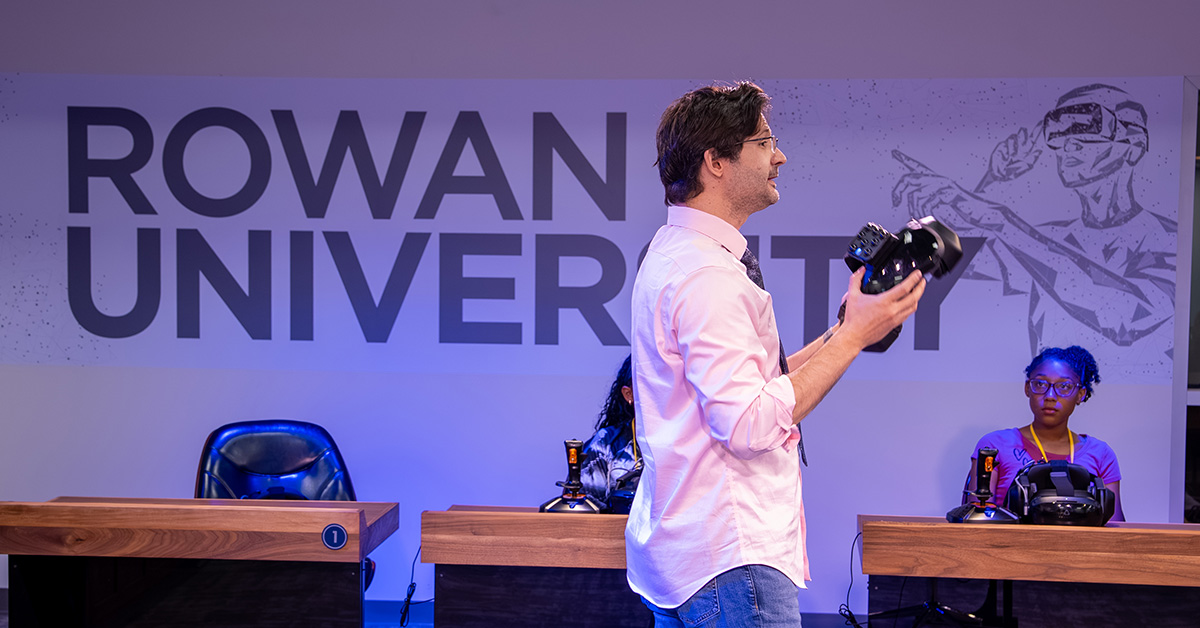
In spring 2026, more than 1,000 students enrolled in courses and events that included sessions at Dreamscape Learn Center at Campbell Library. Below, students will experience new faculty-designed content this fall. Director George Lecakes instructs students how to use the space.
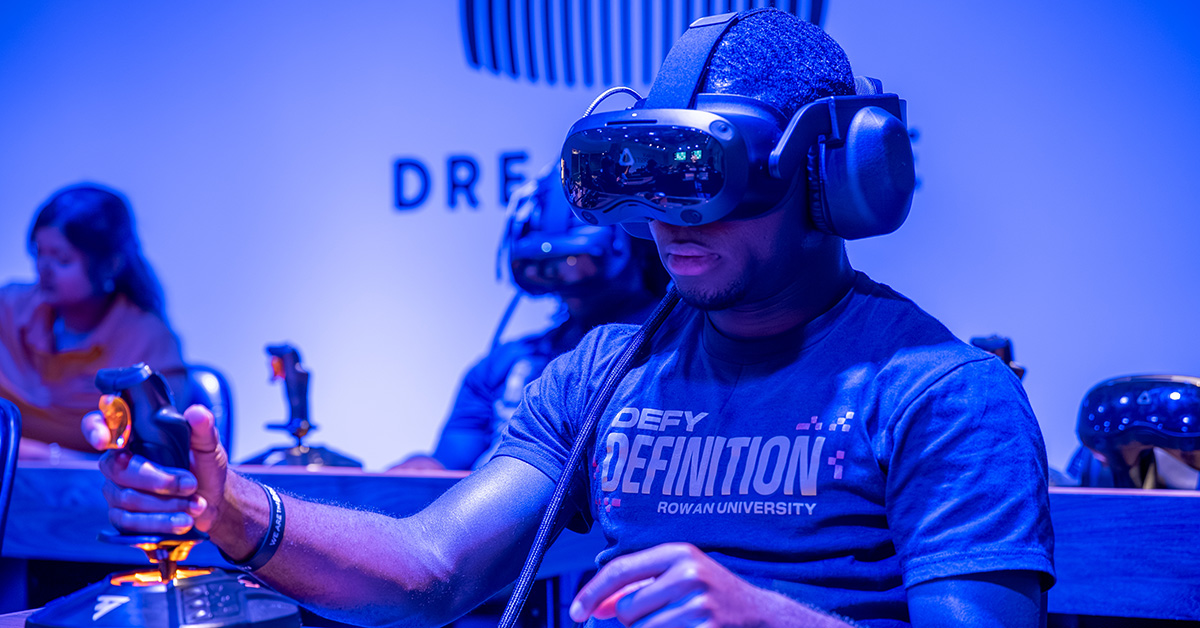
Rowan University students are stepping into virtual worlds designed by their own professors. This fall, the University's Dreamscape Learn Center is debuting its first faculty-designed immersive learning experiences, marking a new phase in Rowan University’s virtual reality (VR) initiative.
Built on an innovative developer platform created by Dreamscape Learn, the immersive experiences place students in realistic scenarios where they can apply classroom knowledge, practice decision-making and build skills for real-world challenges.
After introducing students and faculty to existing Dreamscape Learn experiences during the past academic year, the center is now expanding into content developed specifically for Rowan courses. Through Rowan’s partnership with Dreamscape Learn, immersive content developed by Rowan faculty can be licensed by other institutions, extending the University’s impact beyond its own classrooms.
“Through our partnership with Dreamscape Learn, we’ve made a long-term investment in the future of education,” said Chancellor Tony Lowman. “We were among the first universities to embrace this exciting technology and we’ll be one of the first to offer faculty-designed content for use by others.”
More than 1,000 students enrolled in courses and events that included VR sessions at the immersive learning center at Campbell Library during its first semester. Among them were students enrolled in an introductory biology course for non-STEM majors that used Dreamscape Learn’s Biology in the Alien Zoo experience.
Learning outcomes elsewhere have been encouraging. A multiyear study at Arizona State University (ASU), where Dreamscape Learn and its first immersive content was developed, found that students using Alien Zoo modules were nearly twice as likely to earn an “A” in their lab course compared to peers in traditional wet labs.
As part of Rowan’s collaboration with Dreamscape Learn, faculty also have access to ready-made immersive content in chemistry, astronomy, art and history through modules that faculty can plug in to supplement existing coursework.
But increasingly, Rowan professors are doing more than incorporating existing experiences. They're helping create new ones.
Simulating real-world challenges
With eight offerings underway in topics ranging from health and wellness to physiology and anatomy, Rowan’s modules are designed to be nimble, adaptable and easier to deploy than entire courses, said George Lecakes, Ph.D., director of Rowan University's Dreamscape Learn Center.
“We're focusing on VR as being a creative space where students get to explore and safely fail,” Lecakes said. “They're building critical thinking skills and gaining a better sense of their own responses and decision-making capabilities.”
Guided by Professor Amanda Almon, director of Academic Immersive Learning and Faculty Partnerships, Rowan modules are built in-house by developer Garrett Williams and visualization engineer Leeza Duller.
Classroom discussions remain a key component of Rowan’s VR content. To strengthen the simulation experience, students and their instructors can come together after each module to discuss what they experienced, Lecakes said.
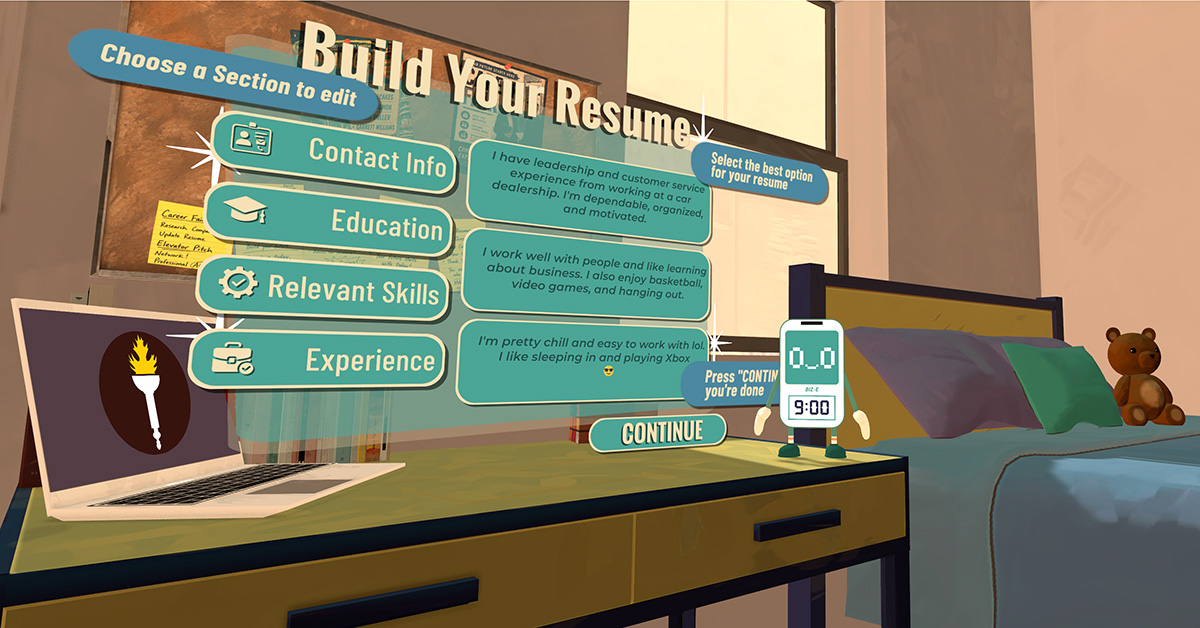
Beginning this semester, all first-year students in the Rohrer College of Business will visit the Dreamscape Learn Center as part of the required course, “How to Succeed in Business School.” There, hundreds of students over the fall semester will participate in a 22-minute virtual career fair experience designed to reinforce professional skills and build confidence before meeting employers in person.
“It's going to reinforce everything that you might hear in class, but don't know how to do,” Lecakes said.
In case of emergency
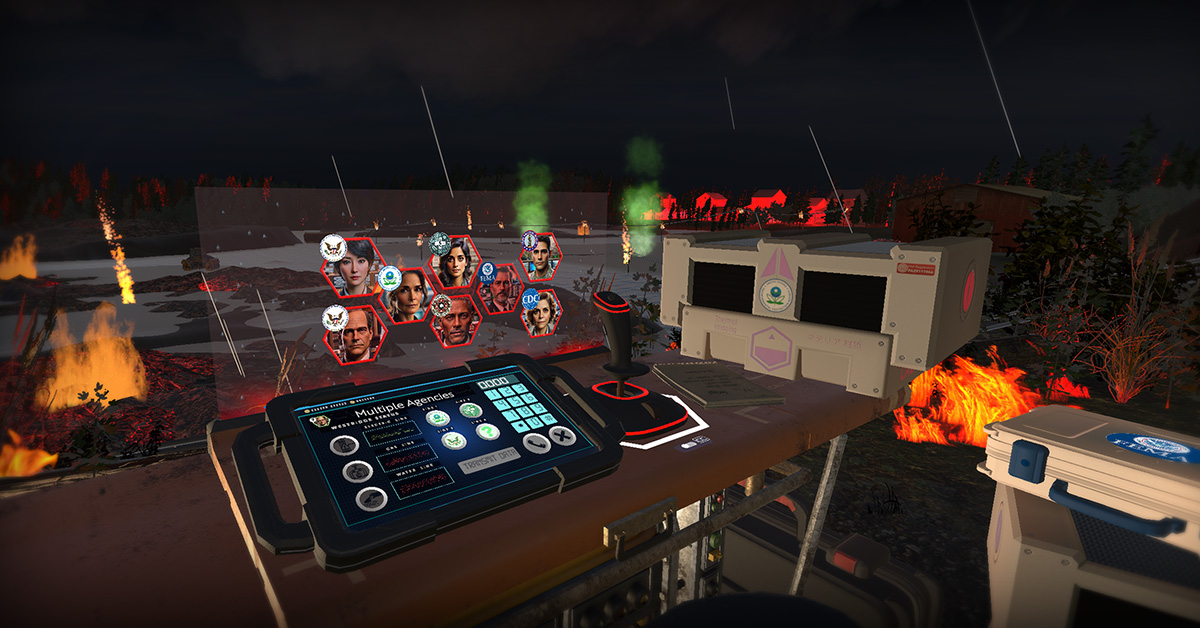
As a professor of disaster science and emergency management, DeMond Miller, Ph.D., immediately recognized VR's potential as a teaching tool. Along with Professor Ronald Roberts, co-director of Rowan's Center for Disaster Science, Risks & Community Resilience, Miller worked with Lecakes’ team to develop CASCADE, or Coordinated Agency Simulation for Catastrophic And Disaster Events.
Offered this semester as part of an elective course taught by Roberts called “Emergency Exercise Design, Implementation & Evaluation,” the simulation allows students to coordinate a disaster exercise involving local, state and federal agencies.
“When you're put into that virtual world, it increases the realism of the program,” said Roberts, “You can watch an event unfold on video and you can talk about it, but when you have the ability to roam in VR, it's putting you in another world.”
While the course walks students through the U.S. Department of Homeland Security's technical manual for designing emergency drills and tabletop exercises, CASCADE enables students to experience and evaluate complex scenarios repeatedly and from multiple perspectives.
“CASCADE converts theory into practice,” said Roberts, one of the nation's few professionals to hold the International Association of Emergency Managers' Certified Emergency Manager (CEM) and Master Exercise Practitioner (MEP) credentials actively engaged with the Dreamscape Learn technology. Unlike a real-world emergency exercise involving multiple agencies, participants can pause a virtual exercise, review decisions and start over. They can compare outcomes as a group and discuss ways to improve, creating additional opportunities for learning.
And it’s not just for students, Miller said. CASCADE could be a valuable training tool for emergency managers, responders, agencies and partner organizations, too, with the flexibility to add new scenarios as needed.
“This is the wave of the future,” Miller said. “This allows us to expand our curriculum. It allows students to interface in environments where it may not be possible to bring an entire class to the middle of a rainstorm or a flood. We can deal with those scenarios in Dreamscape.”
The center is also helping students prepare for a very different kind of challenge: launching their careers.
Building on Rowan's expertise
Under Rowan's agreement with Dreamscape Learn, faculty-developed courses and experiences such as CASCADE and the career fair simulation may eventually be made available to other institutions. The faculty-developed experiences emerging from Rowan could help shape how immersive learning evolves across higher education, said Provost Voki Pophristic.
“What excites us most is that our faculty are not simply adopting a new technology. They are helping shape how it can be used in higher education,” Pophristic said. “The experiences under development at Rowan have the potential to benefit students across disciplines and, ultimately, learners far beyond our campus.”
While the Dreamscape Learn Center at Campbell Library opened in spring 2025, Rowan has been building expertise in VR research for more than two decades through the Henry M. Rowan College of Engineering. Supported by partners including the U.S. Army, the U.S. Navy, NASA and the National Science Foundation, researchers have applied immersive technologies to projects ranging from military training to advanced engineering visualization.
Over the course of his doctoral research, Lecakes evaluated 35 VR projects developed at Rowan, concluding that immersive technologies provide their greatest value in training and education. That’s because virtual environments allow users to actively engage with information rather than simply view it. Students can practice, experiment and learn from mistakes in a setting designed to mirror real-world situations.
For Lecakes, the primary goal remains helping people learn in new ways.
“Education and training are where VR is at its best because it gives you a space for failure,” Lecakes said. “That’s how people learn.”