Rowan's Native Plant Meadow takes root as living laboratory
Rowan's Native Plant Meadow takes root as living laboratory
September 10, 2026
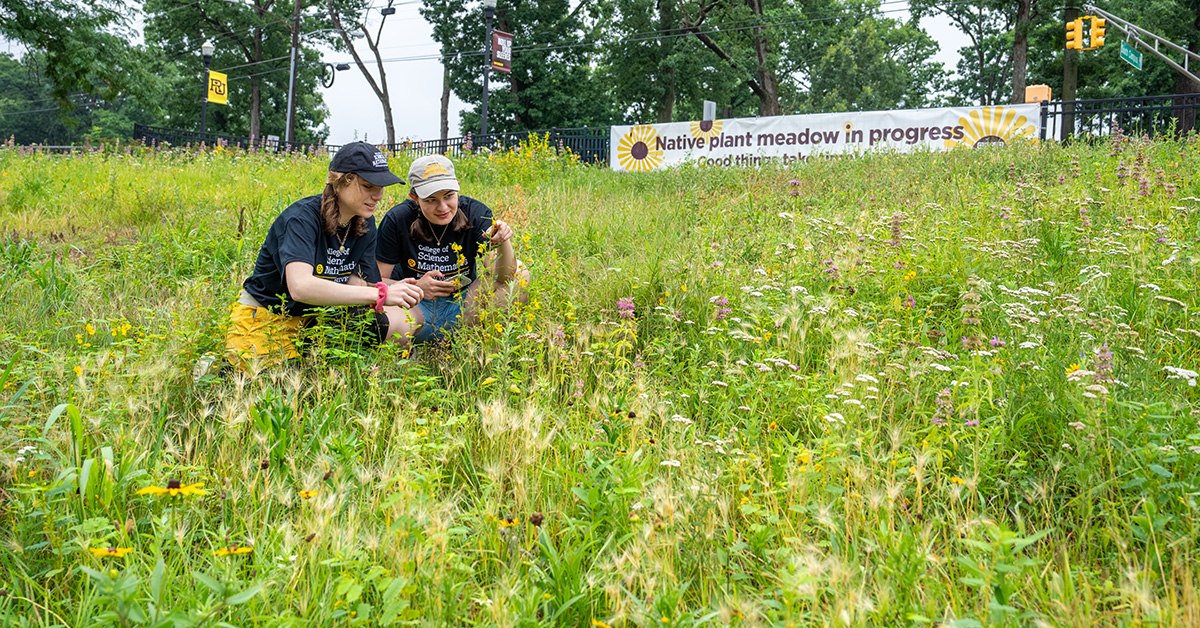
From left, Tess Errickson, a computer science major, and Neve Boudreau, a biological sciences graduate, examine native species within Rowan's new Native Plant Meadow outside Science Hall.
Between Route 322 and Science Hall, within a sloping meadow blooming with black-eyed Susans, goldenrod and purple horsemint, passersby might spot a biology professor or two bearing an electric string trimmer and a pair of hand pruners.
They’re targeting five non-native annuals before they flower and spread seeds throughout the Native Plant Meadow. By hand-weeding the marestail, Queen Anne’s lace, moth mullen, ragweed and lambsquarter, the caretakers can avoid using chemicals that might harm local pollinators and other beneficial creatures.
“We are not treating it at all,” said Stephen Bentivenga, Ph.D., a weed whacker who heads the Department of Biological & Biomedical Sciences at Rowan University’s College of Science & Mathematics. “The native plants should outcompete the non-native annual plants within a year or two.”
Part of the Rowan University Arboretum & Gardens, the meadow serves as a living laboratory where students can study ecology, biodiversity and sustainable landscape management while helping support local wildlife.
Led by Bentivenga and biology professors Michael Grove and Sara Wright, in partnership with Division of Facilities, Planning & Operation, the project reflects Rowan’s effort to transform campus grounds to reflect the University’s commitment to environmental stewardship and hands-on learning opportunities.
“We’re grateful for support from President Houshmand,” Bentivenga said.
Aimed at promoting sustainability and biodiversity, the meadow represents 30 native species of wildflowers, grasses, sedges and rushes. It complements an earlier native plant landscaping project along the foundation of Science Hall, funded by the Society for Biodiversity Preservation.
Inspired by a 2023 Centennial Lecture by entomologist and ecologist Doug Tallamy, a professor at the University of Delaware, the meadow replaced a half-acre lawn that required irrigation and regular mowing.
Late last fall, the lawn was cleared out to make way for the new project. In early December, the dormant ground was prepped, raked and scored to accept several mixtures of carefully selected seeds, pine shavings and water.
Volunteers helped scatter about 20 pounds of seed, approximately 200 seeds per square foot, during the installation process. The meadow was designed and installed by landscape architects at Larry Weaner Landscape Associates of Glenside, Pennsylvania, which specializes in creating native plant meadows for clients along the East Coast.
The Native Plant Meadow is expected to fully mature within five years. The plan includes different seed mixtures for various regions within the meadow, a winding pathway and a mown circle amid the tall grasses and flowers, large enough for a class of 25 or so.
“This is meant to be a multiuser space,” Bentivenga said. “This is for the whole campus and the broader community.”
Once established, the meadow will require only occasional maintenance and mowing only once each February to minimize disruptions to the local fauna, such as birds, pollinators and caterpillars.
“That’s why we tend to leave the drying stuff in place and not cut it down at the end of summer,” said Grove, “because the seed heads and things will be used for habitat.”
Tallamy’s push toward “rewilding” our yards and landscapes stems from the notion that traditional green lawns have little ecological value, especially when it comes to supporting insect life, Grove noted. A meadow filled with moths, butterflies and bugs produce larvae, which provide food for many bird species.
“That was the real impetus for this,” Grove said.