Intervening in neurodegenerative disease
Intervening in neurodegenerative disease
September 17, 2026
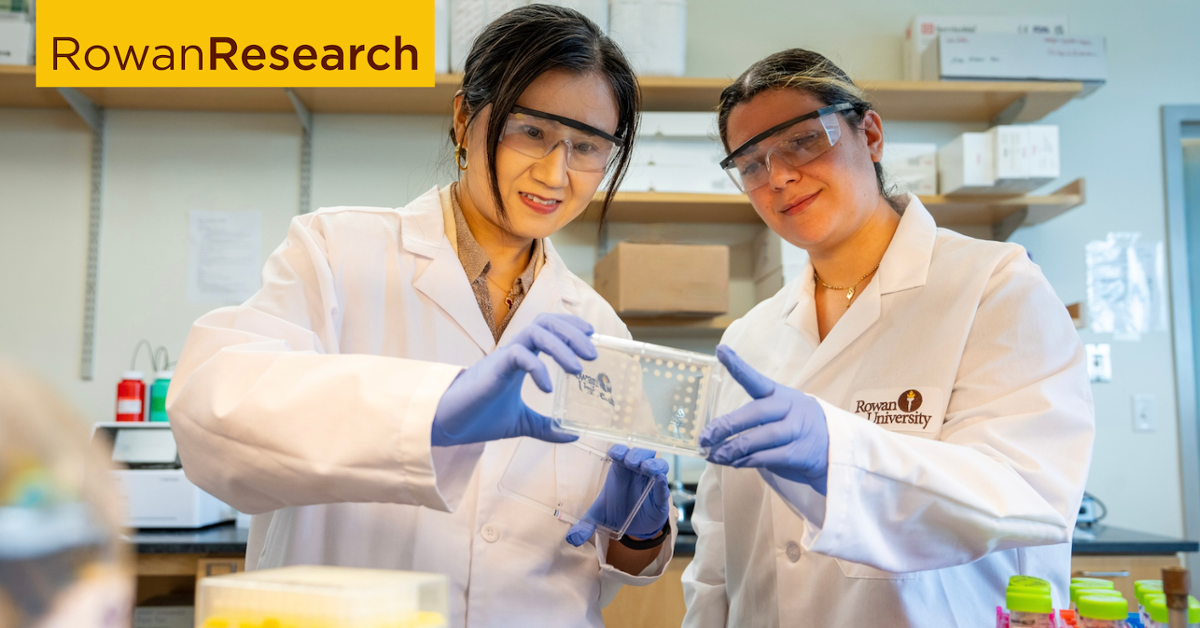
The Lin Lab focuses on proteins linked to neurodegenerative diseases and includes undergraduate, graduate and high school student researchers. JiaBei Lin, left, works with Mary Alkhoury, a graduate student in pharmaceutical sciences, in Lin’s laboratory.
JiaBei Lin, Ph.D.
Quantitative biochemist
Areas of expertise:
Single-molecule biophysics, protein engineering, yeast genetics, molecular biology
In Alzheimer’s disease, Parkinson's disease and other neurodegenerative disorders, abnormal proteins build up in the brain, forming toxic plaques that damage brain cells and eventually interfere with memory, movement and other essential functions.
JiaBei Lin, an assistant professor of chemistry and biology in Rowan University’s College of Science & Mathematics, studies how this process unfolds, aiming to detect harmful protein clumping early and intervene to stop it.
“The earlier you see these errors and reverse the formation of these structures, the less damage they will do,” Lin says.
Lin focuses on several proteins linked to neurodegenerative diseases, including TDP-43, which is associated with Alzheimer’s disease and amyotrophic lateral sclerosis (ALS); FUS, another protein linked to ALS; and alpha-synuclein, which is associated with Parkinson’s disease. As part of their normal function, these proteins collect into droplets before dispersing. However, disease-causing mutations or certain other conditions can lead the proteins to become misshapen and form aggregations that don’t break apart—setting the stage for the plaques.
Her lab is looking closely at these proteins and how mutations change them and their behavior. As part of this research, she hopes to identify biomarkers, or molecular warning signs, that could reveal the earliest stages of plaque formation well before significant neurological damage occurs.
Lin also wants to know more about the clumps’ contents. Although plaques are generally associated with certain proteins, such as TDP-43, they can contain many components. By understanding how these collections of proteins work together, she hopes to develop treatment strategies that address the whole system.
At the same time, her lab is exploring how naturally occurring housekeeping molecules help repair or remove malformed proteins. She and her colleagues previously identified a mutation in a housekeeping protein found in yeast, a type of fungi, that greatly increases its activity. Now, her lab is searching for a similar way to augment human housekeeping proteins.
Ultimately, she envisions using gene therapy to deliver enhanced versions of these protective proteins to patients in the earliest stages of plaque formation.
“When you get bad news, the protective proteins could come to the rescue,” she says. “Once damage happens, it's hard to reverse.”
Rowan University researchers are passionate about what they do. Find more at Meet Our Researchers.