Exhibition highlights Rowan research on warming Arctic
Exhibition highlights Rowan research on warming Arctic
September 23, 2026
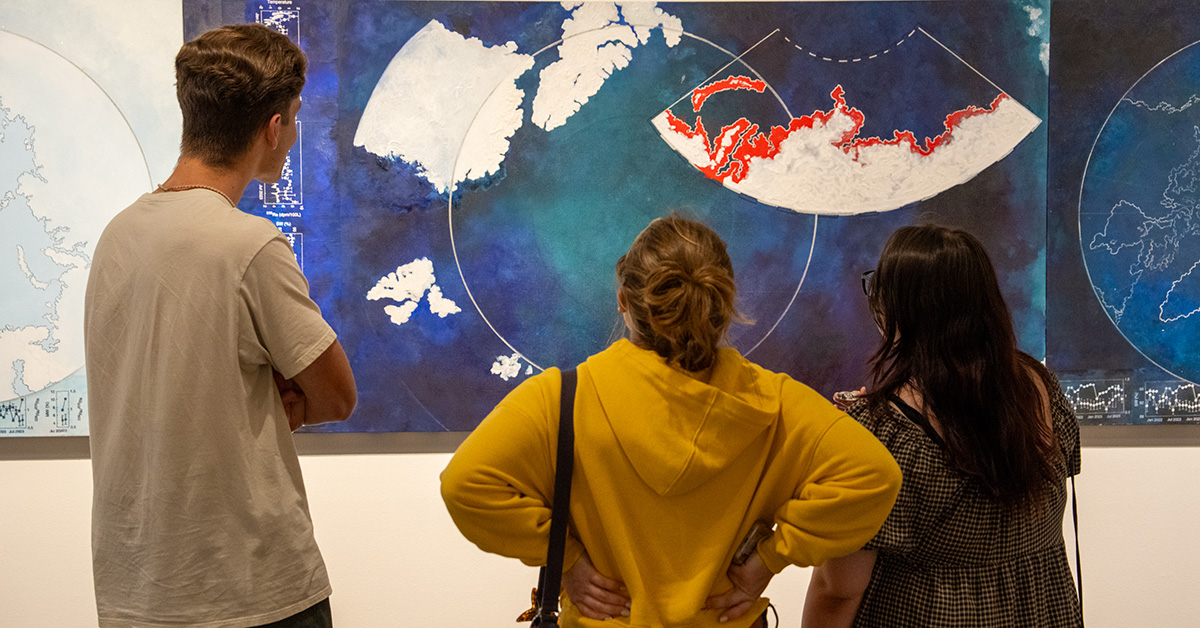
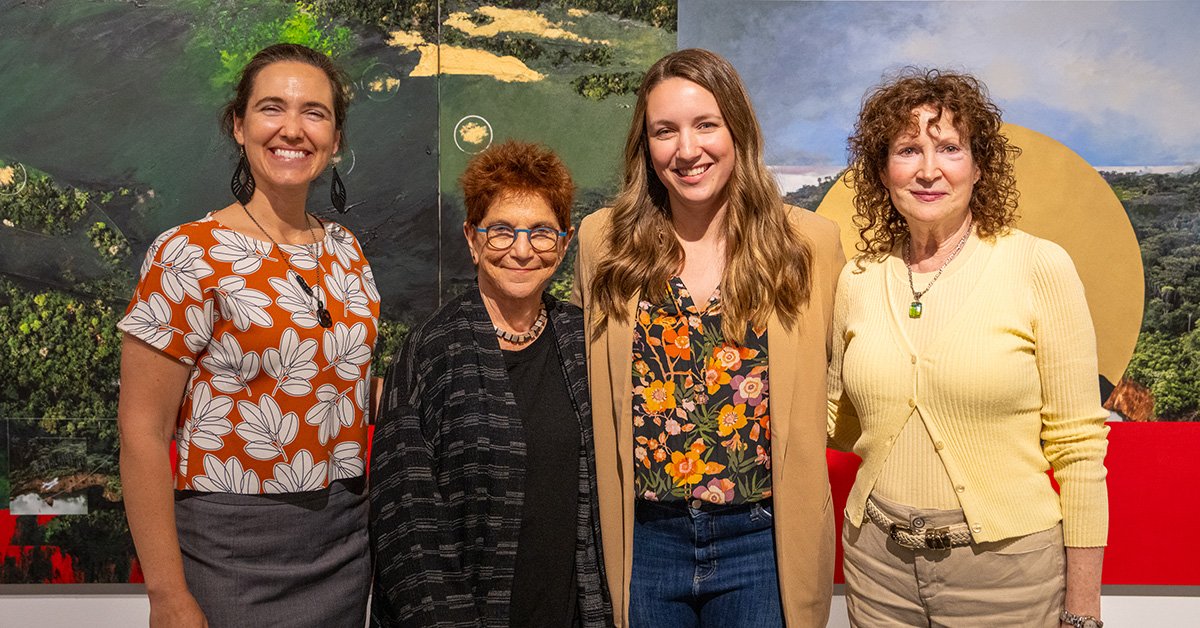
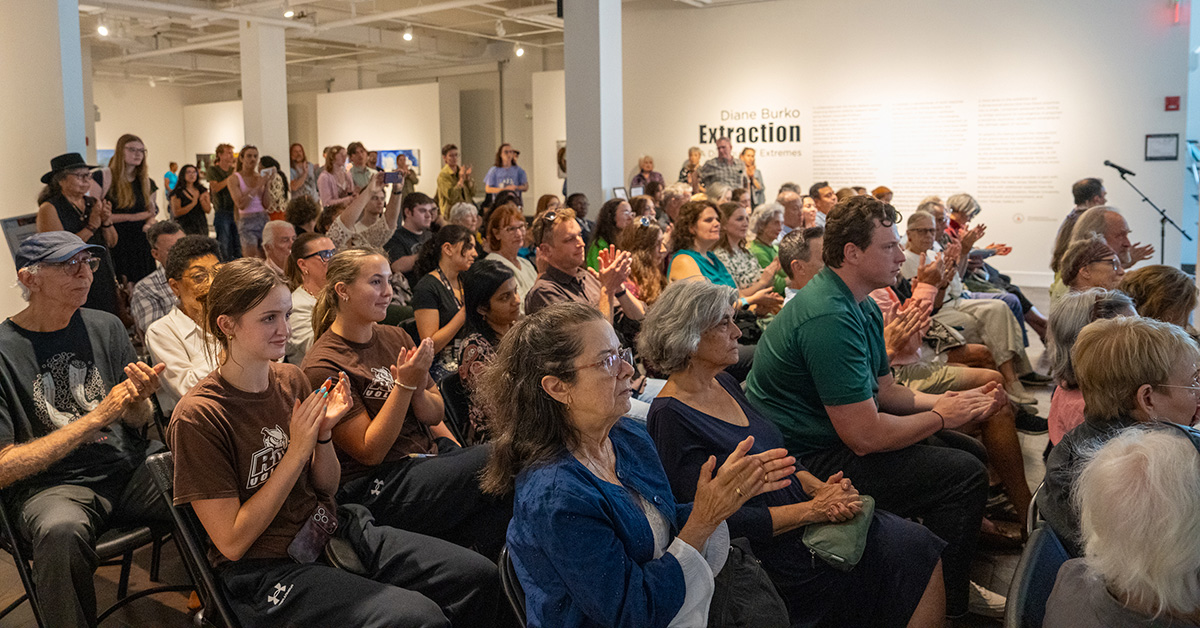
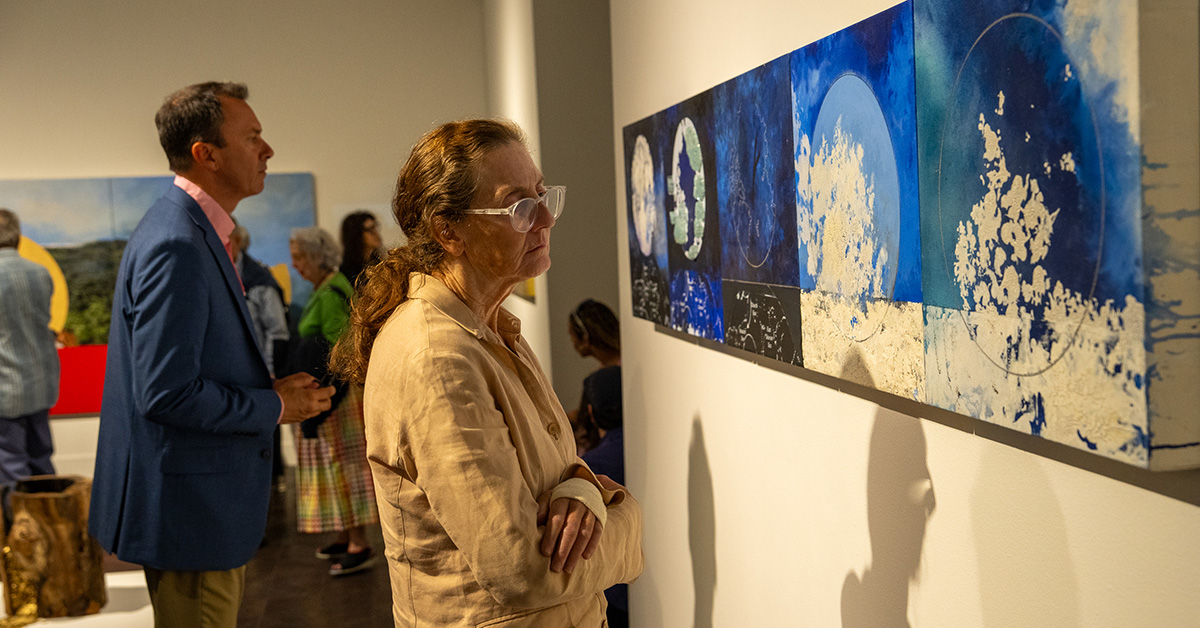
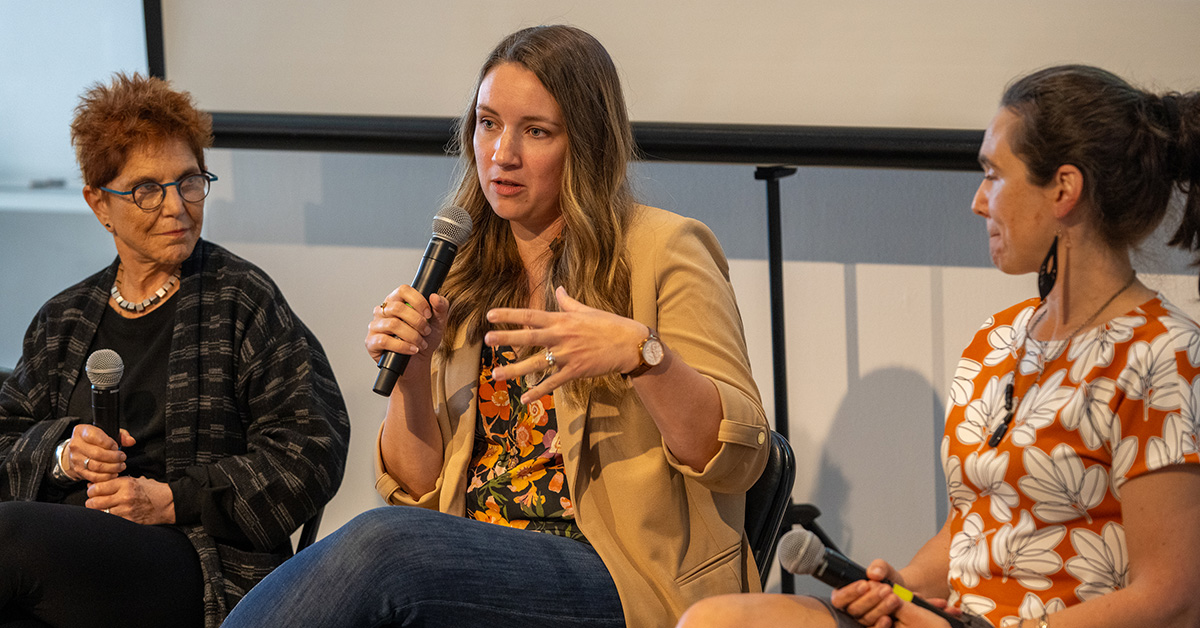
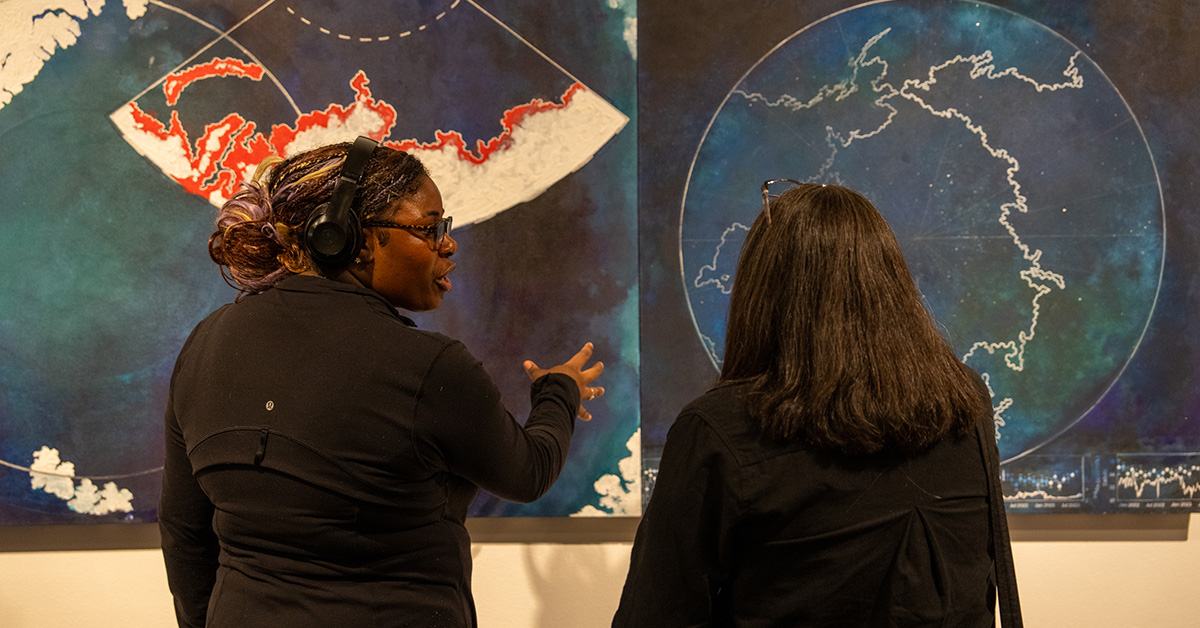
Visitors view artwork by Diane Burko during the exhibition at Rowan University Museum of Contemporary Art High Street Gallery. Below, panelists discuss the intersections of art and science with a crowd of guests. Panelists included (from left): science communication expert Virginia Schutte, Burko, oceanographer Lauren Kipp, and moderator Cynthia Veloric.
A Rowan University researcher investigating dramatic shifts in Arctic Ocean chemistry has partnered with a Philadelphia-based landscape artist to help the public visualize what’s happening in one of the world’s fastest-warming regions.
Lauren Kipp, Ph.D., studies seawater at the top of the world to better understand what’s happening beneath the surface. Sharing that information with the public is a critical component of Kipp’s efforts, which is why she began working with artist Diane Burko six years ago.
Supported by the National Science Foundation, Kipp’s work on the Arctic Radium Isotope Observing Network (ARION) Project generated data that would eventually become a key source of inspiration for Burko's artwork. Their collaboration culminated in the exhibition, “Diane Burko: Extraction, A Dialogue of Extremes,” at the Rowan University Museum of Contemporary Art High Street Gallery now through Oct. 17.
Using naturally occurring radium isotopes as tracers of ocean chemistry, Kipp and her collaborators at Woods Hole Oceanographic Institution found evidence of large-scale changes within a major Arctic current originating over the Siberian Shelf.
“There is a chemical shift happening and we're trying to understand why it's happening,” said Kipp, an associate professor in the School of Earth & Environment. “Understanding the mechanisms will help us make better predictions for the future.”
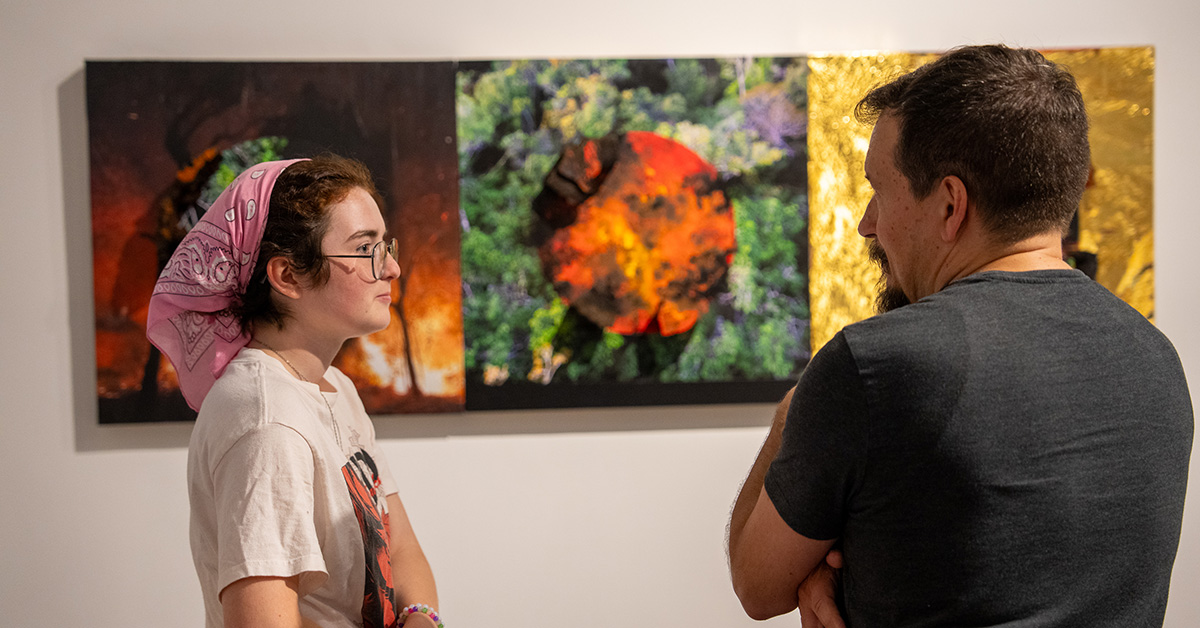
The exhibition features Burko’s data-based paintings depicting maps of an alarmingly blue Arctic Ocean, melting chunks of polar ice, and shrinking glaciers rimmed in red. The work is presented alongside her earlier paintings exploring wildfires in the Amazon rainforest. Between them, hollowed stumps of burned trees cradle representations of coal, gold and ice.
A standing-room-only crowd came to the exhibition’s opening on Wednesday, Sept. 16, to hear a panel discussion with Burko and researchers exploring the intersection of art and science. Moderated by art historian Cynthia Veloric, Ph.D., the discussion included Kipp and another of her collaborators, ecologist and science communication expert Virginia Schutte, Ph.D.
A world traveler who once visited both poles in the same year, Burko said she became interested in the planet’s rising temperatures about 20 years ago.
“I’ve always been a landscape painter, but it hit me that it just was not enough to paint these beautiful vistas,” Burko said. “I needed to make a difference.”
Burko’s polar paintings were inspired by maps, graphs, photographs and charts provided to the artist by Kipp and her students. That information was drawn from 50-day expeditions to the Arctic every two years. During those expeditions, researchers obtained water samples from the Siberian Seas north of Russia, including samples collected monthly from underwater devices.
“We know that a lot of physical changes are happening in the Arctic,” Kipp told the audience. “Sea ice is melting; the air and water temperatures are rising … river discharge is increasing. But all of those physical changes also impact the chemistry.”
Radium isotopes leach into seawater when it comes into contact with sediment on the seafloor or from nearby land. Increasing levels of radium suggest there may be rising levels of carbon and nutrients like nitrogen and phosphorus, which support photosynthesis for tiny plants and animals at the bottom of the food chain.
“There are some shifts happening that might favor one species over another,” Kipp added. “That's not to say that it's necessarily good or bad, but it's just a change that could happen and that could propagate up the food web. It could affect the fish that like to eat one species over another. That might affect the polar bears and it could also affect the people that live around the Arctic.”
Curated by the museum’s director, Mary Salvante, the exhibition includes research graphics produced by Kipp’s students and a virtual reality, 360-degree documentary shot by filmmaker Amy Lauren during one of Kipp’s polar expeditions.
Rylie Jacobs, a senior biomedical arts and visualization major, attended the exhibition and panel discussion because she is interested in using her artistic talents to help audiences understand complex medical information.
In the midst of a buzzing crowd of guests, Jacobs took note of the exhibition’s immediate impact.
“Everything's really beautiful and it's definitely a lot more artistic than maybe something I would do, like a medical infographic or something,” Jacobs said. “But it clearly got enough people to come … I just think it's really impressive that she's able to create art that looks cool in order to get people talking.”
Through the exhibition, organizers hope similar conversations will help visitors appreciate scientific research exploring environmental changes unfolding across the globe.