Rowan researchers receive NSF grant to convert biomass into aviation fuel
Rowan researchers receive NSF grant to convert biomass into aviation fuel
September 29, 2026
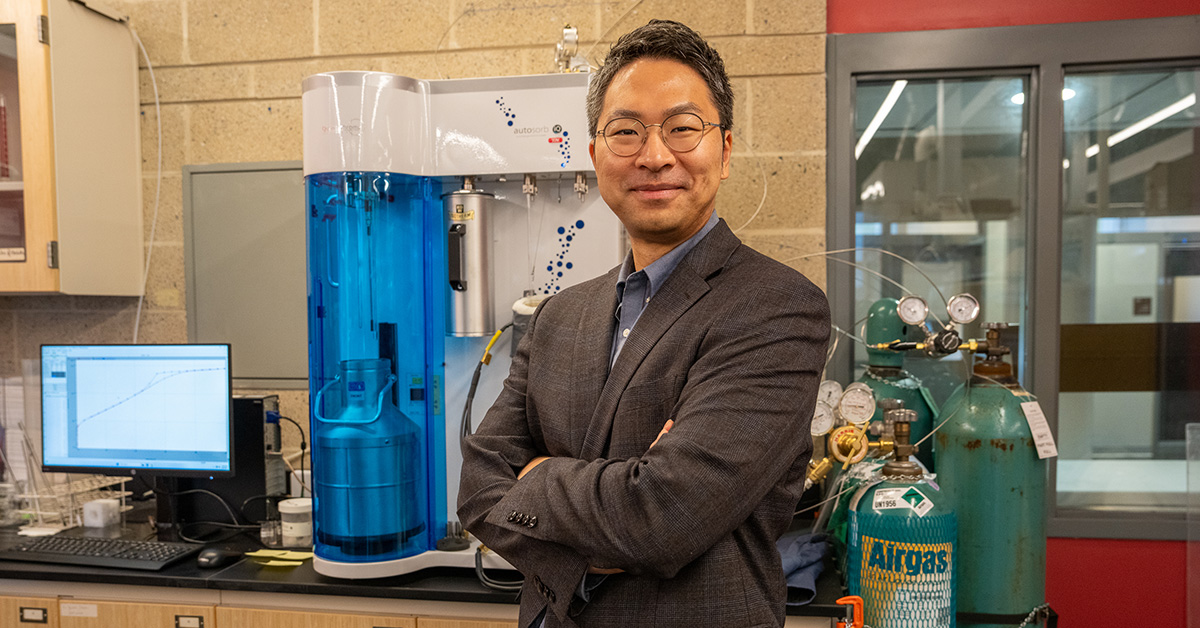
Jun Hee Jang, Ph.D., leads research to expand domestic production of sustainable aviation fuel.
The United States is working to reduce its reliance on petroleum-based aviation fuel by increasing the use of sustainable aviation fuel derived from renewable resources by 2050. A Rowan University research team is studying ways to produce these fuels.
Jun Hee Jang, Ph.D., an assistant professor of chemical engineering in the Henry M. Rowan College of Engineering, received a $199,999 grant from the U.S. National Science Foundation to study a sustainable and cost-effective process for converting biomass into jet fuel. The grant was awarded through NSF's Engineering Research Initiation (ERI) program, which supports engineering faculty at emerging research institutions as they establish independent research programs.
Aviation fuel is a blend of compounds, including linear and branched hydrocarbons and aromatic compounds. Researchers have developed well-established processes for converting biomass such as vegetable oils into hydrocarbons. However, aromatic compounds are typically derived from petroleum. Jang’s research will examine lignin, a natural polymer derived from woody biomass, as a sustainable aromatic alternative for aviation fuels.
If successful, the approach could help expand domestic production of sustainable aviation fuel while creating additional value from biomass feedstocks that might otherwise go unused.
To do so, Jang and his team must first break lignin into smaller molecules. This process produces a mixture of smaller molecules that can be upgraded into aviation fuel components and larger molecules that cannot. However, efficiently separating the smaller molecules from the larger ones is challenging. Jang and his team will develop a size-selective catalyst that allows only the smaller molecules to enter its porous structure, where they can be converted into jet fuel-range aromatic compounds, while preventing larger molecules from entering.
While the smaller molecules can be converted into aviation fuel components, the larger molecules retain properties that may make them useful for other applications. In conventional catalysis processes, these larger molecules are waste products. This approach, however, could create a valuable co-product rather than waste.
“By applying this catalyst, we can produce not only fuel aromatics, but also larger molecules that could have further functional applications,” Jang said. “We are making two products out of the same feedstock.”
Jang will be joined on this project by one doctoral student and one postdoctoral researcher. The postdoctoral researcher has experience designing chemical synthesis methods. The doctoral student will conduct experiments and analyze the resulting products. Together, the team will study how catalyst design influences reaction performance. The team also will evaluate the economic viability of scaling the proposed biomass-to-aviation fuel process using the new size-selective catalysts.