A summer built on questions: Students at Shreiber School of Veterinary Medicine learn how research improves patient care
A summer built on questions: Students at Shreiber School of Veterinary Medicine learn how research improves patient care
August 18, 2026
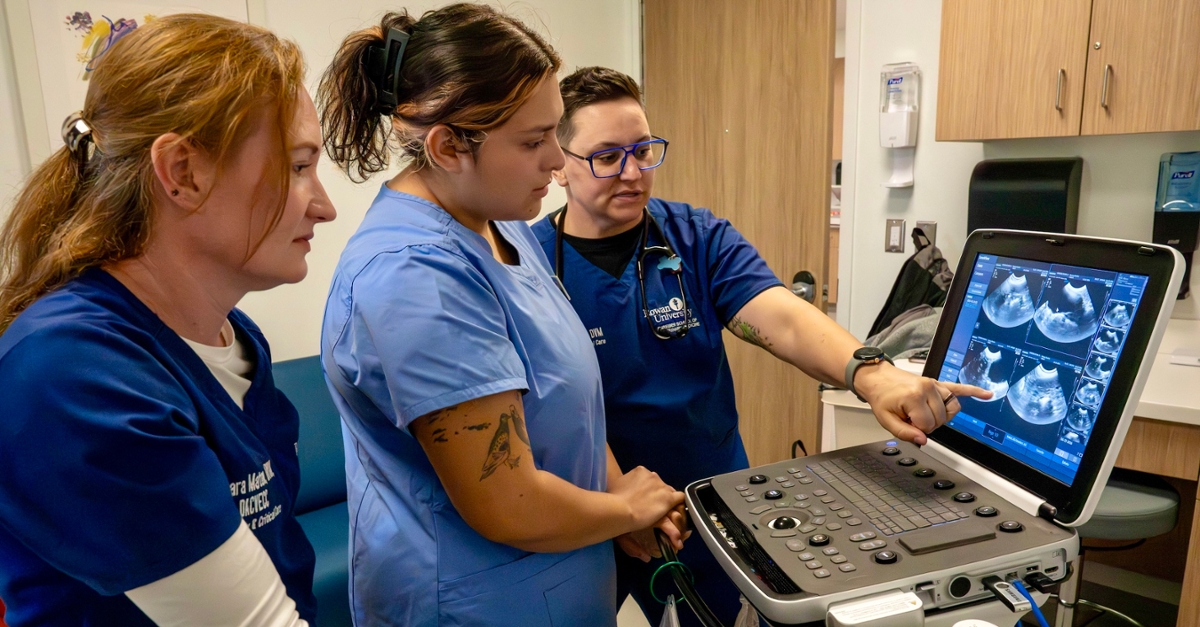
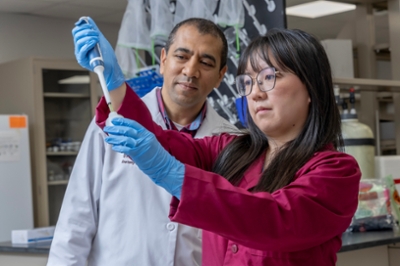
Above: Student Angely Morocho (center) reviews ultrasound images with Shreiber School of Veterinary Medicine faculty members Barbara Maton (left) and Steph Harrier. Below: Student Lisa Nguyen works in the laboratory with her faculty advisor Chandru Charavaryamath.
How can veterinarians improve trauma care for cats? Are dogs exposed to microplastics, too?
Those were just two of the questions explored this summer by students at Rowan University's Shreiber School of Veterinary Medicine (SSVM) through the inaugural Veterinary Summer Scholars Program (VSSP). The program gives students an opportunity to explore the research process while learning alongside faculty mentors.
“Research is far more than a laboratory experience. It is a way of thinking that teaches students to ask meaningful questions,” said Omar Tliba, DVM, Ph.D., associate dean for research and graduate studies and department head for veterinary biomedical sciences.
Over 12 weeks, students conducted research with faculty mentors, attended seminars on scientific writing and data analysis, and presented their findings at the National Veterinary Summer Scholars Symposium hosted by North Carolina State University College of Veterinary Medicine. The symposium draws veterinary student researchers from institutions across the country, making SSVM's participation notable for a school that opened just one year ago.
Among the inaugural cohort were veterinary students Angely Morocho and Lisa Nguyen, whose projects explored different challenges in animal health.
Giving cats a stronger voice in trauma care
“Cats aren’t just small dogs,” Morocho said.
Cats are common patients in emergency hospitals, but they remain underrepresented in veterinary trauma research compared with dogs. That observation helped shape Morocho’s summer research project, which explored the use of point-of-care ultrasound, a portable imaging tool used during an exam, to assess a cat’s injuries.
Morocho worked with SSVM faculty mentors Elena Contreras, DVM, Ph.D., MANZCVS (Animal Welfare), associate professor of animal welfare and behavior, and Barbara Maton, DVM, DACVECC, clinical assistant professor of emergency and critical care. She also collaborated with Kelly Hall, DVM, DACVECC, professor of veterinary medicine at Colorado State University and executive director of the Veterinary Committee on Trauma (VetCOT).
Using data from the VetCOT database, Morocho examined whether abnormal point-of-care ultrasound findings were associated with clinical outcomes in feline trauma patients. Studying these outcomes could help veterinarians make faster, more informed decisions when treating injured cats.
The project introduced Morocho to a different kind of research. Instead of working at a lab bench, she spent the summer analyzing large datasets, applying statistics and critically reviewing scientific literature.
“Research is so important,” Morocho said. “Learning how to read papers and apply those findings can help you provide better care for your patients.”
Following the trail of microplastics in dogs
Scientists have found microplastics in oceans, drinking water and human tissues. But veterinary student Lisa Nguyen discovered little research examining whether dogs are exposed to these tiny plastic particles.
Working with faculty mentors Nora Jean Nealon, DVM, Ph.D., assistant professor of microbiology and associate director for training programs, and Chandru Charavaryamath, MVSc, Ph.D., associate professor of veterinary anatomy and physiology, Nguyen spent the summer investigating microplastics in companion dogs and what exposure might mean for their health.
Nguyen collected samples from dogs with different lifestyles, including household pets and working farm dogs. Because so little research exists in the field, even the testing process required innovation. She partnered with an outside laboratory that had never analyzed canine fecal samples for microplastics before.
 The preliminary findings identified multiple types of microplastics in the samples, including those commonly used in packaging and pet chew toys. The results raise new questions about how long-term exposure might affect canine health.
And because dogs live alongside people and are exposed to many of the same environments, future studies could provide insights into how long-term exposure to microplastics affects both animals and humans.
For Nguyen, the project was as much about learning the research process as generating results. She developed a study from an original idea, worked through unexpected challenges and collaborated closely with mentors to interpret findings and identify next steps.
“This project has definitely reignited how much I really love doing research,” Nguyen said. “It really opened up possibilities for what I might want to do in the future.”
More questions, more possibilities
The inaugural summer cohort tackled questions ranging from infectious disease and cancer therapeutics to diagnostic imaging and public health.
For Nealon, the VSSP program coordinator, that curiosity is one of the program's most valuable outcomes.
“Not only are our students participating in projects, but they are developing into critical thinkers who will help advance veterinary medicine,” Nealon said.
Combining research and one-on-one faculty mentoring, programs like the VSSP enrich the Shreiber curriculum and expose students to the broader impact of scientific discovery.
“By engaging our DVM students in research early in their veterinary education, we are preparing veterinarians who will not only provide exceptional patient care but also drive discoveries that advance animal and human health,” Tliba said.
Student projects
- Jake Attardi: Parasite Burden and Dietary Habits of Bobcats in New Jersey: Linking Diet to Parasite Transmission (faculty advisor: Pratap Kafle, DVM, Ph.D.)
- Megan Fielding: Assessing Coliform Contamination and Antimicrobial Resistance in Canine Probiotic Supplements (faculty advisor: Nora Jean Nealon, DVM, Ph.D.)
- Anna Lauricella: Evaluation of Pacing Gait in Canine Neurologic Disease (faculty advisor: Neil Mittelman, DVM, DACVIM (LAIM, Neurology))
- Amina Mason: Phenotypic and Genomic Comparison of Uropathogenic E. coli in Dogs With and Without Multidrug-Resistant Urinary Tract Infections (faculty advisor: Nora Jean Nealon, DVM, Ph.D.; Study funded by the Morris Animal Foundation, award # D23CA-469.)
- Sydney Matusiak: Understanding Vaccine Hesitancy Among Companion Animal Owners Across Clinical Contexts (faculty advisors: Katie Krebs, DVM, MBA, DABVP (Canine, Feline) and Kirsten White, DVM)
- Angely Morocho: Associations Between Abnormal Point-Of-Care Ultrasound (POCUS) Findings and Outcomes in Feline Trauma Patients: A VETCOT Registry Study (faculty advisors: Elena Contreras, DVM, Ph.D., MANZCVS (Animal Welfare) and Barbara Maton, DVM, DACVECC)
- Lisa Nguyen: It’s Hard to Get Rid of Them, They’re Truly Un-plastic-able! Characterization of Microplastics in Fecal Samples from Client-Owned Dogs (faculty advisors: Nora Jean Nealon, DVM, Ph.D., Chandru Charavaryamath, MVSc, Ph.D.)
- Oliver Pittman: Chitosan-Based Nano-Delivery System as a Novel Approach for Treating Cryptosporidiosis (faculty advisor: Mohadeseh Abouhosseini Tabari, DVM, Ph.D.)
- Amelia Puglia: Evaluating Gait Variability as an Objective Marker of Equine Ataxia Using Inertial Hoof-Mounted Sensors (faculty advisor: Patrick Reilly, GradDip.)