Rowan researchers use 3D printing to study bone cancer cell behavior
Rowan researchers use 3D printing to study bone cancer cell behavior
August 5, 2026
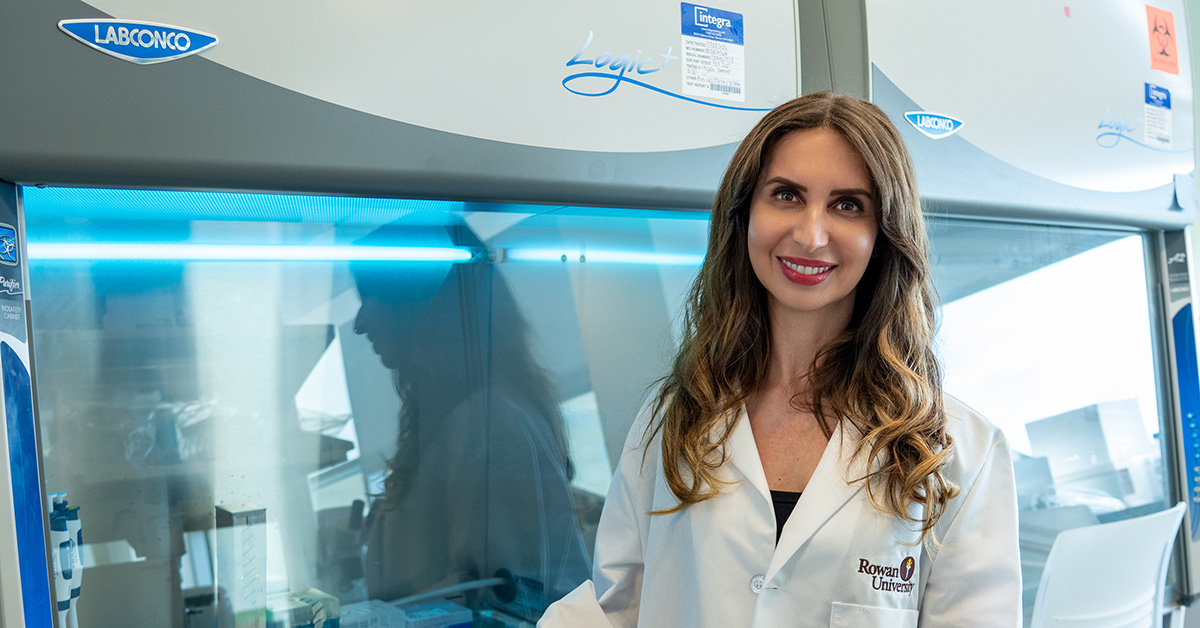
Andrea Vernengo, Ph.D., uses 3D cell printing to study cell interactions to better understand a type of bone cancer that resists existing treatments.
In some cancers, tumor cells recruit healthy stem cells to take their side. This conversion appears to follow an exchange of chemical signals—the cellular version of conversation—that persuades the stem cells to aid the malignancy’s growth.
Andrea Vernengo, Ph.D., associate professor of chemical and biomedical engineering in the Henry M. Rowan College of Engineering, and her colleagues are using 3D printing to investigate this process in bone cancer. By placing both types of cells within small chunks of gel, they hope to recreate the cells’ interactions in a system that mimics human tissue but is simpler to study.
Their research has received a two-year, $155,000 grant from the National Institutes of Health.
“We believe this back-and-forth communication essentially turns the stem cells into accomplices that help out the tumor cells,” Vernengo said. “If we can understand how that’s happening, we may be able to find ways to interrupt this process, which could then help to interrupt growth of chondrosarcoma.”
The study relies on a technique Vernengo developed to recreate cellular interactions within 1- square-centimeter samples of a soft, biocompatible material called a hydrogel. Her lab fabricates them with a specialized 3D printer, which deposits the cells within a stack of ringed channels inside the hydrogel.
Initially, she was interested in using this material to study how cartilage repairs itself. However, co-principal investigator Tae Won B. Kim, M.D., an associate professor of orthopaedic surgery at Cooper Medical School of Rowan University (CMSRU) and an orthopaedic oncologist at Cooper University Health Care and MD Anderson Cancer Center at Cooper, suggested she pursue a related topic: chondrosarcoma, a difficult-to-treat bone cancer that arises from abnormal cartilage growth. With radiation and chemotherapy being ineffective in this disease, research to develop novel treatment options is ever important.
Chondrosarcoma cells release signals that attract the mesenchymal stem cells responsible for producing bone, cartilage and other tissue. The stem cells respond. They also change. Instead of repairing and maintaining tissue, as they would normally do, stem cells send out cancer-promoting factors, such as enzymes that break down tissue, making it easier for the chondrosarcoma to invade.
Vernengo’s team wants to confirm whether this chemical interaction transforms the stem cells’ identity, and, if so, how this shift unfolds.
To make the cubes, the printer will deposit the cells in separate clusters at controlled distances within the channels. By adjusting the temperature of the gel to loosen its texture, the researchers will give the cells the opportunity to migrate.
“Cells naturally want to find each other,” she said. “They're very social creatures.”
Vernengo plans to investigate their interaction over 30 days. Her team will watch under the microscope to see if the cells move toward one another, a “hallmark of cellular communication,” she said. They will also examine the cells’ metabolic activity and their gene expression.
Sophia Orbach, Ph.D., an assistant professor of biomedical engineering, will examine the RNA, a molecule transcribed from DNA, within individual cells. This information will allow them to reconstruct how the stem cells’ identity shifts over time under the tumor’s influence, Vernengo said. Another collaborator, Susy Kohout, Ph.D., associate professor of biomedical sciences at CMSRU, will lead the analysis of the molecular events driving the stem cells to adopt a new cancer-promoting identity.
With the 3D printed cells, researchers can replicate this complex interaction in a way that wasn’t possible before, Vernengo said. “We have our first opportunity to look at the effects both cells have on each other and see what is truly happening.”
Research reported in this publication was supported by the National Cancer Institute of the National Institutes of Health under Award Number R03CA301103. The content is solely the responsibility of the authors and does not necessarily represent the official views of the National Institutes of Health.