Martinson Summer Scholars thrive on tough projects
Martinson Summer Scholars thrive on tough projects
August 12, 2026
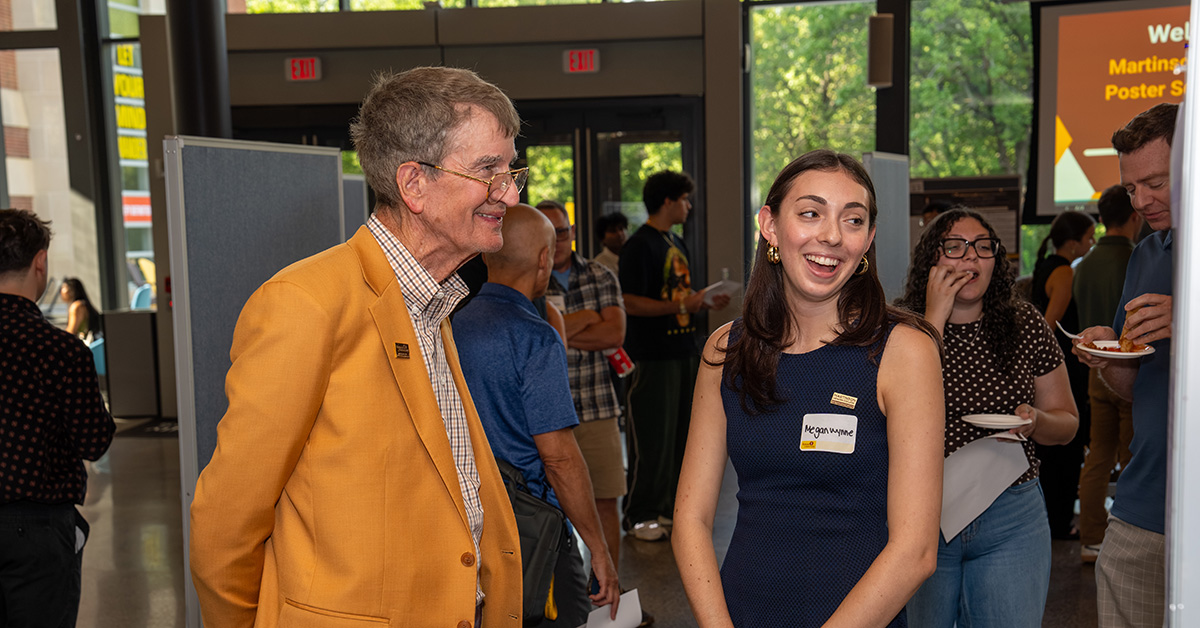
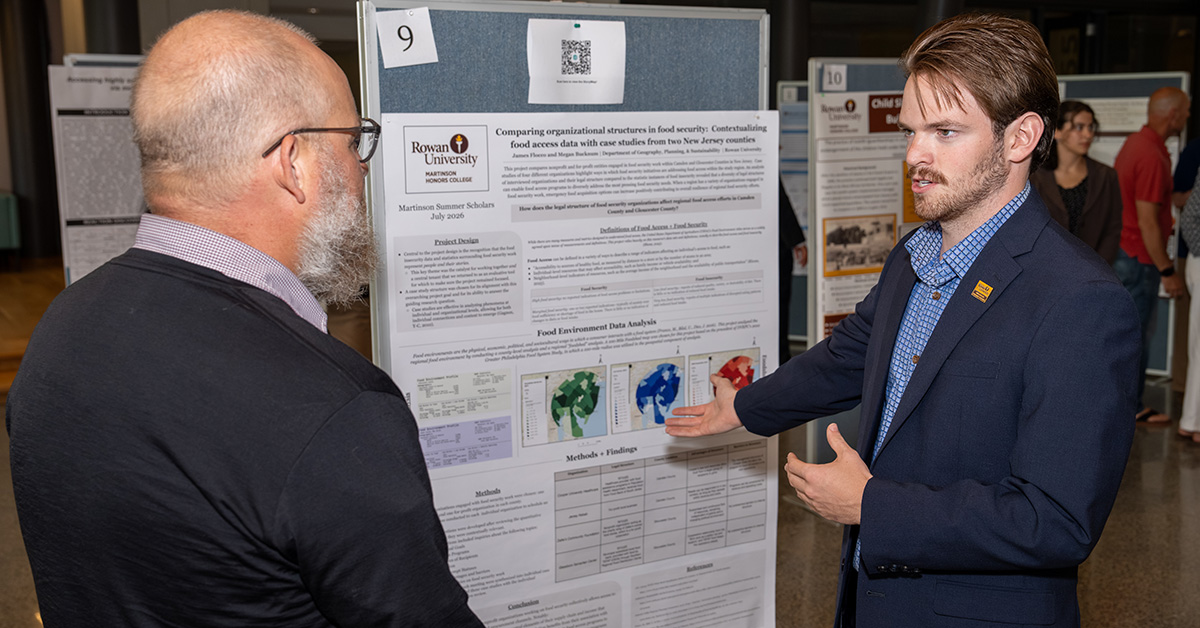
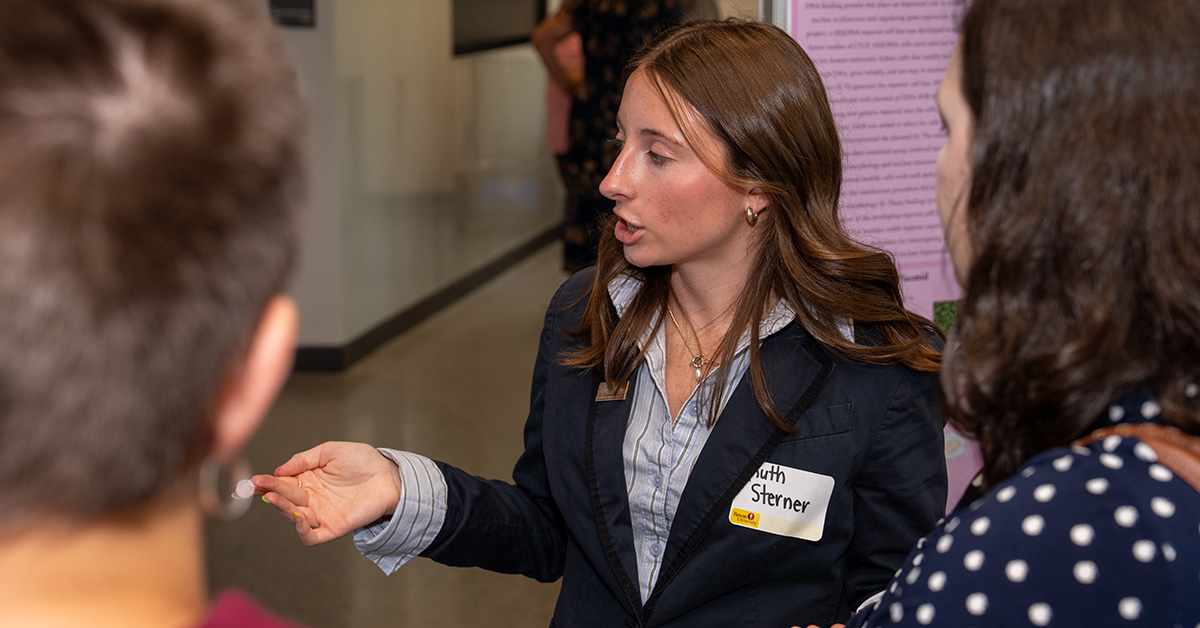
Longtime Rowan supporter John Martinson listens to Megan Wynne's research discussion during the Martinson Summer Scholars presentation on July 29. Below, honors students present their research findings to guests at the Student Center Expansion.
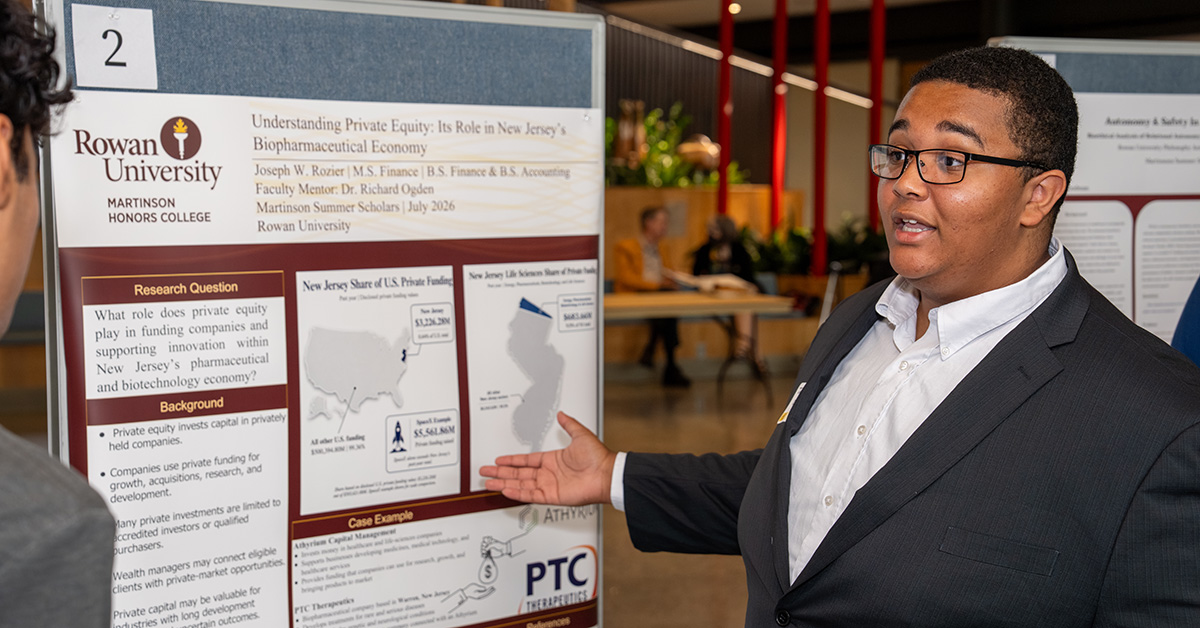
Biomedical engineering major Liam Murphy spent hours working to perfect his research poster for his 2026 Martinson Summer Scholars presentation on July 29. It was the culmination of 10 weeks of his work this summer with Erik Brewer, Ph.D., on a hydrogel to address degenerative disc disease in the spine.
The rising junior’s experience in Brewer’s wet lab inspired the honors student to conduct further experiments on the project throughout the coming year.
“I like working in research,” Murphy said, “because it is challenging and makes me think deeper and ask the hard questions.”
Twenty-two students pursuing the Bantivoglio Honors Concentration in the John H. Martinson Honors College received financial support this summer to focus on projects ranging from AI-directed drones designed to monitor local farmers’ crops to research examining prison personnel’s perspectives on capital punishment. Students representing majors across the humanities, education, science, engineering and business presented their findings to Rowan University faculty, friends, family members and Martinson, the college’s benefactor.
Students learn that academic research takes time, said Honors Faculty Fellow Emily Hyde, Ph.D., who oversees students in the program.
“It requires persistence, patience, learning to ask questions and to be comfortable with uncertainty,” Hyde said. “Many students wrote to me this summer to say that what they were learning was how to find meaning and reward in the process of research, not in a prescribed result.”
“Mentorship is at the heart of what we do,” Hyde added. “Faculty work directly with students, introducing them to academic research methods in their field and building relationships that often continue long past the summer.”
Research experience gives students better opportunities for scholarships, internships and, ultimately, careers, noted Martinson Honors College Dean Lee Talley.
“The students are doing cutting-edge research as freshmen and sophomores—and they’re getting paid to do it,” Talley said. “They don’t have to take the summer job they don’t really want to do. They can do something that’s meaningful to them and position themselves better for their future careers.”
Inclusive education major Aubrey Smith focused her attention on the correlation between childhood trauma and attention-deficit/hyperactivity disorder, which piqued her interest during her first semester at Rowan while in a psychology course taught by Katherine Gotham, Ph.D. She reviewed research publications and found significant parallels between children exposed to trauma and those diagnosed with ADHD.
Her review found a potential connection between the two, said Smith, who aims to become a special education teacher like her mother.
Laura Shaban, a triple major in history, education and international studies, examined handwritten records kept on child slavery and emancipation in Senegal between 1890 and 1910. An aspiring educator, Shaban worked under the guidance of her mentor, Kelly Duke Bryant, Ph.D.
“Getting to do hands-on work as a history student is an opportunity that I definitely do not take for granted,” Shaban said. “It’s not super common to be able to do primary source research to the extent that I’ve been able to.”
“Being a part of this program has been one of the most rewarding experiences of my college career,” Shaban added. “I’ve appreciated having the opportunity to be a part of it.”
Jimmy Flocco, a dual major in geographical information science and philosophy, presented his work comparing the structures of for-profit and nonprofit organizations addressing food insecurity with food access data. With his faculty mentor, Megan Bucknum, Flocco searched for ways to build stronger communities with improved access to food. They found that when both for-profit and nonprofit organizations are involved in food security efforts, regions have more options for obtaining emergency food supplies, strengthening the overall resilience of the food system.
“I would recommend this program to anyone who is even moderately interested in research,” Flocco said. “This is a learning experience which is necessary for anyone looking to build a professional career.”
Ava Santiago, a dual political science and psychology major, proposed her research on prison personnel’s attitudes toward capital punishment during her sophomore year. To understand their coping mechanisms, the aspiring law student spent weeks this summer reading and listening to audio recordings of interviews with people tasked with carrying out state-mandated executions.
“It definitely was a tough topic to read about,” said Santiago, who worked under the guidance of Jeanna Mastrocinque, Ph.D. “But I think it was worth it.” Her research suggests that longtime employees who have adopted more coping mechanisms into their thinking may experience the lowest number of negative effects from their work, a hypothesis that could lead to future research.
A longtime University supporter, Martinson spent time speaking with each student and listening to each presentation. He said he was pleased by their enthusiasm for their research.
“I do want to encourage undergraduate research,” Martinson said. “I’m a believer you should start that much earlier in life and get a taste of it. It may lead to a grad school career or it may help you appreciate what other researchers are doing.”