Q&A: Inside Rowan University’s first year of veterinary education
Q&A: Inside Rowan University’s first year of veterinary education
August 18, 2026
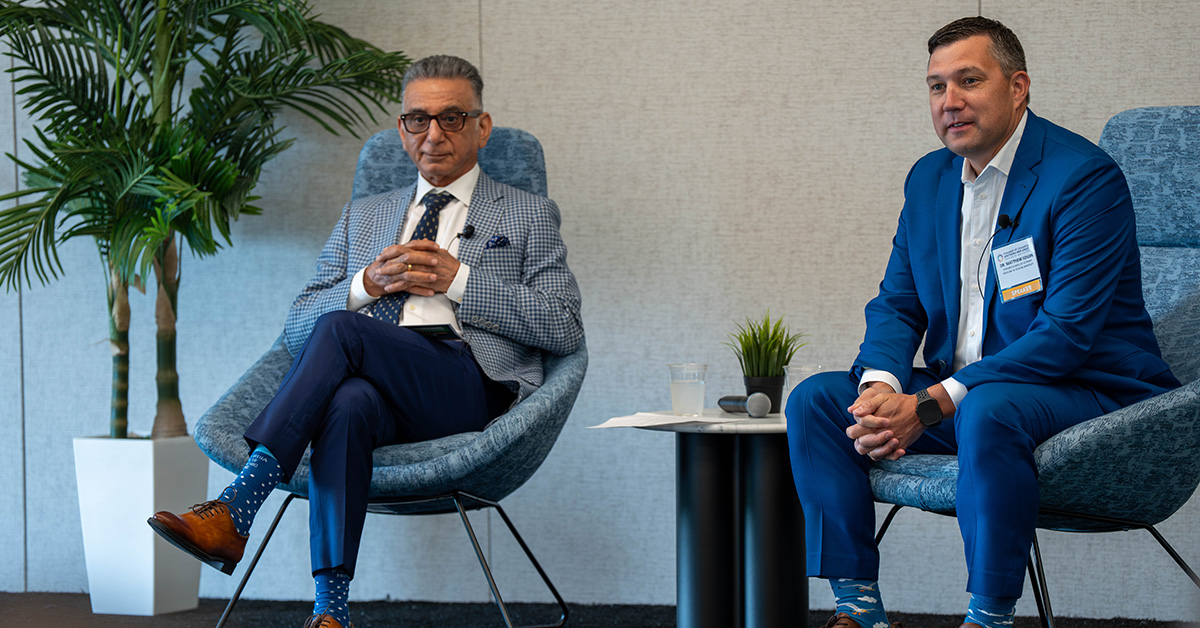
From left, Rowan University President Ali Houshmand and Founding Dean Matthew Edson discuss the first year, mission and future of Shreiber School of Veterinary Medicine.
The Chamber of Commerce of Southern New Jersey held a special “Executive Series” event on Tuesday, hosted by TD Bank, celebrating the growth of New Jersey’s only veterinary school, the Shreiber School of Veterinary Medicine of Rowan University. President Ali A. Houshmand interviewed Founding Dean Matthew Edson about the school’s first year, its mission and the future of veterinary education in the state.
The following interview has been edited for length and clarity.
Q: Take us back to opening day. What moment from that first week stayed with you the most?
EDSON: This has really been a wonderful, wonderful experience watching this program grow, but we spent at least six plus years just in the planning stages. And early on, it was me. And then two of us and then three of us. And even as our team grew, what was really missing was the students. And to see all of the students walk in on that very first day, it really made this whole place feel like an actual vet school. It wasn't an empty building anymore. We worked all that time for that group. And just to have them here and see how excited they were to be here with us, that for sure—and I think for the entire faculty—was probably the biggest memory from our opening day.
Q: Affordability was a major reason for creating this school. How is that mission playing out?
EDSON: Many New Jersey students previously had to leave the state—and often the country—to pursue veterinary education, paying significantly higher tuition. I probably paid three times what my Kansas State cohort friends did because they had in‑state tuition.
Lower tuition doesn’t just reduce student debt—it expands graduates’ career options, allowing them to pursue fields like equine or cattle medicine that traditionally struggle to attract new veterinarians.
HOUSHMAND: Donor support, including a major gift from Mr. Gerry Shreiber, will become a long‑term source of scholarships. My focus when approaching prospective donors is singularly for student support. Student debt in this country right now stands at $1.7 trillion.
Q: What surprised you most about running a brand-new veterinary school?
EDSON: Every day is a new and exciting surprise.
I think one of the biggest surprises we had the very first week while we're moving in that two-week period, we ordered a bunch of anatomical and clinical skills models from Canada, which we never opened because we had to order them a year and a half in advance. We put them in storage and we said, "All right, we're going to move them into the building today." Well, it turns out that an anatomical model of a cow is too big to fit through a standard doorway.
We didn't plan for that. So we had to cut out one of our nice new Sheetrock walls and we put the cow through the wall and then put the wall back together. Things you probably wouldn't expect to be the opening issues for a dean of a vet school, but we had to overcome a lot of those little surprises along the way.
Q: The curriculum was designed to be hands-on from day one. How has that worked in practice?
EDSON: I think we have a challenge in medical education because we have a four-year program after a student gets a bachelor's degree, but we have like a hundred more years of knowledge to share since it's a four-year program. So there's a tendency to shove all of that knowledge into the same amount of time, which I think sometimes takes away from the ability of the student to do something really basic, like communicate with a client or put in an IV catheter or listen for a heart murmur.
We've been very intentional here to not take away the core of what makes someone a good doctor and what makes them able to leave this program and start the first day and act as a competent, entry-level veterinarian. So we've really focused on those hands-on clinical skills, not just with our model cow, but with live animal partnerships too.
We have those all across the state of New Jersey from a dairy right here in Gloucester County to animal shelters that are scattered all through the southern part of the state to large equine hospitals in North Jersey. We have a sheep farm in Burlington County with 200 sheep. So we've made all these partnerships with places that have animals our students can get hands-on experience with.
Our students get to go and help the farmers with the production tasks that they're doing there while learning hands-on skills. And it really has gotten them out into the community, as well, to make those connections because it’s not just the “talking to clients” or the hands-on clinical skills, but having connections in that community is a really wonderful asset for students who are graduating as a New Jersey student wanting to practice in New Jersey.
Q: How does your private practice background shape your decisions as dean?
EDSON: I have to hire the products of veterinary education. I was maybe not always thrilled with my options. My industry perspective drives the school’s focus on producing graduates who are immediately competent, confident and marketable.
Q: The teaching hospital treats everything from pets to exotics. What case best captures what makes this place different?
EDSON: We have a lot of very state-of-the-art equipment here. We have a lot of wonderful specialists who have done postgraduate training in all sorts of different areas from cardiology to dentistry and exotics.
When your pet frog needs bladder surgery, we have the expertise and the equipment here to do that that may not exist somewhere else. So every day is a new and exciting day with new and exciting cases, whether it be general practice cases or cases that are going through all of our fancy imaging equipment, the CT and the MRI that we just started last week.
You’re not going to find many places that are doing bladder surgery on a three‑inch frog.
Q: Are students planning to stay and practice in New Jersey?
EDSON: I think so. We even have some students that have come here from out of state who have become residents since they enrolled in the program. So I think New Jersey really is a wonderful place. Many students have become state residents since enrolling. We have students from 19 of the 21 counties.
Community engagement programs, including an emergency response team, help root students in the region.
Q: What will the second year look like?
EDSON: The second year is a little bit of a change from the first. The first year is basically all of the normal things. And then second year is all the abnormal things.
Third year, we return to making the abnormal normal again. And then our fourth year is 13 months in the clinic where they do that hands-on in a hospital setting.
I think the second year for a student is going to be a little more like what they were hoping for in that school, disease processes and all the stuff that's not physiology and anatomy that are more core science.
I think the other surprise for our first-year class is there were 75 of them, but they're getting 100 new friends, because we have 90 new D.V.M. students and 10 new master's students joining us on Monday.
Q: What do you envision this school becoming in 10 years?
EDSON: Rankings aren’t the focus. For us, this is really about giving students a good educational experience. The rankings follow that in time.
I expect the program to evolve with emerging technologies, including artificial intelligence, while staying true to its mission.
HOUSHMAND: Rowan University’s Shreiber School of Veterinary Medicine is redefining what a modern veterinary program can be—hands‑on, affordable, community‑rooted, and forward‑looking. The school embodies Rowan’s ethos: “We dream, and then we make it happen.”