Helping bones heal: Researchers turn lab discovery into startup
Helping bones heal: Researchers turn lab discovery into startup
August 19, 2026
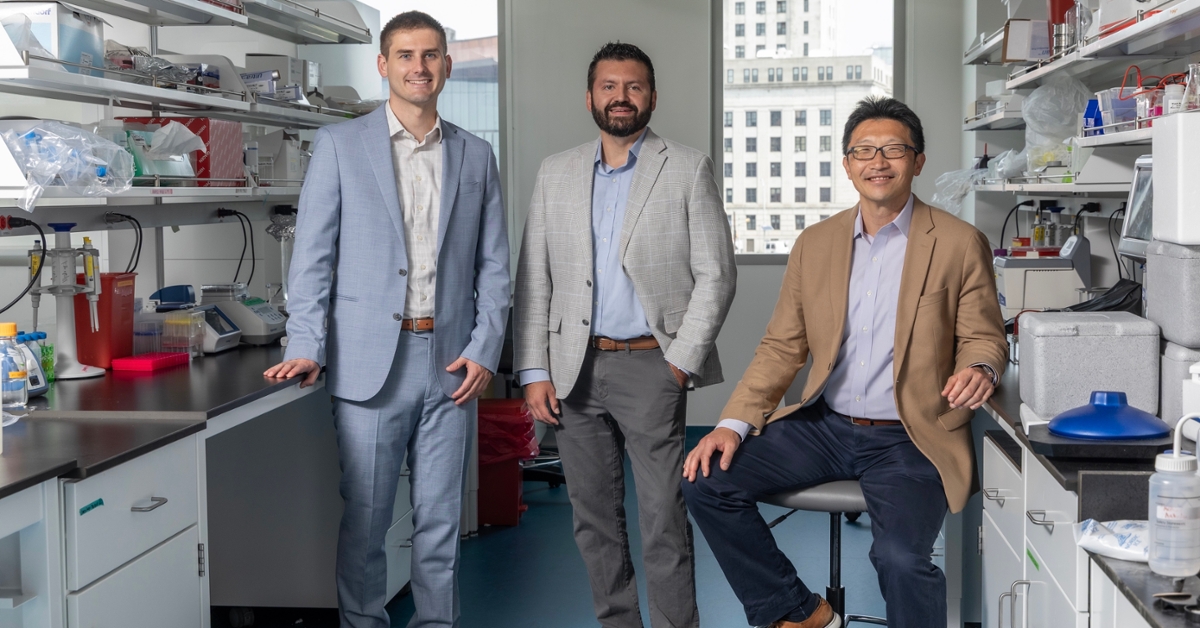
The HydroPep Therapeutics research team (from left): Matthias Recktenwald, Sebastian L. Vega and Tae Won B. Kim.
A team of Rowan University and Cooper Medical School of Rowan University researchers is turning collaborative research into a startup focused on helping bones heal faster and more effectively.
HydroPep Therapeutics is developing an injectable material designed to stimulate new bone growth and improve healing after fractures. The startup was co-founded by Sebastián L. Vega, Ph.D., an associate professor of biomedical engineering at the Henry M. Rowan College of Engineering, and Tae Won B. Kim, M.D., an associate professor of orthopaedic surgery at Cooper Medical School of Rowan University and research director in the Department of Orthopaedic Surgery at Cooper University Health Care.
The company grew out of a research collaboration that began in 2018, when Vega started working with Kim to address osteoporosis-related fractures in older adults.
A problem worth solving
Osteoporosis weakens bones and increases the risk of fractures. Worldwide, about one in three women and one in five men over age 50 will experience an osteoporosis-related fracture. These injuries can lead to long recoveries, loss of independence and other serious health complications, particularly for older adults.
The researchers set out to address that problem with an ambitious question: “Can we develop a local therapeutic to prevent or help minimize the risk of osteoporosis-related fracture?” Vega asked.
Initially, Vega and Kim envisioned an outpatient treatment that could strengthen bones before fractures occurred. As they spoke with patients, physicians and other stakeholders through the National Science Foundation’s I-Corps program, however, they identified another pressing need: helping broken bones heal more effectively.
“What we realized through those interviews and through our customer-based research is that prevention is great, but a lot of the bigger pain points are for patients that have already sustained a fracture,” Vega said.
The team shifted its focus to accelerating fracture healing and preventing nonunion, cases in which broken bones fail to heal properly. According to Vega, as many as 10% of long-bone fractures can result in nonunion, often requiring additional treatment and prolonged recovery.
Harnessing the body’s healing signals
HydroPep's lead product, HydroBone, takes a targeted approach to bone repair using peptides, small protein fragments that can signal cells to form new bone.
The researchers use peptides rather than full-sized proteins, which can spread beyond the treatment area and sometimes cause unwanted side effects. The peptides are designed to mimic the effects of bone morphogenetic protein-2, or BMP-2, a molecule used in some bone surgeries to stimulate bone growth.
To deliver those signals, the researchers created HydroBone, an injectable hydrogel that forms a scaffold at the treatment site. Once injected, the material conforms to the surrounding space and helps keep the peptides localized where healing is needed. The technology is designed to work alongside existing surgical procedures rather than replace them.
The team envisions surgeons injecting HydroBone directly into a fracture site during surgery alongside existing hardware and surgical techniques used to treat long-bone fractures.
“Instead of using hardware exclusively and relying on the body's ability to regenerate bone, we also introduce this biochemical approach that gives the body a little boost to say, ‘Make bone here. Do it quicker. Do it better,’” Vega said.
From lab discovery to startup
The path from academic research to startup began to take shape in 2023, when the team developed and patented the technology behind HydroBone's delivery system. That work led to the formation of HydroPep Therapeutics in May 2025.
The company's growth reflects a collaborative effort among researchers, Cooper University Health Care and Rowan University's Office of Technology Commercialization. Working with the Cooper Innovation Center, the team helped turn years of research into a startup focused on developing new treatments for patients.
“We're helping researchers bring promising discoveries from the lab to patients,” said Neal Lemon, associate vice president for technology commercialization and innovation at Rowan University and director of the Cooper Innovation Center.
This support helped position HydroPep to secure pre-seed funding from Foundation Venture Capital Group as it advances HydroBone through preclinical development.
Today, Vega serves as CEO, Kim serves as chief medical officer, and Rowan alumnus Matthias Recktenwald, Ph.D., serves as chief scientific officer, leading peptide discovery and preclinical development efforts.
While bone healing remains the company's primary focus, HydroPep's broader vision extends beyond orthopaedics.
“We had this epiphany,” Vega said. “Why stop here?”
That question led the researchers to look beyond bone healing. Using artificial intelligence-assisted computational screening, they can identify and design new peptides that may one day be used for other localized therapies, including cartilage repair and cancer treatment.
By combining engineering, biology and clinical expertise, the team hopes to transform discoveries made in the lab into treatments that improve patients' lives.