Repairing damage in minutes: Rowan researchers advance composite repair
Repairing damage in minutes: Rowan researchers advance composite repair
July 1, 2026
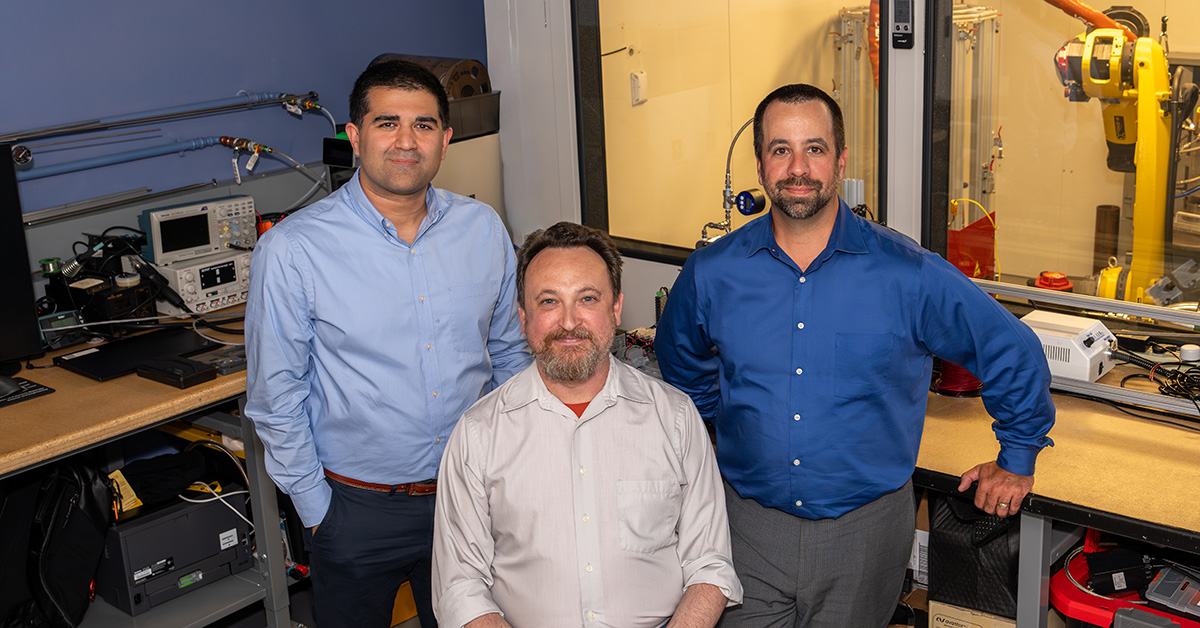
From left: Behrad Koohbor, Ph.D., Francis M. Haas, Ph.D., and Joseph F. Stanzione III, Ph.D., stand in the Cold Spray Lab at Rowan University’s Henry M. Rowan College of Engineering. The team leads research on advancing cold spray technology, a key area of study at the Advanced Materials & Manufacturing Institute, directed by Stanzione.
Rowan University researchers have demonstrated a new method for repairing damage in advanced composite materials, offering a faster, more effective alternative to conventional repair techniques used in industries such as aerospace, automotive, infrastructure, maritime and energy production.
In a recent study published in the Journal of Thermal Spray Technology, a multidisciplinary Rowan-led team investigated the use of polymer cold spray to restore the strength of glass fiber-reinforced polymer composites after impact damage. These lightweight materials are widely used for their strength and durability but are vulnerable to impact-induced damage that can reduce performance and lead to catastrophic failure over time.
“If you start to break a composite, it acts sort of like a zipper,” said co-author Francis Haas, Ph.D., an associate professor of mechanical engineering at the Henry M. Rowan College of Engineering. “One fiber breaks and then another fiber breaks. The fibers that are left have to carry all of the load. If there’s a big gust of wind or some other force that’s applied, they can unzip catastrophically.”
To address this, the team examined a repair method using cold spray, a process that deposits fine polymer powders onto a damaged surface without high heat. Though widely used in manufacturing, finding a cold spray method for making on-site repairs to damaged composite materials has posed a major challenge for years.
The researchers developed a specific method of cold spray application that can recover a significant portion of a material’s lost mechanical strength by acting something like a dental filling. In cases of shallow damage, their method restored up to 80 percent of the material’s original strength, and about 40 percent in most severe cases.
Across all conditions tested, the team’s cold spray approach outperformed traditional resin-based repair methods in both effectiveness and speed. While conventional repairs may require up to 48 hours to cure, the cold spray process can be completed in roughly 30 minutes, making it especially attractive for rapid, on-site repairs.
The study also showed that material choice matters. An epoxy-based powder reinforced with chopped glass fibers consistently delivered the strongest results, improving both the recovery of mechanical properties and the ability of repaired materials to withstand additional impacts.
The research was led by Behrad Koohbor, Francis M. Haas and Joseph F. Stanzione III in Rowan’s Henry M. Rowan College of Engineering, with significant contributions from students in the Department of Mechanical Engineering, the Department of Chemical Engineering and the Advanced Materials & Manufacturing Institute. Rowan researchers played central roles in designing experiments, fabricating test samples, conducting mechanical testing and analyzing how the repair materials bonded to composite structures.
The project also included collaboration with Isaac Nault and Tristan Bacha of the U.S. Army Research Laboratory, bringing together academic and federal research expertise to address challenges in materials durability and repair.
Potential applications for this technology range from wind turbine blades and pipelines to aircraft structures and composite vehicle components—anywhere lightweight composite materials are used and subject to wear or impact damage.
The research was sponsored by the Army Research Laboratory (ARL) and was accomplished under Cooperative Agreement Number W911NF-19-2-0152. Additional support was provided by a Wind Institute Fellowship funded by the New Jersey Economic Development Authority through Rowan University. PPG Industries supplied key materials used in the study and Rowan’s Advanced Materials & Manufacturing Institute provided research infrastructure and support.
The views expressed are those of the authors and do not reflect official U.S. Government policy. The U.S. Government is authorized to reproduce and distribute this material.