How cells respond to electrical cues and what it means for human health
How cells respond to electrical cues and what it means for human health
June 11, 2026
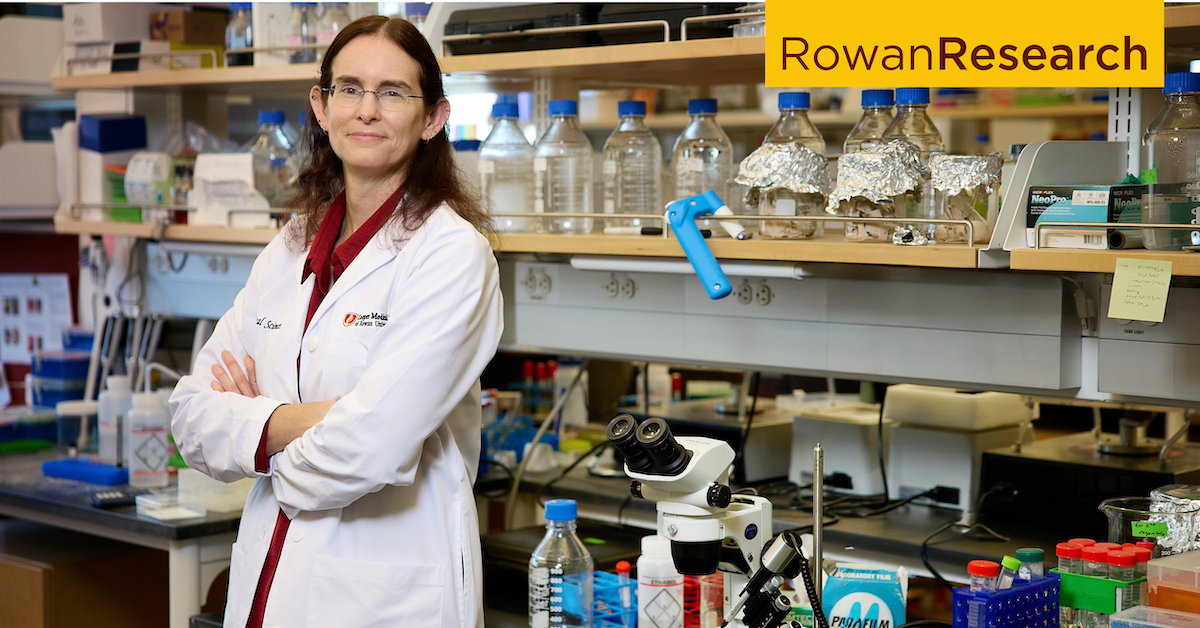
Susy Kohout studies electrical and chemical cell signaling, focusing on a little-understood protein that may influence cell movement and cancer spread.
Susy Kohout, Ph.D.
Biophysicist
Areas of expertise:
Biophysics, cell biology, electrical and chemical cell signaling
It’s fairly common knowledge that the human brain is electrical, meaning its cells communicate through tiny bursts of electricity. But what about, say, the pancreas?
“All of our cells are electrical to some degree,” says Susy Kohout, Ph.D., an associate professor in the Department of Biomedical Sciences at Cooper Medical School of Rowan University. “All cells use chemical signaling, and all cells use electrical signaling.”
Kohout’s research, funded by the National Science Foundation (NSF), focuses on voltage-sensing phosphatase (VSP), a unique protein that bridges both types of cell signaling at once—and has implications for human health. VSP, which reads an electrical signal and then changes a cell’s chemistry, was discovered more than two decades ago, but still confounds scientists.
“That’s what gets me up in the morning,” says Kohout, a 2025 Fellow of the American Association for the Advancement of Science (AAAS), one of the world’s largest general scientific societies. “We still don’t know why we have this wacky protein that fits two pathways that we never thought interacted with each other.”
Her theory—that VSP is involved in electrotaxis, or how cells move along an electrical field—points to a connection between the protein and cell migration. If that’s the case, then VSP might have implications for cancer metastasis, which is when cancer cells spread to other parts of the body from the original tumor site. While she works to test her theory, Kohout and members of her lab are collaborating with researchers at the Camden Cancer Research Center to study VSP in relation to melanoma and breast cancer.
“The most immediate health implication is in cancer,” Kohout says. “But I think there are going to be a lot of possibilities.”
Rowan University researchers are passionate about what they do. Find more at Meet Our Researchers.
This material is based upon work supported by the NSF under Award No. 2310489. Any opinions, findings and conclusions or recommendations expressed in this material are those of the authors and do not necessarily reflect the views of the NSF.