Study seeks more accurate climate metrics for New Jersey’s wetland restoration projects
Study seeks more accurate climate metrics for New Jersey’s wetland restoration projects
May 6, 2026
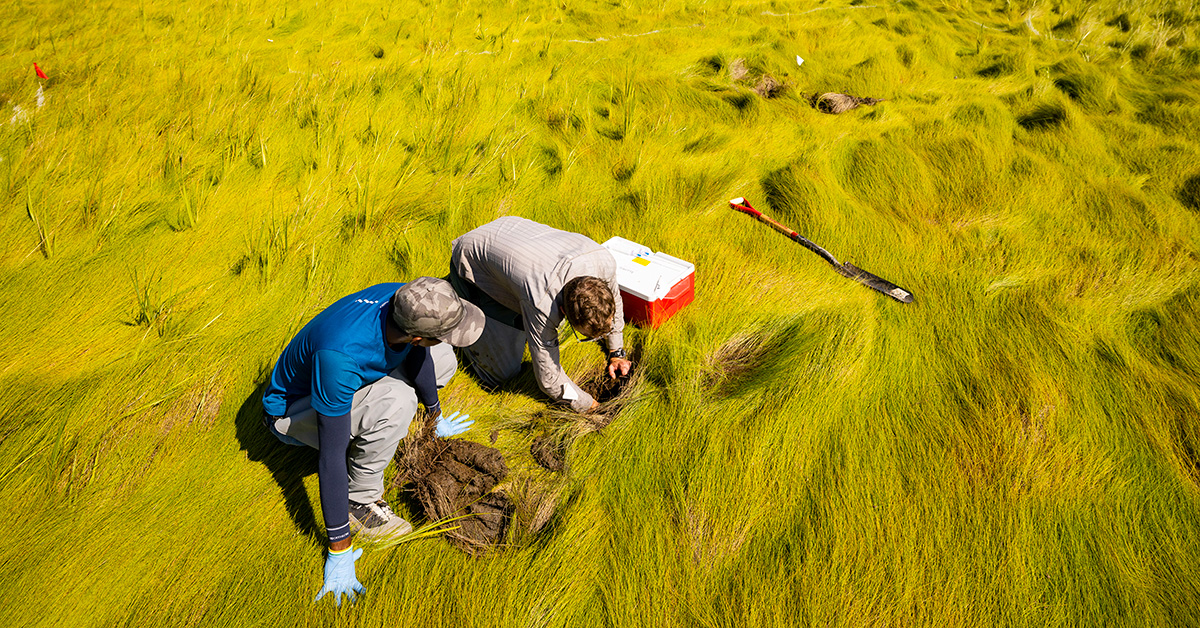
Charles Schutte, Ph.D., (right) and a student collect soil samples in the salt marshes of the Edwin B. Forsythe National Wildlife Refuge, near Stafford Township, N.J.
Marshes are underappreciated ecosystems that protect New Jersey’s shoreline from storms and floods, provide habitats for fish and waterfowl, and offer both economic and recreational opportunities for humans. But there’s another reason scientists are working to restore these tidal wetland ecosystems: they have a unique potential to combat climate change.
“There's a relatively recent push, in New Jersey and globally, to restore these ecosystems because they can take carbon dioxide out of the atmosphere and bury it in their soil,” said Charles Schutte, Ph.D., associate professor in the Department of Environmental Science at the School of Earth & Environment.
The result of burying carbon beneath the soil could be a long-term cooling effect on the Earth’s atmosphere—but it depends on what Schutte refers to as the “radiative balance,” or the overall effect that restored marshes can have on the greenhouse gas concentration in the atmosphere. This effect is complex, and the most widely used calculations fail to consider every factor.
With a four-year, $500,000 grant from the New Jersey Department of Environmental Protection, Schutte is developing a method to assess all of the factors that determine whether these ecosystems have a net cooling or net warming effect.
Beyond flood protection: Marshes as carbon sinks
Carbon burial is only one component of the overall radiation balance. Yet decisions to restore these wetlands are made based solely on carbon burial, ignoring other important factors. Methane release from plants and microorganisms in these ecosystems can counteract the carbon burial benefits. Groundwater discharge can also affect the radiative balance.
“Looking at all of these components together can help us make decisions about future restoration projects with more confidence,” Schutte said. “If we don't quantify every part of the radiative balance, estimates could be off by 30 percent.”
While scientists believe these wetlands have an overall cooling effect on the atmosphere, certain components of the radiative balance could result in a warming effect in individual ecosystems, instead.
The processes for measuring the full range of these components aren’t built into the calculations currently used to decide what wetlands restoration projects to undertake. Schutte and his team are bringing together the distinct sets of tools and expertise needed to measure each component into one framework.
Measuring carbon, methane and groundwater
Researchers will collect soil samples to understand how quickly carbon is being buried underground in these ecosystems. To assess the impact of groundwater discharge, they will measure the chemical composition of the groundwater and surface water. Using a highly precise field-based greenhouse gas analyzer, researchers will measure the concentration of carbon dioxide and methane in the air.
It can take years to see the impact of restoration efforts on these ecosystems. By comparing restorations in progress with mature sites with similar features, the researchers can see the effects of restoration in different wetland ecosystems much sooner.
Supporting Schutte’s research are co-principal investigator Lauren Kipp, Ph.D., assistant professor in the Department of Environmental Science, and collaborators at the NJDEP Division of Science & Research, the nonprofit Partnership for the Delaware Estuary and the U.S. Department of Agriculture Natural Resources Conservation Service.
Over the course of the project, numerous students in Schutte’s lab will collect water and soil samples, gather greenhouse gas measurements, analyze samples and interpret data.
“The data we’re generating will have an immediate, measurable impact on how we address environmental issues,” Schutte said. “The state is investing a lot of money in these efforts, and we need to know these investments are working.”