Rowan students earn NSF Graduate Research Fellowships to explore health, environmental and planetary research
Rowan students earn NSF Graduate Research Fellowships to explore health, environmental and planetary research
May 21, 2026
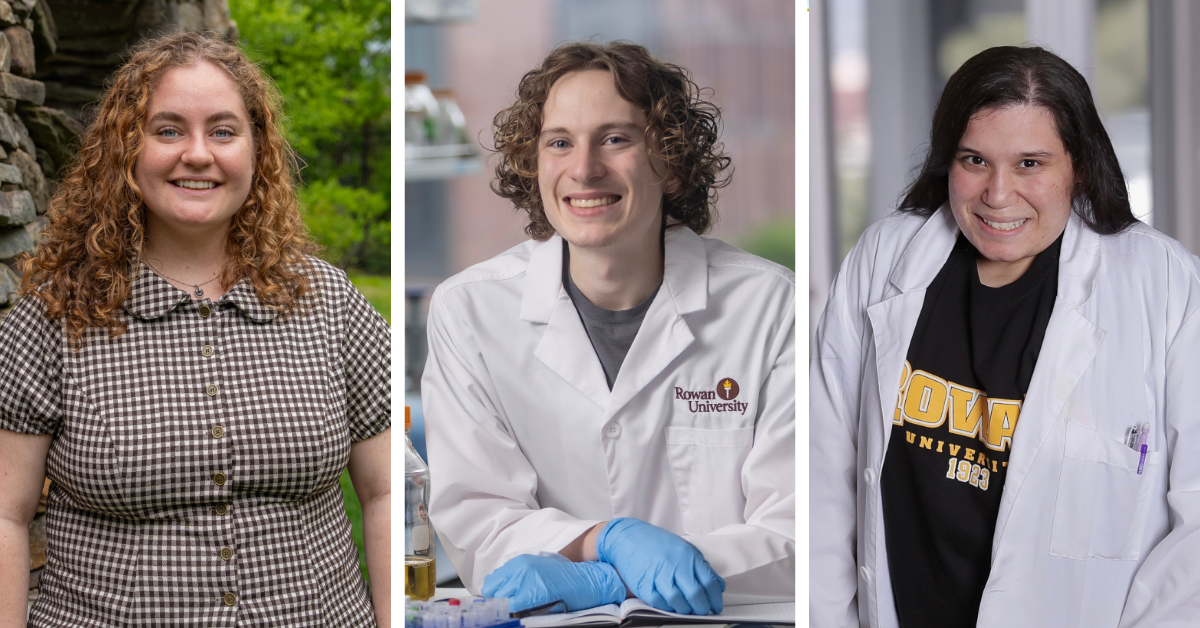
From left, NSF Graduate Research Fellows Scarlett McCourt, Connor Castro and Alyssa Singer.
Three Rowan University students earned National Science Foundation (NSF) Graduate Research Fellowships, one of the nation’s most competitive awards supporting graduate research in science, engineering and related fields.
The NSF Graduate Research Fellowship Program provides three years of funding to students early in their careers whose work has the potential to advance knowledge and benefit society. This year’s recipients are studying cell therapies, how planets form and evolve and environmental contamination.
Connor Castro: Reprogramming cellular function
Connor Castro, a first-year Ph.D. student in biomedical engineering at Rowan, received the fellowship for his proposal to reprogram how cells respond to their environment. Castro was drawn to the project because it allows him to build on his background in biomaterials while learning the fundamentals of synthetic biology, an area he thinks has strong potential to create new treatments for patients.
Many diseases are caused by cells responding to chemical and mechanical cues in their environment that alter their function, creating a cycle that spirals out of control. Castro’s research proposal focuses on equipping cells with the ability to break this cycle by changing how they respond to such signals.
“It’s taking what would normally be a response like, ‘Leave me alone,’ and turning it into, ‘Hey, let’s talk,’” said Castro.
This approach could create new cell therapies that are more effective and potentially reduce damage to healthy tissue compared to current treatments.
Castro conducts his research alongside recent Ph.D. graduate Evan Hutt in the lab of Peter Galie, Ph.D., professor of biomedical engineering and associate dean for research and graduate studies in the Henry M. Rowan College of Engineering.
A Rowan alumnus, Castro conducted undergraduate research with Erik Brewer, Ph.D., associate teaching professor of biomedical engineering. He earned his bachelor’s degree in biomedical engineering in 2023 and worked after graduation, including as a biomedical equipment technician, before returning to Rowan to pursue doctoral research.
Scarlett McCourt: Exploring planetary impacts through meteorites
Scarlett McCourt, a geology major who graduated in 2026, will pursue a Ph.D. in Earth, atmospheric and planetary sciences at Purdue University. Her research proposal focuses on meteorites and what they reveal about impact events that shaped the early solar system.
When large space rocks collide with planets or asteroids, they generate extreme pressure that permanently alters the minerals inside them. McCourt studies these altered minerals to understand how violent collisions occurred and how planetary materials behave under intense conditions.
“These minerals form at different pressures and under different conditions, so based on those conditions, we can understand the impact event and how the asteroid reacted after the impact,” McCourt said.
Understanding how planetary materials respond to these forces helps scientists better interpret the history of Earth, Mars, and other rocky bodies in the solar system. Because similar pressures exist deep within planets, this research also informs models used to study Earth’s interior, earthquakes and long-term planetary evolution.
Reproducing such conditions in a laboratory is extremely difficult, making meteorites an important natural record of processes scientists cannot observe directly.
At Rowan, McCourt conducted research with several faculty members in the School of Earth & Environment, including Harold Connolly Jr., Ph.D., professor and founding chair of the Department of Geology. She has also worked with the Smithsonian National Museum of Natural History and completed a 2025 internship at the Lunar and Planetary Institute, conducting research at the Johnson Space Center.
Alyssa Singer: Finding new uses for persistent chemicals
Alyssa Singer graduated from Rowan in 2025 with bachelor’s degrees in biochemistry and biological sciences and will pursue a Ph.D. in organic chemistry at the California Institute of Technology.
Singer’s research centers on per- and polyfluoroalkyl substances (PFAS), a group of long-lasting chemicals often referred to as forever chemicals because they are extremely difficult to break down once they enter the environment. PFAS are widely used in products that resist heat, water or chemicals. This is due in part to fluorinated chemistry, which involves adding fluorine to molecules to make them more stable and durable. However, PFAS are linked to environmental and human health impacts.
Singer’s work focuses on breaking down PFAS so their chemical components can be reused to create new materials and products.
“Rather than eliminate PFAS entirely, we ultimately hope to be able to recycle PFAS that would otherwise end up as persistent waste,” Singer said.
This reuse strategy could help reduce long-term environmental contamination while preserving the benefits of fluorinated chemistry used in medicines and other essential applications.
Singer conducted undergraduate and post-baccalaureate research in organic chemistry in the lab of Gustavo Moura‑Letts, Ph.D., professor of chemistry and biochemistry in the College of Science & Mathematics, where she helped develop methods to build small molecules with pharmaceutical relevance. She plans to pursue a career in academia and eventually lead her own research lab.
Two Rowan alumni, Milo Barkow and Amari Howard, also received honorable mentions for their NSF Graduate Research Fellowship proposals. Barkow earned a degree in chemical engineering in 2025 and is currently pursuing graduate study at the Colorado School of Mines. Howard graduated in spring 2025 with a degree in biochemistry and is pursuing a Ph.D. in organic chemistry at the University of Michigan.
Together, these award recipients reflect Rowan University’s growing strength in research and graduate education. They underscore the value of hands-on experience in preparing students for advanced study and careers that address challenges in health, the environment and planetary science.