At Big Data Alliance symposium, experts examine AI’s promise and risks
At Big Data Alliance symposium, experts examine AI’s promise and risks
May 22, 2026
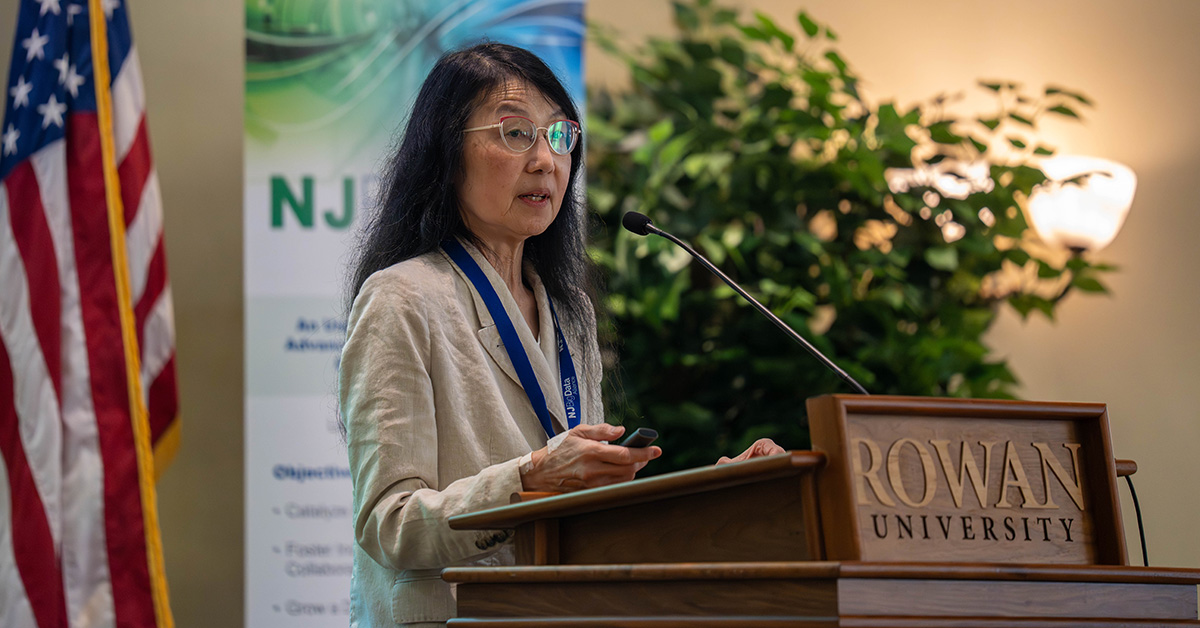
Keynote speaker Jeannette Wing, Ph.D., explains the need for further research on artificial intelligence at the N.J. Big Data Alliance symposium held Wednesday at Rowan University. Below, an industry panel discusses the real-world implications of AI.
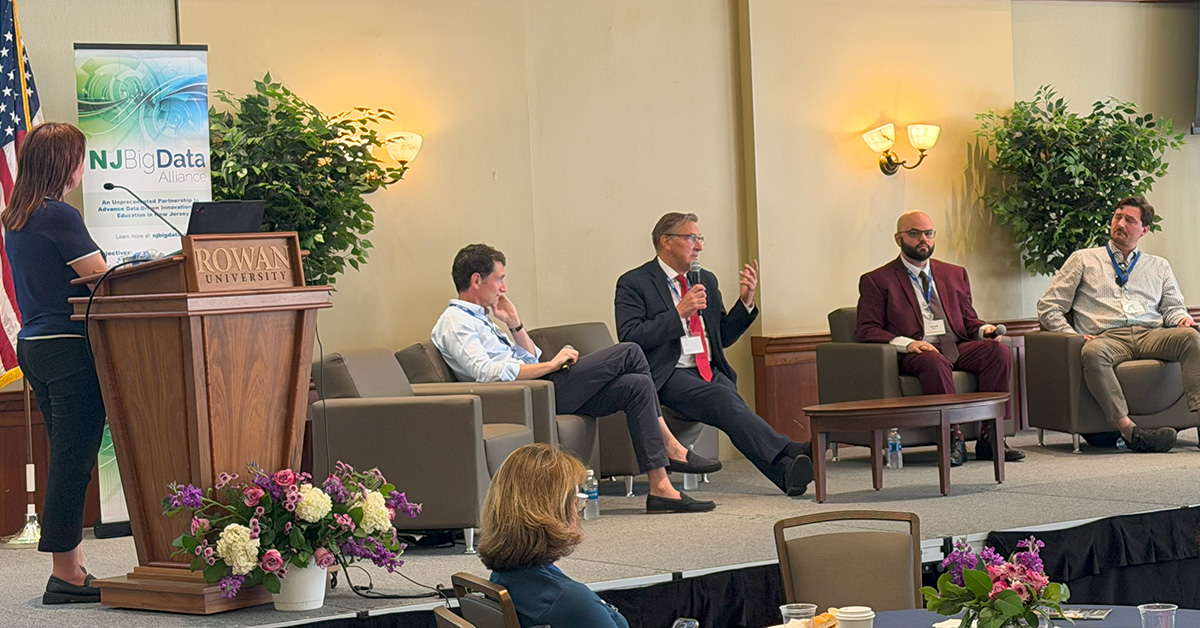
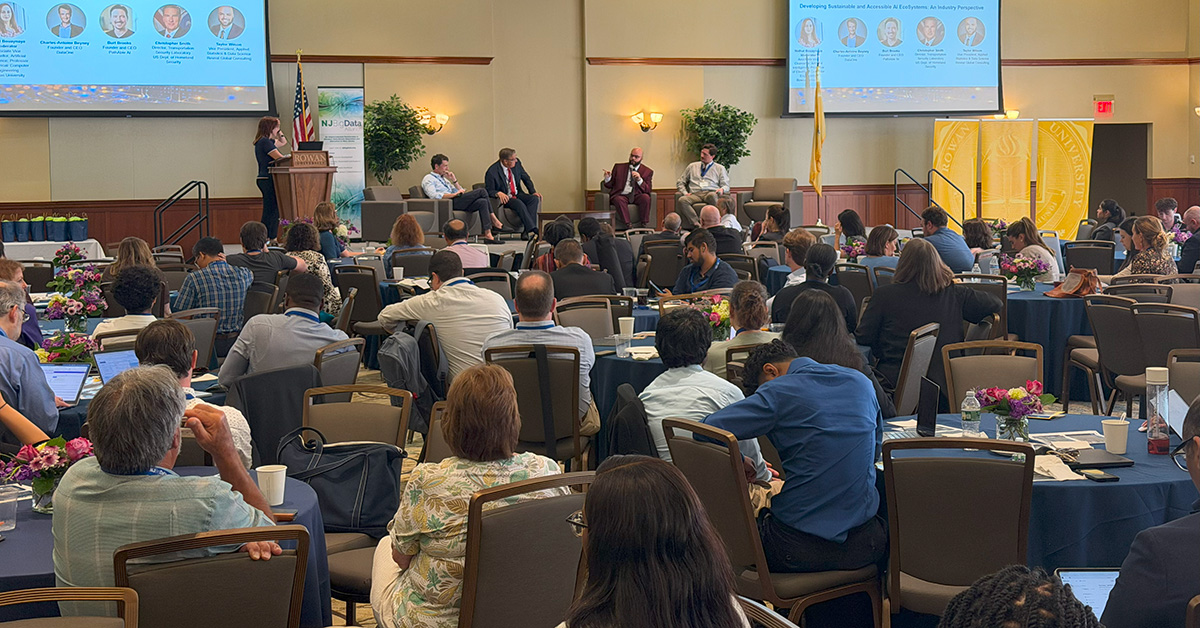
Industry and government leaders, researchers and academics gathered at the 13th annual New Jersey Big Data Alliance symposium Wednesday, where they explored the growing promise—and challenges—of artificial intelligence.
Established in 2013 to advance computing and data analytics in New Jersey, the alliance hosts an annual gathering to build the state’s expertise and leadership in AI. Hosted on Rowan’s campus, the event underscored the institution’s growing role as a hub for AI research and collaboration in the state.
Led by Rowan University mathematics professor and department head Umashanger Thayasivam, Ph.D., a statewide committee organized the daylong symposium, which drew about 350 attendees, including more than 80 students.
AI’s growing impact
Artificial intelligence—the use of machines to simulate human intelligence—is a hot topic, speakers acknowledged, with profound implications for humanity. For New Jersey, the stakes are especially high as industries across the state seek to remain competitive in a rapidly evolving economy.
Keynote speaker Khalifeh Al Jadda, Ph.D., director of data science at Google, called it a “transformative technology” that will surpass the internet and the smartphone in its impacts on the global economy.
“This is a general purpose technology that’s going to be embedded and integrated in each and every aspect of our lives,” Al Jadda said. “Therefore, it’s going to transform our lives the way electricity transformed our lives.”
Citing estimates of up to nearly $27 trillion in economic impact, Al Jadda said every sector of the economy will need to leverage AI. Rather than replacing humans with machines, Al Jadda argued the technology will augment human workers to increase productivity, capabilities and innovation. Meanwhile, companies and even entire countries are striving to meet those expectations in a race toward their own AI revolution.
“There’s a huge demand and there is a lack of supply because there are not enough compute data centers,” Al Jadda said. “Suppliers can’t keep up.”
Building trustworthy AI
AI can benefit society—that’s why so many people want to use it, said another keynote speaker, Jeanette Wing, Ph.D., executive vice president for research and professor of computer science at Columbia University. From improving cancer detection to the advent of self-driving cars, the technology offers innovations that will help humans.
Even while industry leaders have embraced AI, scientists haven’t yet answered important questions about the technology, Wing explained. She outlined key unknowns about how AI makes decisions and how researchers are working to develop trustworthy technology to address human concerns, like fairness and equity, safety and reliability, respect for people and doing the most good.
Generative AI, she said, “ups the ante on ethics.”
“How can we deliver on the promise of the benefits of AI, but address these scenarios that have life-critical consequences for people and society?” Wing asked her audience. “In short, how can we achieve trustworthy AI?”
From ideas to implementation
Beyond the keynotes, a student poster session and research talks, industry panel discussions explored how these ideas are being applied on the ground.
In an industry panel discussion about developing sustainable and accessible AI ecosystems, company and government leaders talked about the real-world challenges involving communities and data centers.
Charles-Antoine Beyney, CEO of DataOne, said his company is building a massive AI factory in Vineland that will not impact residents’ energy or water supplies, a concern driven by the impact of older data centers in other parts of the United States. Designed for sustainability and minimal environmental impact, the factory will rely on a closed-loop water system and near carbon-free energy.
“If you do it right, you can really nullify your impact on Earth,” Beyney said. “You can always take the smart choice that takes a little bit more engineering, a little more risk. If you do it correctly, you can revamp the entire mindset of everyone.”
Students look ahead
Among those directly impacted by the day’s conversations were students.
Sean Twomey, a 2026 computer science graduate from Rowan University, walked away from the symposium with a team award for best undergraduate student poster. He was interested to hear industry leaders talk about the technology’s impact on their companies, as well as audience members who posed sharp questions about its effects on jobs and the environment.
After researching a method to integrate AI and drones to improve blueberry production in South Jersey, he’s looking for a job. For students like Twomey, the conversations underscored both the opportunity and concern around AI.
“I’m a little worried about the future, but also excited,” Twomey said. “It’s kind of uncertain right now.”