Mastering the fine art of anatomical science: Rowan-Virtua TBES graduate Hannah Sullivan
Mastering the fine art of anatomical science: Rowan-Virtua TBES graduate Hannah Sullivan
May 5, 2026
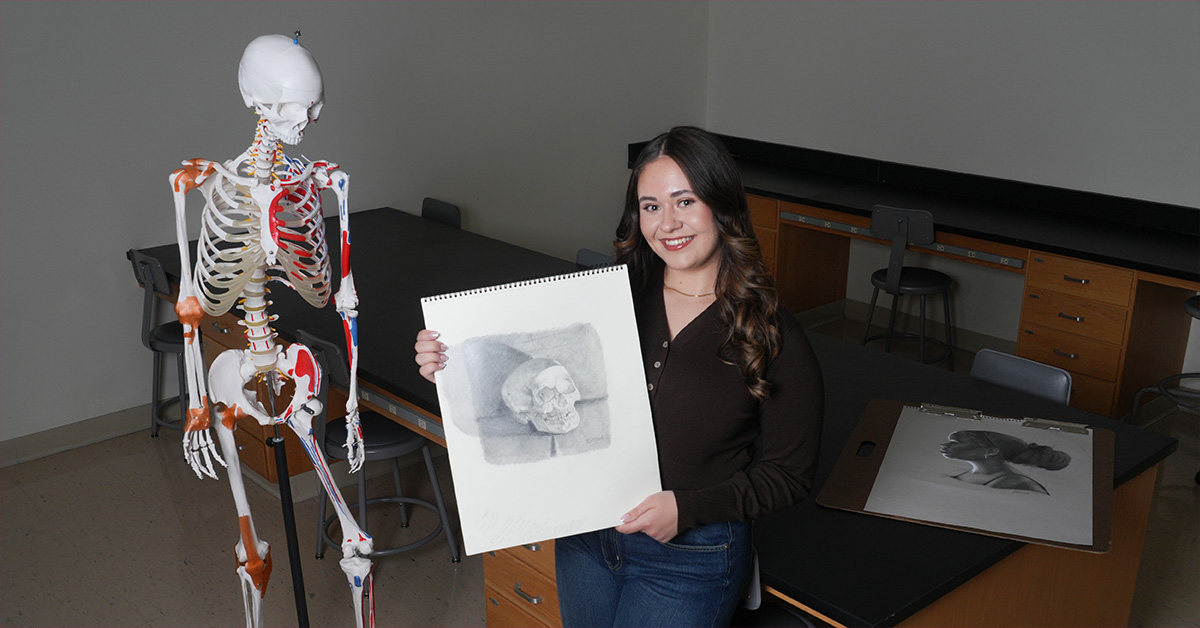
Stand in front of a mirror, turn your head to one side, and note the large, protruding muscle running from your collarbone to the base of your skull. That’s your sternocleidomastoid, which helps you rotate your head left to right.
According to Hannah Sullivan ’26, an Anatomical Science master’s student at Rowan-Virtua School of Translational Biomedical Engineering & Sciences (TBES), it’s one of the most alluring parts of the body to draw.
“It’s such a beautiful piece in portraiture, with its delicate divots that create certain colors as light reflects on it,” she says.
Sullivan has spent years studying the human body and what makes it beautiful. When she was seven years old, she began learning to paint still lifes and portraits under the tutelage of classical realist painter Rebecca Tait. A few years later, Sullivan enrolled in the emerging artist program, also taught by Tait, at Studio Incamminati in Philadelphia. There, she spent eight hours every Saturday learning to capture the contours, angles, colors and essence of the human form.
“The point of it was that you can never master the human body,” she says. “The reason why a work has so much energy and life is because of the minute changes that people have; they're breathing a different way and the flesh and the color in their cheeks becomes different. And it's all these kinds of very specific changes that I just completely fell in love with. I love the fact that you can't master it.”
So when Sullivan began to study anatomy from a more clinical perspective as a health sciences student at Rutgers University, she brought with her a deep understanding of the superficial aspects of the body. As she learned more of how form, which she had long understood, connected to function, she found herself growing more passionate about the subject of anatomy as a whole; she continued her education at Rowan-Virtua TBES to further develop her expertise.
She’s approached her master’s program in the same way she’s learned in the studio. Instead of encapsulating who a model is through oil and canvas, she uncovers a portrait of who a donor was with a scalpel and forceps. She views the laboratory just as she would an atelier, with the mentorship between student and professor closely resembling that of an apprentice and master artist.
“I think it's important to have a one-on-one connection in your learning, even in a bigger class. Having that kind of connection and knowing that someone else is there supporting you makes you so much more motivated for yourself and for other people,” she says.
Through the program, Sullivan discovered yet another passion for anatomy: teaching all that she’s learned, both in art and in science, to others. For the past semester, she has rolled up her sleeves and served as a teaching assistant in the anatomy lab for Rowan-Virtua School of Osteopathic Medicine students, gaining hands-on experience while helping train and support future physicians. Training future doctors “can be nerve-wracking,” she says, but being able to play a role in someone’s medical education has been one of the most fulfilling parts of her experience.
“That’s kind of what made me fall in love with [teaching],” she says. “It's a privilege to teach people who want to be a doctor and help other people and so to be a small step in that is really amazing.”
After graduation, Sullivan plans to continue as an anatomy instructor, combining her love of teaching and mentorship with her multifaceted understanding of the human body. She hopes to bring that appreciation for personal connection between teacher and pupil that she developed so acutely in her training to her role as an educator.
And as a painter, she plans to further study at ateliers around the world to gain new perspectives and deepen her craft—though mindful, as she learned when she first began her journey, that the human body is a subject one can never truly master.
“My art before my graduate program versus after I feel like is very vastly different, which is so interesting to think about,” she says. “If you don’t know anatomy, you don’t even think to look at these areas; you’re focused on your eyes and nose and mouth, but it’s really the surrounding structure and foundation of the anatomy that makes [portraiture] so beautiful and lifelike.”
Every spring, Rowan University highlights one graduating student from each school and college. Read more about this year’s featured graduates. Their stories show the ambition, purpose and creative collaboration that drive all Rowan students to Defy Definition.