Rowan separation scientist receives international HTC Innovation Award
Rowan separation scientist receives international HTC Innovation Award
May 29, 2026
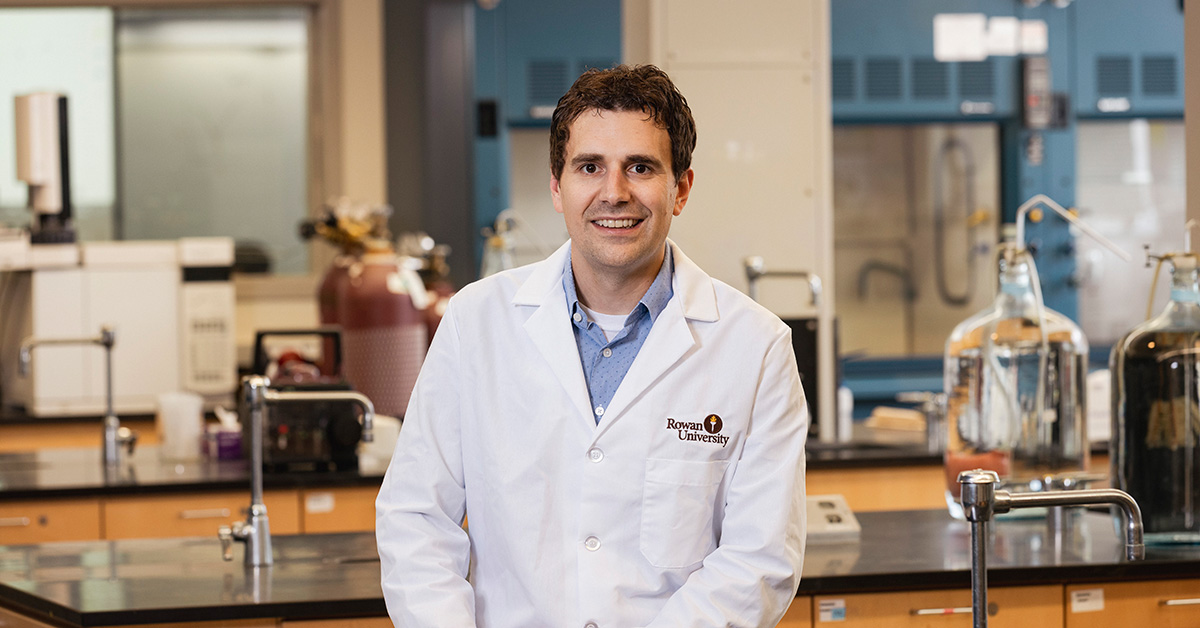
James Grinias, Ph.D., is a professor of chemistry in the College of Science & Mathematics.
James P. Grinias, Ph.D., a professor of chemistry in Rowan University’s College of Science & Mathematics, has received the 2026 HTC Innovation Award. The award was presented at the Hyphenated Techniques and Separations Technology (HTC-19) conference in Leuven, Belgium, on Friday, May 29. The award is co-sponsored by the HTC conference and LCGC International.
The HTC Innovation Award was launched by LCGC International and the HTC Scientific Committee and Industry Board in honor of separation scientists who make pioneering contributions to the field of analytical separation science, with a strong focus on applications that benefit society. At the HTC-19 award ceremony, Deirdre Cabooter, full professor at KU Leuven, Leuven, Belgium, and co-chair of the HTC-19 conference, highlighted Grinias’s exceptional contributions to the field of liquid chromatography (LC), particularly in the area of instrument miniaturization. His work has been instrumental in the commercialization of compact capillary LC systems, including integrated modules for automated sampling, sample preparation and diode-array detection.
“These innovations have significantly expanded the practical use of portable LC instrumentation, enabling applications not only in field analysis but also in routine laboratory workflows, more specifically for the analysis of highly complex samples in pharmaceutical and clinical settings,” Cabooter commented.
Separation science innovator“Grinias’s early work on the physical structure of packed beds in fused-silica capillaries led to strategies for packing more efficient columns, benefiting high resolution separations across pharmaceutical, environmental and biomedical applications,” Cabooter said.
“A major impact of this work lies in advancing sustainability in chromatographic analysis. By helping move capillary LC beyond specialized research laboratories into mainstream analytical practice, Grinias’s developments contribute to dramatically reducing solvent consumption and chemical waste associated with conventional LC separations,” Cabooter added.
Cabooter emphasized that Grinias has also played a leading role in pushing the boundaries of high-throughput LC analysis. Through the implementation of segmented-flow, droplet-based injection techniques, his research has demonstrated ultra-fast capillary-scale separations with complete analysis cycles as short as one second. This work addressed one of the longstanding bottlenecks in liquid chromatography: rapid sample introduction onto the column. By efficiently transporting segmented sample droplets directly from well plates to the analytical system, the technology enables unprecedented analytical speed.
She also highlighted that Grinias’s current developments continue to focus on automation and parallelization. Using four parallel capillary liquid chromatography ultraviolet (LC–UV) platforms operating simultaneously, Grinias and collaborators have achieved analysis methods requiring only five seconds for each complete cycle, corresponding to an average throughput of approximately 1.3 seconds for each sample. Further automation through droplet tracking and synchronized valve actuation is expected to substantially increase sample capacity and operational efficiency.
“Together, these innovations are expected to have a lasting influence on the future of liquid chromatography, particularly by enabling greener and faster analysis of large sample sets,” Cabooter concluded.
Beyond his scientific and technological achievements, Grinias is also widely recognized for his commitment to science communication and education in analytical chemistry. He has authored numerous educational publications in the Journal of Chemical Education, including work on low-cost open-source data acquisition tools for chemical instrumentation and innovative web-based learning approaches for quantitative analysis. He is also a frequent contributor to LCGC International as a writer and podcaster, and remains an active and influential presence in the chromatography community through conferences, lectures, workshops and professional events across the United States.
Grinias received his Ph.D. from the University of North Carolina at Chapel Hill in 2014 under the supervision of James Jorgenson and then moved onto a postdoctoral fellowship at the University of Michigan in Robert Kennedy’s research group until the end of 2016. He has received a number of awards for his work to date, including the HPLC 2013 Csaba Horváth Award, the 2020 Young Investigator Award from the Chinese American Chromatography Association, a National Science Foundation CAREER grant, the National Institutes of Health Maximizing Investigator’s Research Award, the 2021 Satinder Ahuja Young Investigator in Separation Science Award from the American Chemical Society, and the 2021 LCGC Emerging Leader Award. To date, he has published over 60 articles and been author or co-author on over 160 oral/poster presentations.
In addition to his research interests, James has held several service roles within the research community. He is an associate editor for Journal of Separation Science and is a regular reviewer for several other analytical journals. He has also served as the president of the Chromatography Forum of Delaware Valley and the chair of the American Chemical Society Subdivision on Chromatography and Separations Chemistry. Grinias also regularly serves on the organizing committee of the HPLC Symposium Series.
“I greatly appreciate the recognition of my nominators, LCGC International and the HTC Scientific Committee and Industry Board for this honor,” Grinias said. “Our work over the past decade in miniaturized liquid chromatography has stemmed from an outstanding collaboration with capillary chromatography leader Milton Lee. The joint efforts of our teams and many other collaborating scientists has been essential in pushing the boundaries of compact liquid chromatography instrumentation. None of this work would be possible without many outstanding mentors in chromatography over the years and the dozens of Grinias Lab members over the past decade who have been so dedicated to the work.”
The HTC Innovation AwardThe HTC Innovation Award was launched by LCGC International and the HTC Scientific Committee and Industry Board to celebrate a separation scientist who has made a pioneering contribution to the field of separation sciences by introducing new methodologies, new instrumentation, or new techniques in the field, with a strong focus on applications that benefit society.
“LCGC International is very pleased that the HTC Scientific Committee and Industry Board have awarded the prize to Jim Grinas who is widely regarded as a pioneer and innovator in separation science,” said Alasdair Matheson, executive editor of LCGC International. “Jim’s work has helped make chemical separation methods faster, smaller, more sustainable and more accessible. His research focuses on improving LC, especially ultra high-pressure liquid chromatography (UHPLC), capillary-scale chromatography and portable analytical instruments that play a pivotal role in a wide range of real-world separations that benefit society.”