Could growing crystals in space lead to better drugs?
Could growing crystals in space lead to better drugs?
May 11, 2026
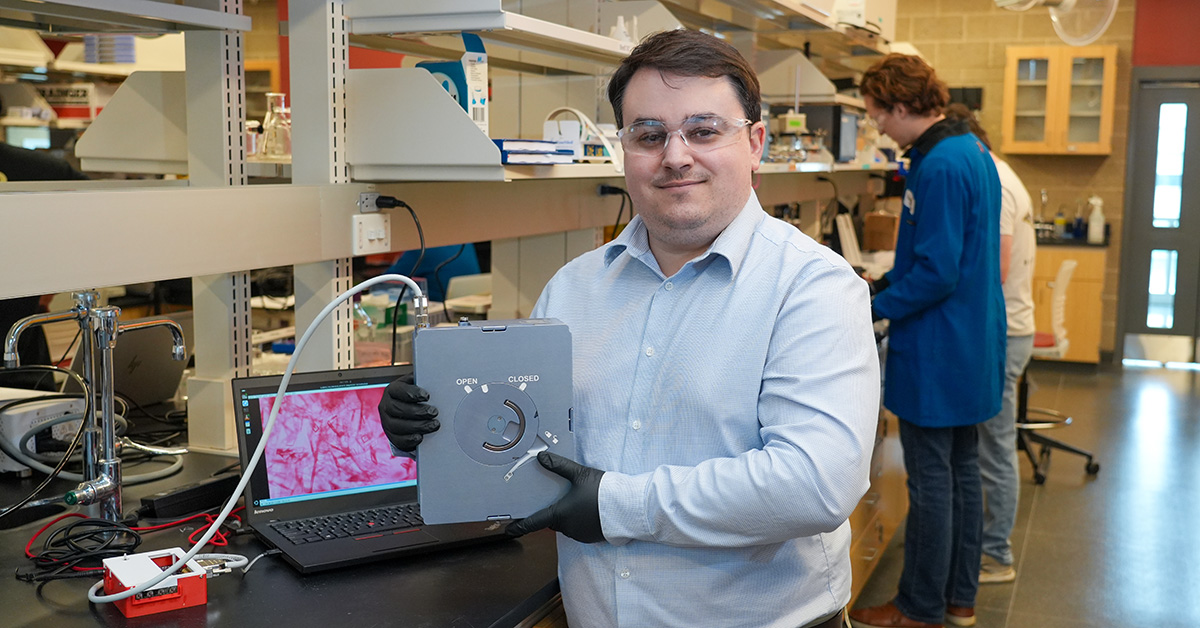
Gerard Capellades, Ph.D., holds Redwire's automated platform for growing crystals in microgravity. His experiments are scheduled to arrive on the International Space Station.
Astronauts may struggle to function without the pull of Earth’s gravity, but weightlessness isn’t always a drag. Research has shown that crystals—like those used in many pharmaceuticals—benefit from growing in space.
This week, Gerard Capellades, Ph.D., an assistant professor of chemical engineering in the Henry M. Rowan College of Engineering, plans to send crystallization experiments into Earth’s orbit aboard the International Space Station (ISS). Through this research, he hopes to better understand how microgravity (or very low gravity) affects the formation of crystals like those in tablets and powder-filled capsules, with an eye toward improving production of these drugs.
While others have crystallized drugs in space before, previous experiments have focused on crystals made of one substance. By contrast, Capellades’ experiments will be conducted inside of Redwire’s innovative, automated platform for growing high-quality protein crystals in microgravity called PIL-BOX (short for Pharmaceutical In-space Laboratory – Bio-crystal Optimization eXperiments). Capellades’ experiment will be the first to incorporate an additive to this process.
“We aim to use microgravity to grow multicomponent alloys with controlled purity in a way that would not be possible on Earth,” Capellades said.
For this latest investigation, Rowan University is working on behalf of Redwire to advance mutual research opportunities. Redwire is funding the study through a contract from the NASA In-Space Production Applications (InSPA) program. The experiments will travel to the ISS onboard the SpaceX CRS-34 commercial resupply mission. The results of the investigation could lay groundwork for improvements to medications made on Earth and to multicomponent crystals used in other fields.
Pharmaceutical tablets, semiconductors, steel, chocolate, even kidney stones are all crystals—that is, they are solids made of a highly organized arrangement of molecules. The growth of those crystals occurs in two general steps. Molecules in solution first travel to the crystal surface, and then attach themselves to the growing crystal. Microgravity slows down this early movement and, often, the overall rate of crystal growth. This results in more defined, higher quality crystals.
Capellades expects to see crystals grown on the ISS during this experiment to develop more slowly, resulting in a more homogenous product.
Previous experiments found that crystals of blood-sugar regulating insulin were unusually large and well-ordered when grown in space. Crystal size and orderliness can affect the release of a drug, such as the hormone insulin, into the body, potentially creating opportunities to improve delivery.
Currently, crystalline drugs contain mostly single substances. Capellades is interested in adding a second safe ingredient to generate pharmaceutical alloys, much like adding carbon to iron makes steel. This new approach could eventually allow drug makers to fine-tune a medication's properties.
“You're not designing a new drug molecule, but, for example, you may be able to turn a drug that’s difficult to dissolve into a soluble tablet so you have an alternative to an injection,” Capellades said. “Or you may be able to extend a drug’s shelf life, by stabilizing the crystal and ensuring it dissolves only at the right time and under the right conditions.”
For his experiments, Capellades will crystallize common substances like acetaminophen with purple dyes serving as additives, using color as a visual marker for their distribution inside the crystal. His team will load these compounds into Redwire’s PIL-BOX.
Once the prepared PIL-BOX is in place on the ISS, the Redwire on-orbit operations team will initiate an automated program to start the crystallization process. A microscope camera mounted inside the module will take pictures every few minutes so the Redwire team on Earth can watch the experiment unfolding in near-real time.
Regardless of the results, drug companies may not shift manufacturing into orbit just yet, but advances in space technology could make off‑Earth production increasingly feasible in the future. Capellades foresees drug companies using space-grown crystals as seeds for better crystal growth on Earth, in cases where the additive stabilizes a new crystal structure. Full, in-space production of crystalline alloys is more likely to make sense for high-value materials used only in tiny quantities—for instance, for certain semiconductors or laser optics.
Two graduate students in Capellades’ lab ran tests to prepare for the launch. Timing is a particular challenge, especially as crystallization is slowed down in microgravity by levels that are difficult to predict.
“It’s risky,” Capellades said. “There’s a lot of pressure to do things right the first time, because you only get one shot to make it happen.”
Updated 5/15/26: Launch is scheduled for Friday, May 15, at 5:45 p.m. NASA will livestream the event on its YouTube channel.