Learning to practice medicine where ethics, community, and care intersect
Learning to practice medicine where ethics, community, and care intersect
May 1, 2026
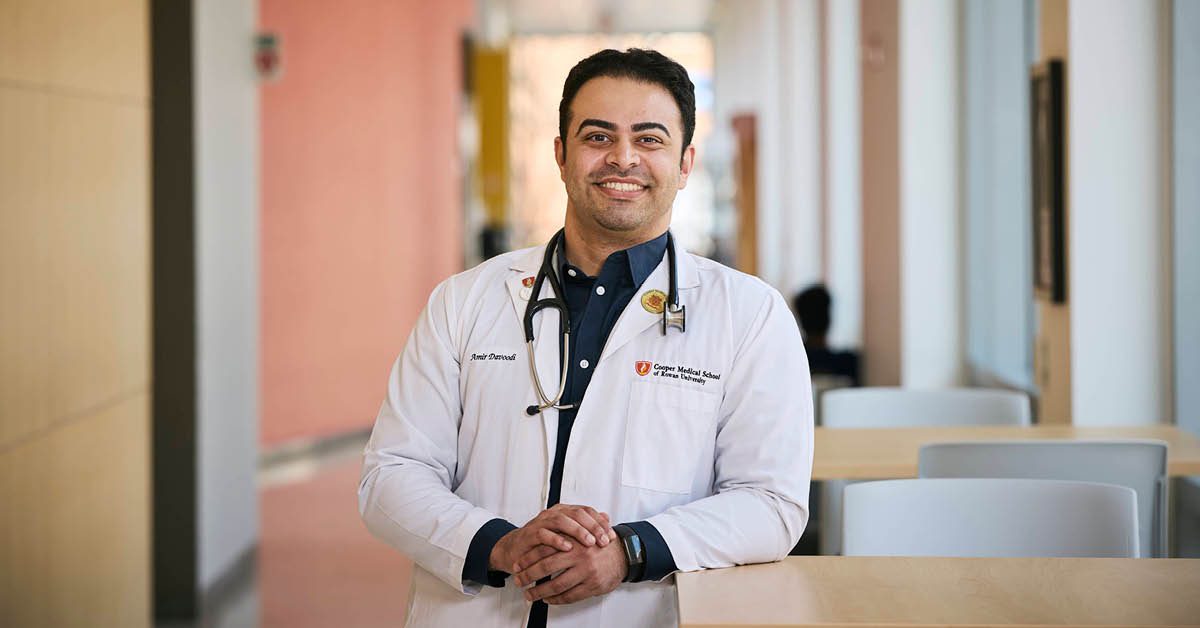
For Amir Davoodi, medicine has never been just about biology.
During his time at Cooper Medical School of Rowan University (CMSRU), Davoodi has come to understand health care as a practice shaped as much by culture, community and ethical responsibility as by anatomy and physiology. That perspective—rooted in his upbringing, strengthened through service in Camden and sharpened through nationally recognized scholarship—has guided his development as a physician and now defines the kind of doctor he hopes to become.
A member of CMSRU’s Class of 2026, Davoodi will graduate this spring with plans to pursue a residency in internal medicine and a long-term goal of working at the intersection of clinical care, public health and policy.
During medical school, his work in bioethics gained international attention, culminating in a peer-reviewed publication in the British Medical Journal’s Journal of Medical Ethics. The achievement reflects both the rigor of his scholarship and CMSRU’s emphasis on ethical inquiry as a core component of medical education.
Shaped by culture and scholarship
Born in Iran and raised in New Jersey from age two, Davoodi grew up influenced by both his American education and Persian culture at home. His father is a civil engineer, and his mother teaches Persian literature, an influence that grounded him early in both analytical problem-solving and humanistic inquiry.
As a teenager, he spent several years abroad attending an international school. The experience exposed him to different educational and social systems and reinforced the importance of context in understanding how people live, learn and receive care.
“I like to say I was born in Iran, but ‘made’ in America,” Davoodi said. “That combination helped me see that while my medical education provided the hard sciences, my experiences here and abroad taught me that treating a patient is a responsibility shaped by culture, values and lived experience.”
Understanding medicine beyond the exam room
Davoodi carried that perspective into his undergraduate studies at the University of Miami, where he majored in public health and sociology. There, he developed a strong interest in how medicine, public health and policy intersect —particularly how systems influence access to care and health outcomes.
This curiosity led him to Australia on an NIH-funded public health grant to further his research in global health systems, where he studied how social support structures impact cardiovascular health. He graduated in 2020, just as the COVID-19 pandemic was unfolding.
In the years that followed, Davoodi rolled up his sleeves working with the New Jersey Department of Health on COVID-19 tracking efforts and helping his father’s firm develop public health protocols. The experience reinforced his belief that physicians must understand the systems surrounding patient care, not just the science behind disease. “So much of health is shaped by forces outside the exam room,” he said. “I wanted to be the kind of physician who understands that bigger picture.”
Doing work that matters
That commitment drew Davoodi to CMSRU in 2022. “Camden is a city where health disparities are visible, but so is resilience,” he said. He said the school’s emphasis on early clinical exposure, service learning and its location in Camden were central to his decision.
Through the Bridging the Gaps summer public health internship, Davoodi worked with Joseph’s House, a Camden program serving individuals experiencing homelessness. There, he helped develop public health interventions, including a COVID-19 vaccine hesitancy survey and a smoking cessation initiative, and fostered partnerships with local health agencies to support community engagement.
Beyond the clinic, he remained actively engaged in advocacy through the American College of Physicians, working with policymakers in the New Jersey Legislature and in Washington, D.C., on initiatives including Step Therapy Reform legislation aimed at reducing insurance-based barriers to prescribed medications.
“These programs made ethics real,” he said. “They showed me how clinical decisions are shaped by trust, access and the realities people face every day.”
Ethics in practice
That focus on ethics became a defining part of Davoodi’s academic work at CMSRU. As a member of the first cohort to complete the school’s Scholarly Concentration in Bioethics, he pursued advanced study that culminated in the publication of his article in the British Medical Journal’s Journal of Medical Ethics, an internationally recognized journal.
Influenced by the “Woman, Life, Freedom” movement and the political unrest in Iran, Davoodi examined how physicians navigate moral responsibility when clinical care occurs under extreme constraints.
Drawing on international case studies and core bioethical principles, he explored how clinicians balance patient welfare, professional ethics and personal risk when systems place pressure on medical decision-making. His work proposes a “sliding scale of moral obligation,” a framework that accounts for individual risk, proximity to harm, and capacity to act, reframing responsibility as something that shifts with circumstance rather than remaining fixed.
Rather than prescribing a single standard, the framework defines ethical responsibility as dynamic, anchored in a baseline duty to protect patient welfare and to avoid complicity in harm, while recognizing that ethical action may take different forms depending on the constraints physicians face.
“Ethics isn’t about heroism,” Davoodi said. “It’s about the daily responsibility to avoid being complicit in harm. My goal was to create a tool for maintaining professional integrity even when the system around us is under pressure.”
Davoodi previously presented his research at a national student bioethics conference, where it received recognition. The journal publication marks a significant milestone, placing his work within a broader international conversation about medical ethics and professional responsibility.
Looking ahead
Davoodi will remain in Camden to begin his residency in internal medicine at CMSRU/Cooper University Health Care, a next step that aligns closely with his commitment to patient-centered care and community-based medicine. He looks forward to building on the relationships and experiences that shaped his education at CMSRU.
Over the long term, he envisions a career that combines clinical practice with health policy, bringing a systems-level perspective to patient advocacy.
Reflecting on his time at CMSRU, Davoodi credits the school with helping him synthesize his background, academic interests, and commitment to service into a cohesive professional identity.
“Medicine is practiced everywhere,” he said, “but the values that guide it—care, responsibility, and respect for human dignity—are universal. CMSRU helped me learn how to live those values in practice.”
As he prepares to graduate, Davoodi represents the kind of physician CMSRU strives to educate: one whose clinical preparation is matched by scholarly rigor, ethical insight and a deep commitment to compassionate care.
Every spring, Rowan University highlights one graduating student from each school and college. Read more about this year’s featured graduates. Their stories show the ambition, purpose and creative collaboration that drive all Rowan students to Defy Definition.