Rowan biophysics senior heads to competitive medical physics Ph.D. program
Rowan biophysics senior heads to competitive medical physics Ph.D. program
May 11, 2026
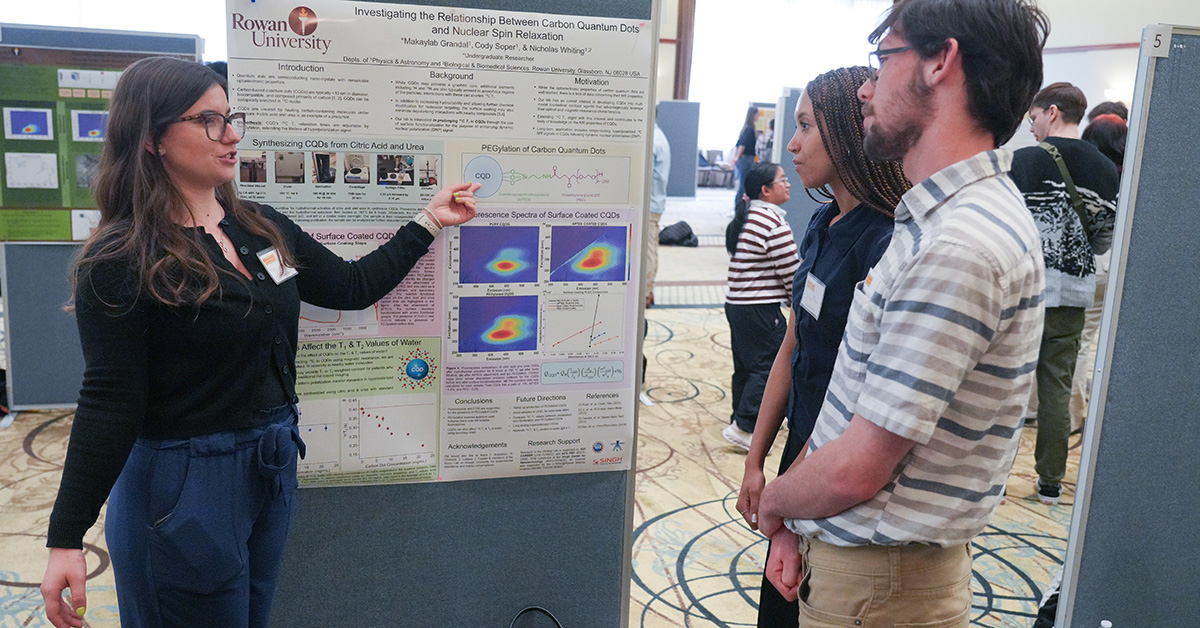
Makaylab Grandal (left) presents her poster during the College of Science & Mathematics' Student Research Day on April 28.
After Commencement Week at Rowan University, biophysics senior Makaylab Grandal will head to one of the nation’s most competitive medical physics Ph.D. programs—joining The University of Texas MD Anderson Cancer Center UTHealth Houston Graduate School of Biomedical Sciences.
It’s the result of several years devoted to work in a research lab, where she learned how to process organic molecules: baking materials for hours at 180 degrees Celsius, spinning the results through a centrifuge, and then running everything through filters, columns, incubators, washers and more.
“This is why Ph.D.s take five years,” Grandal said with a laugh. “Because science takes a long time.”
Attracted to Rowan’s hands-on research opportunities for undergraduates, Grandal joined the lab of Nicholas Whiting, Ph.D., during her sophomore year as a fellow in a concluded program formerly funded by the National Institutes of Health.
Biophysics applies the principles of physics to biological systems, while medical physics combines biophysics with medicine and engineering to improve the diagnosis and treatment of human disease.
“I’m more interested in the diagnostic side of it,” said Grandal, an Edison, New Jersey, native who recently received Rowan’s Dean’s Outstanding Senior Award for physics. “My job will be to analyze how we can improve radiation, and how we can improve systems like PET scanners and MRIs, and advance technology to treat cancer more effectively.”
Grandal’s interest in the field deepened during a 10-week summer research experience at MD Anderson through its Partnership for Careers in Cancer Science and Medicine program for undergraduates. The experience introduced her to the collaborative nature of cancer research and helped solidify her decision to pursue a doctoral degree.
She stayed in touch with the researchers she met during the program and later applied to the institution’s medical physics Ph.D. program, where she will begin her studies this fall.
At Rowan, Grandal spent three years in the Whiting Lab working on projects involving carbon quantum dots—tiny, fluorescent nanoparticles used in medical imaging, drug delivery and other applications. Her work focused on exploring their potential use as contrast agents in next-generation MRI technology.
Such alternatives could be especially valuable for patients who are pregnant, have kidney disease or are allergic to standard contrast dyes.
“Those are future studies,” Grandal said. “Right now, we’re still at the basic science of it all.”
During the College of Science & Mathematics’ recent Student Research Day, Grandal presented her poster, “Investigating the Relationship Between Carbon Quantum Dots and Nuclear Spin Relaxation.” The project required months of work in a wet lab and explored whether carbon quantum dots could be suitable for hyperpolarization, a process that can enhance MRI signal strength.
While Whiting spent the semester overseas on sabbatical, Grandal largely worked independently or alongside graduate student Cody Soper.
“Basically, when I’m not home sleeping, eating or doing classes, I’m in the lab,” Grandal said.
Although the research requires further study, Grandal said the skills and principles she developed at Rowan have prepared her well for the next phase of her academic journey. She also plans to remain a resource to Rowan students and alumni.
That’s how she was introduced into the close-knit scientific community. Whiting, who served as her mentor, was previously a postdoctoral associate at MD Anderson, where he conducted cancer systems imaging research.
“I'm happy and proud that her hard work has opened the door to this prestigious program at one of the top cancer research centers in the entire world,” Whiting said. “I am confident in her continued success and look forward to interacting with her in the future as a colleague.”