Ric Edelman examines the truth about college during fireside chat
Ric Edelman examines the truth about college during fireside chat
April 21, 2026
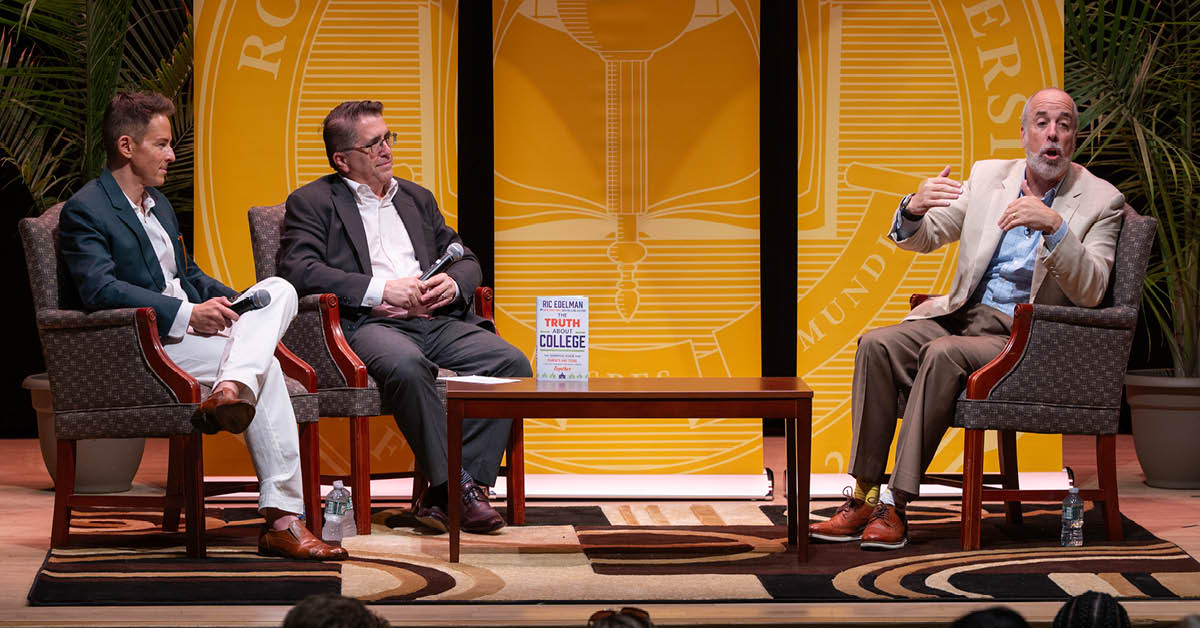
(Left to right) Emil Steiner and Bill Carrigan from the Ric Edelman College of Communication, Humanities and Social Sciences join financial advisor and Rowan alumnus Ric Edelman for a conversation on April 16
Financial advisor, author and Rowan alumnus Ric Edelman returned to campus for a fireside chat on April 16 for students, faculty and staff, examining the real cost, value and future of higher education in an era increasingly shaped by artificial intelligence.
Moderated by professors Bill Carrigan and Emil Steiner, the conversation centered on themes from Edelman’s latest book, The Truth About College: The Essential Guide for Parents and Teens, which is a practical and candid guide for families navigating college decisions.
Named three times as the nation’s top Independent Financial Advisor by Barron’s, Edelman is a New York Times-bestselling author with 14 books on personal finance. He and his wife, Jean Edelman founded the nation’s largest financial planning firm. Steadfast supports of their alma mater, the Edelmans have helped with key university initiatives like the Jean & Ric Edelman Fossil Park and Museum, Ric & Jean Edelman Planetarium and the Edelman Scholars program supporting students in the Ric Edelman College of Communication, Humanities & Social Sciences.
College as a foundation, not a formula
A major theme of the conversation was the rapidly changing job market as artificial intelligence transforms how and where work is done. Edelman identified four fundamental skills for lasting career success: thinking, creating, managing and communicating.
“That’s what we are taught in the liberal arts world. What matters is that each of those majors is teaching us how to think,” he said, while recognizing the new dynamic between the workforce and AI. “We are finding that liberal arts are setting a terrific foundation for your ability to go forward.”
Students asked about navigating the job market for white-collar careers, particularly as AI continues to automate entry-level roles. Edelman advised students to engage directly with employers and ask what skills are most valuable. He recommends using AI as a tool for learning, not a substitute.
Beyond workforce trends, Edelman also explored the responsibilities higher education institutions have when it comes to incoming students.
“I believe institutions should have a fiduciary obligation to serve the students’ best interest, but that’s just not how it is,” he said, admitting that at the end of the day higher education is a revenue-generating business.
Edelman also praised Rowan’s focus on affordability, student success and access, calling the student-centered approach to education “uncommon.”
He also addressed the need for oversight once students are enrolled to prevent students from accumulating life-altering debt without earning a degree. According to statistics cited from his book, 24 percent of first-year college students drop out and 50 percent of college students have been diagnosed with clinical depression. Edelman says this is an issue institutions are not adequately addressing.
Making college work for you
Edelman emphasized the importance of informed decision-making as the cost of higher education continues to rise. Many college graduates say if they had the opportunity to do it over again they would have chosen a different major, a different school or they wouldn’t be going to college at all. Edelman says many high school seniors don’t have an accurate explanation of what the college pathway is going to be about, which is something he addresses with his book.
Despite his candid critique of higher education, Edelman asserts that college remains one of the most rewarding investments if approached thoughtfully.
“You can craft the college path in a manner that minimizes the time it takes to get there, minimizes the cost and therefore minimizes the debt and allows you to position yourself for success upon graduation,” he says, adding that today Americans carry more than $1.7 trillion in student loan debt.
Part of that thoughtful approach, Edelman says, is focusing on getting good grades which translates into learning more. He added that getting involved inside and outside the classroom is paramount and that anyone can be successful with time, effort and hard work.
“You don’t need to be a genius. You don’t need to be smart. You just have to be willing to make the effort,” he said.
Carrigan and Steiner concluded with a book giveaway and signing, giving attendees the opportunity to continue the conversation one-on-one.