New Jersey Health Foundation funds 25 Rowan projects addressing critical health needs
New Jersey Health Foundation funds 25 Rowan projects addressing critical health needs
April 29, 2026
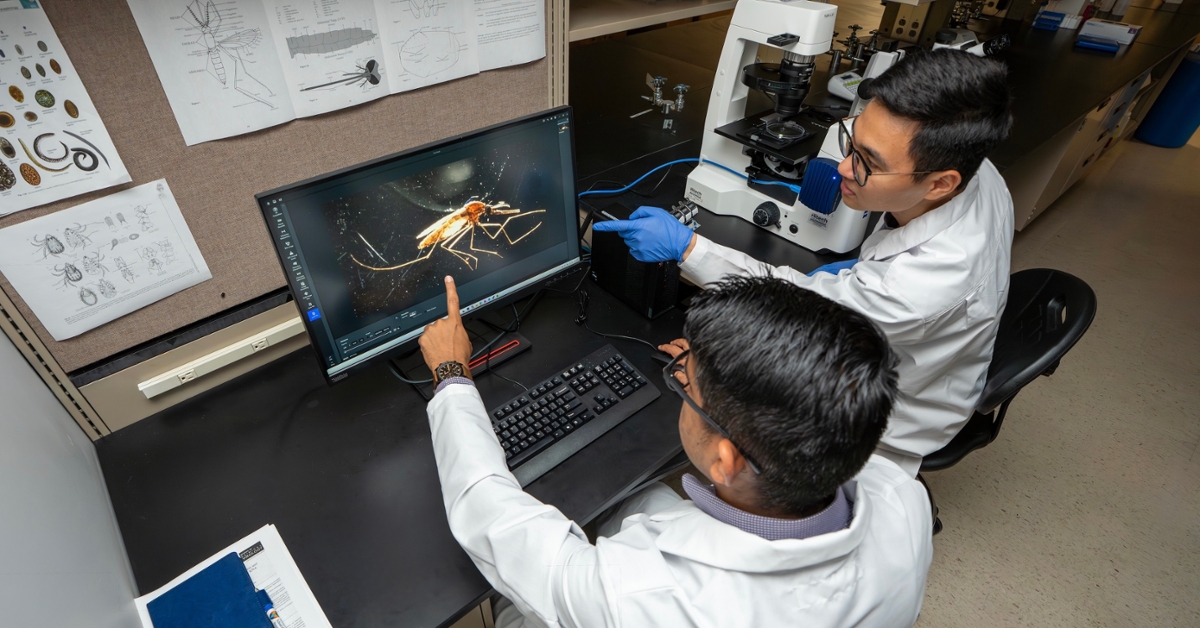
Above: Pratap Kafle (left) and postdoctoral scholar Viet Linh Nguyen. One of 25 Rowan‑led projects recently awarded funding from the New Jersey Health Foundation, Kafle’s lab team is researching new methods to detect mosquito-borne viruses.
Severe cases of West Nile virus and other mosquito-borne pathogens are on the rise in New Jersey. Pratap Kafle, DVM, Ph.D., DACVM, an assistant professor of parasitology at the Shreiber School of Veterinary Medicine, hopes to build a simpler, scalable surveillance system that can track these pathogens faster and more cost-effectively.
Kafle’s project is one of 25 Rowan-led studies funded this spring by the New Jersey Health Foundation. Together, the projects address a range of urgent health care and biomedical needs. In total, the foundation awarded more than $1.18 million in seed funding to Rowan University researchers. The grants support early-stage research, allowing investigators to gather preliminary data, compete for larger external grants and drive innovative ideas closer to clinical application.
With support from the New Jersey Health Foundation, Kafle is using ecological modeling and molecular monitoring to detect mosquito-borne viruses.
West Nile virus, the most common mosquito-borne disease in the continental United States, causes about 2,000 human cases each year. In New Jersey alone, the virus was linked to eight human deaths in 2024.
West Nile virus is not the only concern. “The disease landscape is changing rapidly,” Kafle said.
The State of New Jersey actively monitors five mosquito-borne diseases. In 2025, more than 130 cases were reported statewide, underscoring the growing public health threat. These illnesses infect a range of animals, including birds, wildlife and particularly horses. Kafle is especially interested in Eastern equine encephalitis virus, a rare but devastating virus that threatens both horses and humans.
“Emerging arboviruses are going to be a bigger problem in the future,” Kafle said. “Detecting them earlier means we are better prepared.”
Current methods for detecting mosquito-borne pathogens are proven and effective, but they are costly, resource-intensive and slow. Traditional surveillance involves trapping mosquitoes, keeping them cold, sorting specimens by species, extracting genetic material and testing for individual viruses. The process can take several days to yield results.
Kafle and his team are testing a new approach by integrating Fast Technology for Analysis of Nucleic Acids (FTA) cards into mosquito traps. FTA cards are small filter paper cards treated to capture and preserve viral genetic material left behind in mosquito saliva and waste, allowing researchers to detect pathogens without trapping and processing whole insects. Researchers can then analyze the cards to identify pathogens, potentially producing faster results while screening for multiple mosquito-borne pathogens at once.
The project will use both new and traditional methods in parallel to compare cost, turnaround time, sensitivity and the ability to screen for multiple pathogens.
“If this works, it could improve the economics of multi-pathogen surveillance in a meaningful way and allow us to be proactive instead of reactive,” he said.
Kafle hopes to develop a validated, easily deployable protocol that county mosquito commissions can use to supplement existing mosquito control programs. The approach would extend geographic coverage and reduce the per-site processing burden.
Doing work that matters
From disease detection to advanced drug delivery systems, Rowan researchers are advancing early-stage ideas with the potential to improve health outcomes and save lives. Support from the New Jersey Health Foundation is helping move this work forward.
To date, the New Jersey Health Foundation has awarded more than $6.6 million to support Rowan-led research, including the following projects funded this spring:
College of Science & Mathematics
“Analysis of Antiviral Molecules Against Herpes Simplex Viruses in Organoid Cultures,” Claude Krummenacher
“Polymer-Based Nanomaterials for Targeted PFAS Removal,” Amos Mugweru and Dongmei Dong
“Targeting Astrocyte-Mediated Neuroinflammation for the Treatment of Depression,” Melissa Manners
“Targeting the MRAS-SHOC2-PP1C Complex: Chemical Strategies to Disrupt Oncogenic Signal Transduction,” Zhihong Wang
“Feasibility and Pilot Evaluation of Psychological Stress Response Measurement in Conjunction with Virtual Reality Parent Training for Severe Behavior,” Christina Simmons and Maximilian Heitmayer
Cooper Medical School of Rowan University
“Comparative Transcriptomic and Proteomic Profiling of Epigenetic Modifiers Romidepsin and Mithramycin A Under Hyperthermic Conditions in a Murine Model of Colorectal Cancer Peritoneal Carcinomatosis,” Weam Elbezanti and Hong Young
“A Novel Therapeutic Strategy to Alleviate Hypertension-Induced Diastolic Heart Failure,” Eduard Dedkov
“AMPP Foley Catheters: Pathogen-Activated Antimicrobial Peptides for CAUTI Prevention,” Valerie Carabetta and Sebastian Vega
“Addressing the Possibility of Using Bacteriophage as a Novel Antimicrobial Agent Against Highly Drug-Resistant Acinetobacter Baumannii,” Valerie Carabetta
“Optimizing Delivery of a Novel Chemotherapeutic Drug to Human Glioblastoma Tumors Using Bacteria,” Russell Buono
“Evaluating Mechanotransduction Inhibitors as a Potential Treatment Strategy for Aggressive Breast Cancers,” James Holaska
Henry M. Rowan College of Engineering
“Design and Control of a Magnetic Möbius Microbot for Biomedical Applications,” Dhritiman Bhattacharya
“Multifunctional Janus Dressing Disrupting Biofilm, Inhibiting STING Pathway, and Modulating Antioxidant for Infected Wound Treatment,” Mina Shahriari Khalaji
“Cellular-Resolution LiDAR Guided Surgery System Based on Femtosecond Laser for Intraoperative Blood Vessel and Nerve Mapping,” Ben Wu and Ying Tang
“Ultra-Fast Time-Resolved MRI for Functional Disorder Diagnosis Enabled by High-Sensitivity Radio-Frequency Analyzer,” Ben Wu and Ying Tang
“Drag-Reducing Polymers with Therapeutic Capability,” Peter Galie
“A Soft Robotic Approach to Intelligent High-Precision Hydrogel Drug Delivery Patches,” Wei Xue, Mitja Trkov and Xiaohui Xu
“Electrowritten Metallo-Elastomer Conduits for Next-Generation Vascular Repair,” Ying Chen
Ric Edelman College of Communication, Humanities & Social Sciences
“Nature, Data, and Healing—A Model for Ecological and Human Resilience Using Bird and Bat Vocalizations,” Marilena Vilceanu and Gerald Hough
Rowan-Virtua School of Osteopathic Medicine
“Identifying molecular factors for cell-free joint therapeutics,” Minwook Kim
“Enhancing a 21 Year Prospective Study on Breast Arterial Calcification and Cardiovascular Disease with CDC Mortality Data,” Peter Schnatz
“Development of a Specialist Program for Peer Recovery Coaches to Prevent Health-Related Mortality in Substance Users,” Kenneth Stagliano
“Student-Led SBIRT to Decrease Transition to Substance Use Disorders in College Students,” Joshua Coren and Scott Woodside
Shreiber School of Veterinary Medicine
“Mechanistic and Therapeutic Exploration of Macrolide Antibiotics as Repurposed Anticancer Agents,” Mohamed Abouelkhair and Vincent Manna
“Developing a Molecular Xenomonitoring System for West Nile Virus and Emerging Arboviruses in New Jersey,” Pratap Kafle, John Eddie Ekakoro and Mohamed Abouelkhair