Making waves with acoustics: From tiny microrobots to massive infrastructure, acoustic waves resonate
Making waves with acoustics: From tiny microrobots to massive infrastructure, acoustic waves resonate
April 17, 2026
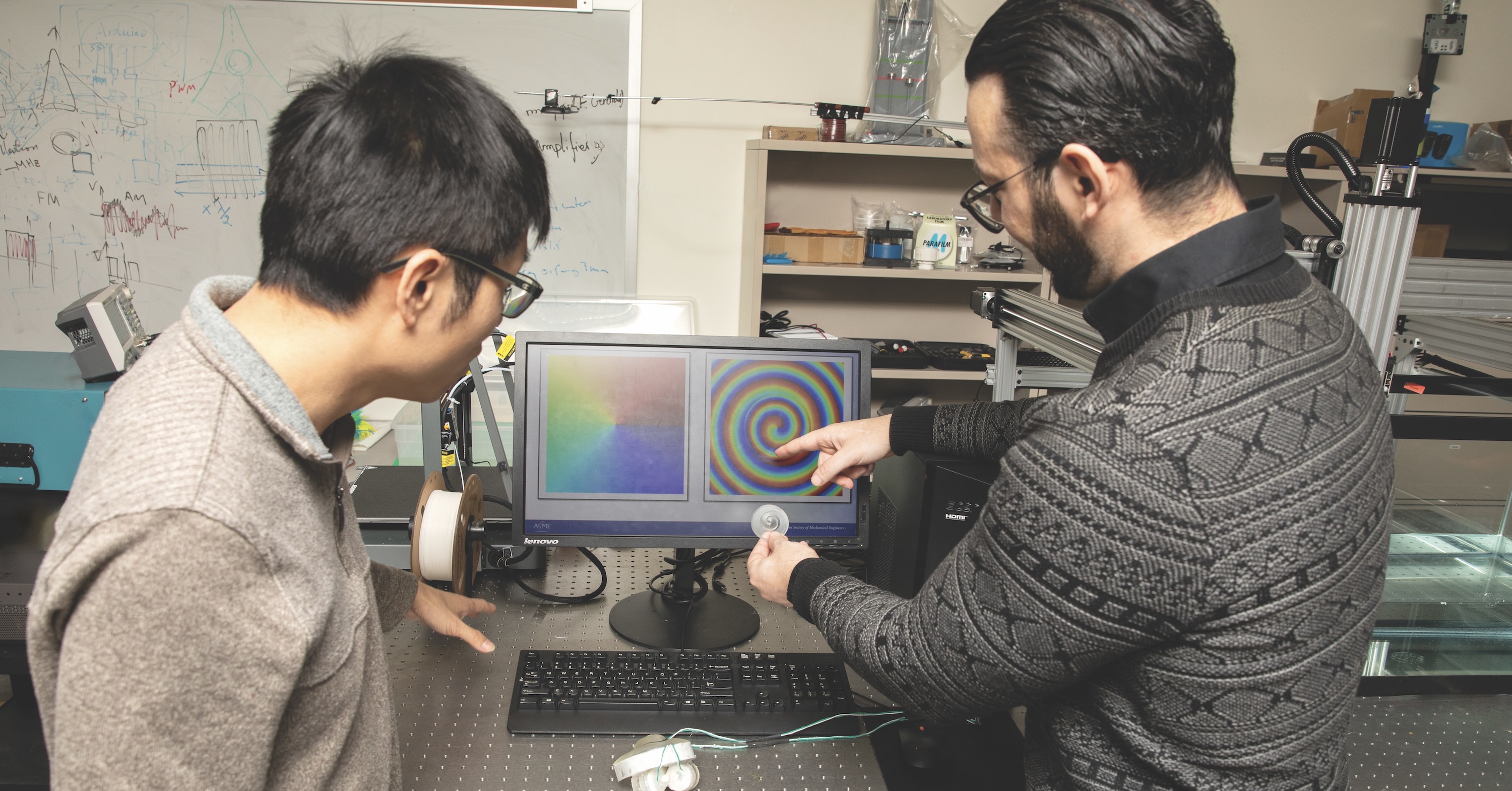
Ph.D. student Chadi Ellouzi (right) shows Chen Shen a 3D printed acoustic lens that can spin sound waves. Their research has shown acoustic waves can propel a miniature robotic swimmer through water.
A love of music fueled an early interest in acoustics research for Chen Shen, an assistant professor in the Department of Mechanical Engineering at the Henry M. Rowan College of Engineering.
Acoustics are like ripples in water. Sound waves behave similarly, spreading and interacting with obstacles.
However, unlike in music, acoustics are not limited to only audible sound, points out Shen, who has won awards and published dozens of papers for his groundbreaking work in the basic science and real-world applications of acoustic waves.
With support from the National Science Foundation’s Faculty Early Career Development Program (CAREER) Award, Shen searches for ways to fine-tune the direction and intensity of sound waves. Because the pattern of waves depends on the medium through which they move, simply changing the material isn’t always enough to get the desired result. Instead, Shen fine-tunes acoustic waves by developing novel structures through which they can travel and change in desired ways.

Imagine changing the shape of a musical instrument to alter its sound, rather than changing the material it’s made of.
“Developing specific structures provides greater freedom of control because you don’t always find the material properties you want. Harnessing structures and the way they interact with acoustic waves gives us different propagation patterns that we can then use to facilitate different applications,” Shen says.
Steering acoustic waves for real-world applications
One of these applications is using acoustic waves to power microrobotic “swimmers,” potentially for monitoring aquatic environmental conditions. Traditional actuators—the components that make robots move—don’t work for microrobots because they’re mechanically complex and difficult to miniaturize. Acoustic propulsion is a viable alternative.
Key to the process is an acoustic “vortex,” a spinning sound wave that transfers energy to the robot to make it move. A 3D printed component Shen and his team developed acts as an “acoustic lens,” focusing the sound waves into a small area and pushing the robot.

Above: 3D printed acoustic lenses in sizes ranging from 10 to 49 millimeters for a range of micro applications.
Shen attached the acoustic lens to the robot along with a miniature piezoelectric transducer, a tiny device that turns electricity into ultrasound waves. By adjusting two sound-generating devices placed at right angles to each other, Shen can steer the robot like a remote-controlled boat.
For environmental monitoring, users apply sensors to the robots, including acoustic ones, which can detect varying conditions, like the presence of foreign materials or humidity.
“I really like this research because it’s a good demonstration of how we can build on fundamental science knowledge to develop interesting applications,” Shen says.
Just as acoustic waves can move tiny robots, they can also be manipulated to tame unwanted noise.
The principle of using specially designed structures to modify acoustic waves also found use in a compact multiresonator duct silencer that Shen and his research team developed. The 3D printed “folded” silencer uses many tiny traps to quiet a wide range of noises while letting air flow freely.
Acoustic waves as diagnostics
Beyond noise control, acoustics has other applications as Shen and team have shown. Screening of cell and tissue samples to diagnose cancers or other illnesses is laborious and time-consuming. But acoustic waves can help sort cells by exploiting differences in cell behavior that lead them to be sorted in easily identifiable ways.
And similar to the way physicians use ultrasound imaging to look inside the body, engineers can use elastic waves—sound waves that travel through solid materials—to find damage within public bridges and roads. By interacting with cracks and voids within materials, these waves could lead to fast and accurate diagnoses, even of problems beneath the surface.
For Shen, the harmony between science and sound continues to inspire discoveries that go far beyond music.
“The most exciting thing around the corner is to really push the boundaries of what we can achieve with acoustic waves, especially for biomedical and structural applications,” Shen says. “We’re just getting started.”
Any opinions, findings, conclusions or recommendations expressed in this material are those of the authors and do not necessarily reflect the views of the NSF.