Rowan University hosts South Jersey’s first cybersecurity conference
Rowan University hosts South Jersey’s first cybersecurity conference
April 23, 2026
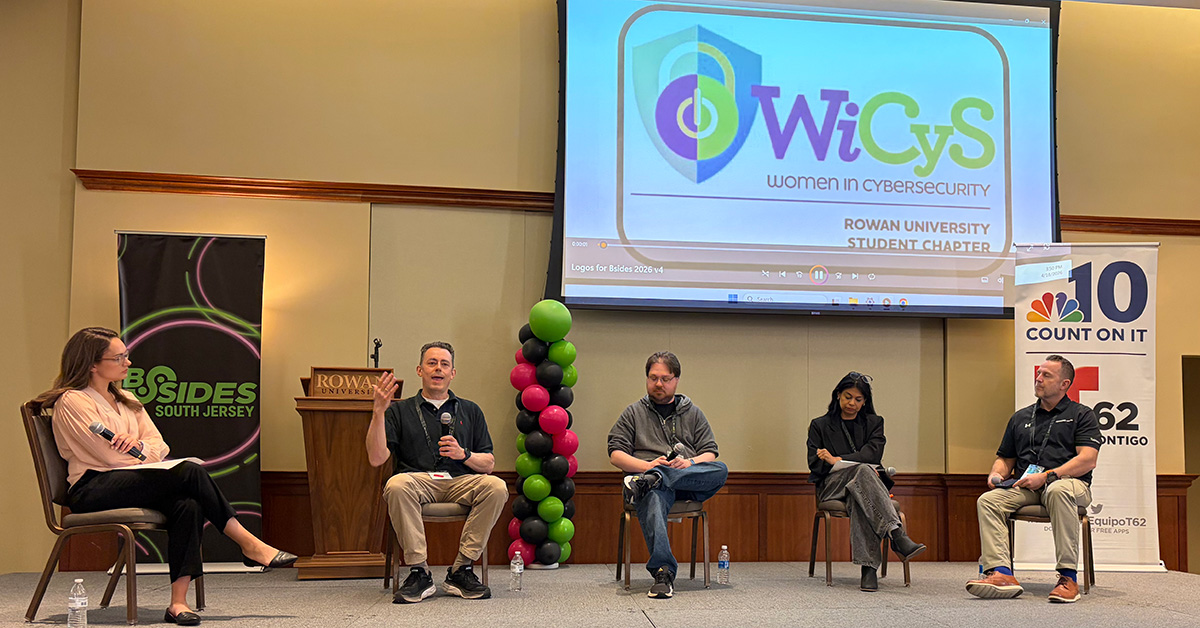
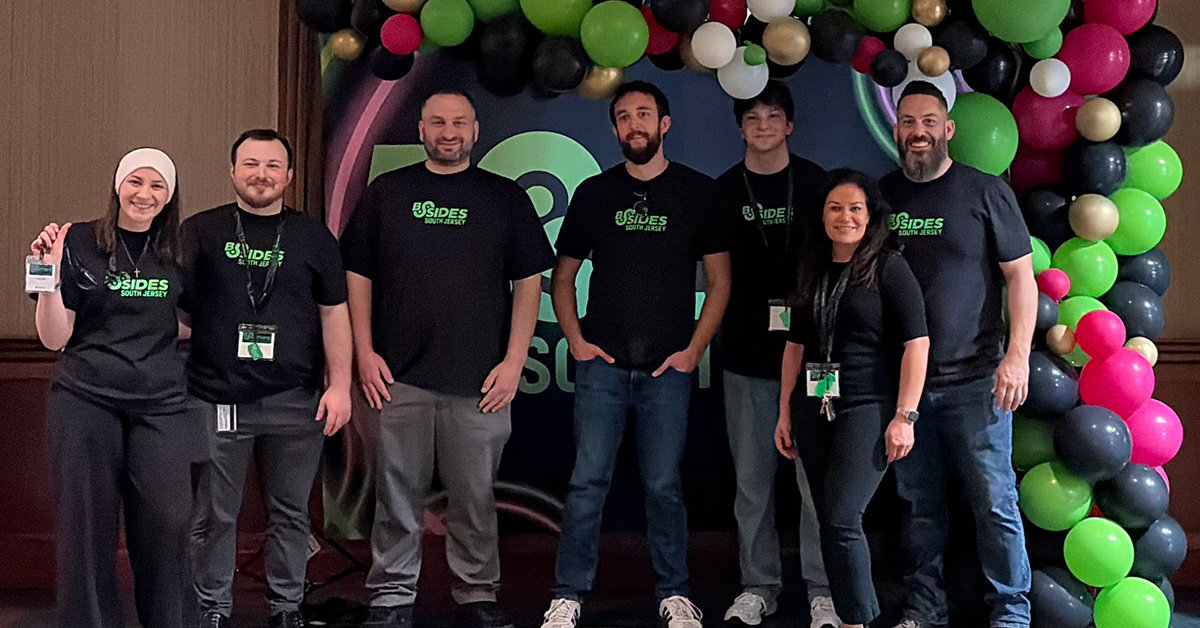
Moderated by NBC10 morning weekend anchor Brenna Wicks, panelists discussed artificial intelligence and cybersecurity during BSides South Jersey, a one-day conference held at Rowan University on Saturday, April 18. Below, event organizers pose for a photo during the conference. From left: Olivia Santini, Ian Manahan, Nick Perkins, Scott Howard, Tyler Walters, Nancy Bradley and Rowan alumnus Dan Jones. Photo credit: Nancy Bradley
On Saturday, April 18, more than 200 cybersecurity professionals and students filled the Eynon Ballroom at Rowan University’s Chamberlain Student Center for the region’s first-ever BSides South Jersey, a one-day cybersecurity conference. Part of a global series of grassroots cybersecurity conferences, the event was hosted by the Rowan Women in Cybersecurity Chapter (WiCyS) and Cybersecurity Club students, with support from Rowan alumni and the University’s Department of Computer Science.
The goal of the event, organizers said, was to bring together hackers, security professionals, students and the community for presentations centering on today’s real-world cybersecurity challenges and tomorrow’s threats. During the day’s opening remarks, Cybersecurity Club president Tyler Walters explained that the event had been in the works for nearly a year after the group observed few cybersecurity events in the South Jersey region. Walters and WiCyS vice president Nancy Bradley met with the conference organizer, BSides, which selected Rowan University to host the regional event.
“We're not Philadelphia. We are not New York. We are not Princeton, and we're not Rutgers. We're South Jersey,” said Bradley, a computing and informatics major in the College of Science & Mathematics. “Let's host an event that represents who we are. We're a community of support.”
The conference began with a keynote presentation from Hazel Cerra, the director of digital security convergence at BlackCloak, an organization that protects corporate executives from cyberattacks, and a 25-year veteran of the Secret Service.
In her talk, “How to Protect Your Enterprise Using the Presidential Protection Methodology,” Cerra drew parallels between the role of cybersecurity professionals and Secret Service members. Both are tasked with protecting crucial assets—the company and the president, respectively—from adversaries. Like the Secret Service, cybersecurity workers must prepare for attacks by creating multiple layers of protection and identifying threats. The future of the industry, Cerra said, is no longer about protecting systems, but the executives and people who work at organizations.
“Security is a mindset,” Cerra said.
BSides featured other expert-led talks including “Fully Automated Phishing: How Attackers Use Vibe Coding to Generate and Launch Campaigns in Minutes” from Yotam Perkal, the director of security research at Pluto Security, a workspace security platform. Perkal spoke of how phishing transitioned from a manual process to an automatic one through the help of artificial intelligence, a process known as vibe coding. No longer do hackers need technical coding skills when AI platforms build a fully functional phishing website in 30 seconds without human intervention.
So how can cybersecurity workers protect their organizations? Perkal said these AI-driven hacking campaigns leave “fingerprints” that allow professionals to identify malicious attackers. For example, AI-generated code utilizes a different language than human-generated code.
As artificial intelligence continues to impact many industries, computer science is particularly vulnerable. Entry-level computer science workers must contend with the ongoing threat to the industry by learning new skills. BSides, organizers said, aims to close that gap with accessible knowledge-sharing.
“Students at any university learn the fundamentals of cybersecurity,” Bradley said. “They understand the tools. But how do those tools actually apply in real-life scenarios in the workforce? It was really important to bridge that gap of taking academia and marrying it with real-life workplace experiences.”