Developing taste: How molecular signals in infant tongues shape how we eat, taste and speak
Developing taste: How molecular signals in infant tongues shape how we eat, taste and speak
April 28, 2026
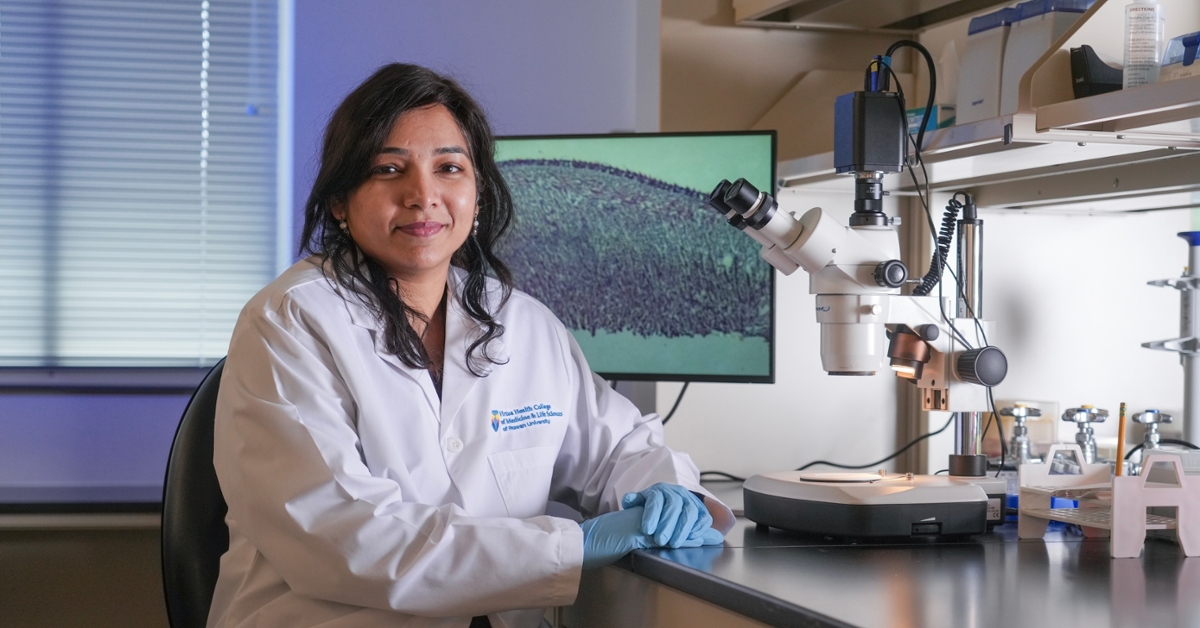
Archana Kumari and her lab team study infant tongue development and pediatric tongue disorders.
During her postdoctoral research, Archana Kumari read a blog post by an oral cancer patient taking medication that disrupted taste. At Thanksgiving dinner, the patient couldn’t detect the subtle saltiness of the gravy or the sweet notes of the candied yams.
“It was so awful to read,” said Kumari, now an assistant professor of neuroscience at Rowan–Virtua School of Osteopathic Medicine. The story stayed with her and eventually helped shape the direction of her scientific career.
She began working to understand the role of a cell-signaling pathway known as Hedgehog signaling and how it might contribute to taste disturbances experienced by cancer patients treated with Hedgehog-inhibitor drugs.
“Taste is being altered in so many medical conditions, not just from anti-cancer drugs,” Kumari said. “I really wanted to do something meaningful.”
How cell signals influence tongue development
Cell-signaling pathways are a series of chemical reactions inside a cell that control its function. First discovered in fruit flies, the Hedgehog pathway is essential for numerous processes in embryonic development, including formation of the tongue. The pathway is named after the Hedgehog gene. Fly larvae lacking this gene develop a short, spiky appearance that resembles a hedgehog.
“We know that Hedgehog signaling plays a vital role in taste organ development before birth and it maintains them in adulthood,” Kumari said. “But there is a critical gap in our understanding of its role in tongue and taste organ development after birth in juvenile stages.”
Then working with her team at the University of Michigan, Kumari returned to study the tongue with a fresh perspective. She began investigating underexplored components of Hedgehog signaling from birth through adulthood, identifying genes not previously studied in the tongue. What particularly fascinated her were the dynamic changes in these signaling components after birth and their biological relevance.
That curiosity broadened her focus beyond taste organs to the tongue as an integrated, multifunctional organ.
Children with lesions on the top or back of their tongues often face significant challenges with eating and speaking. Although the structural and developmental changes of the tongue are well-documented, the signaling pathways guiding those changes remain poorly understood, slowing progress in addressing pediatric tongue disorders.
With support from the National Institutes of Health, Kumari is leading research to fill this gap. She uses mouse models that allow researchers to delete individual genes one at a time and watch how each change affects the tongue structure and architecture of taste-organ tissues.
Her work poses a fundamental question: Can the tongue still perform its functions—taste, speech, and movement—without specific genes? “This can tell us whether a gene is essential,” she explained, “or whether it simply provides a supporting role.”
By uncovering how Hedgehog signaling works in the developing tongue, Kumari hopes to clarify why tongue disorders occur in children in the first place.
“A clearer understanding of these biological signals,” she said, “could one day help doctors move beyond treating symptoms and toward more effective, targeted care.”
This research is supported by the NIH under Award Number R01DC022319. The content is solely the responsibility of the authors and does not necessarily represent the official views of the NIH.