Researching additive manufacturing in civil engineering
Researching additive manufacturing in civil engineering
March 3, 2026
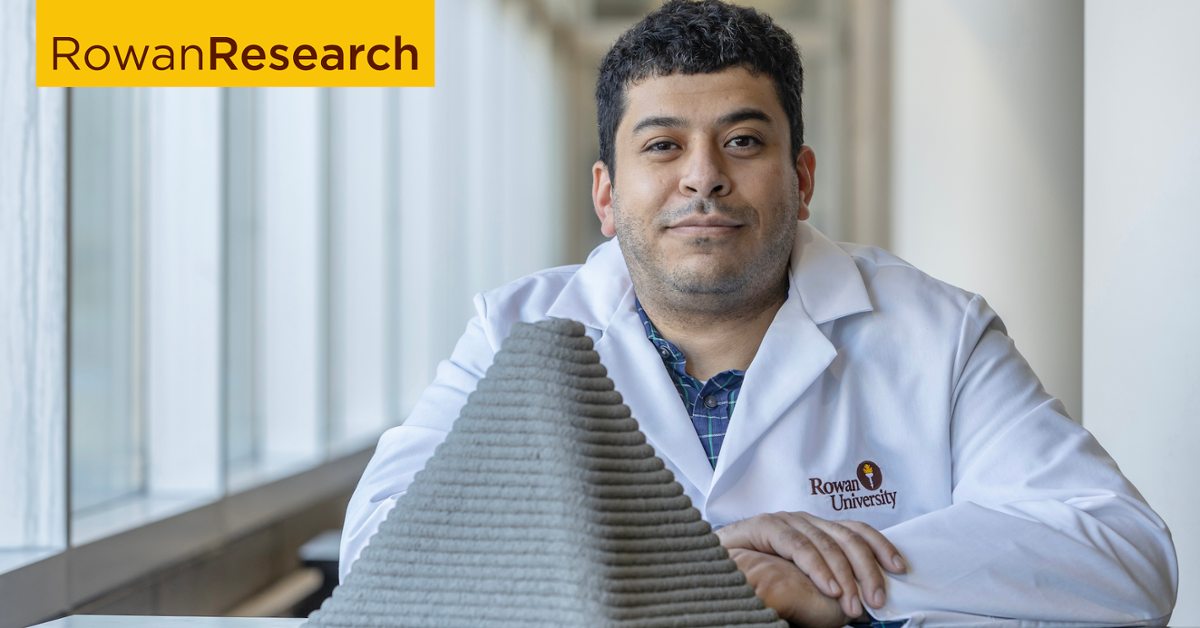
Islam Mantawy develops methods for 3D printing concrete structures.
Islam Mantawy, Ph.D.
Structural engineer
Areas of expertise:
Structural engineering, bridge engineering
A structural engineer by training, Islam Mantawy, Ph.D., wants to leverage additive manufacturing and robotic construction to solve problems conventional methods can’t easily overcome. Hazard resilience and climate adaptation are major concerns. How can we, for example, build structures faster using sustainable materials that are simultaneously resilient and that can adapt to different stressors such as climate variabilities?
To explore the role cutting-edge additive and robotic construction might play in the built environment of the future, Mantawy, an assistant professor in the Henry M. Rowan College of Engineering, set up the Additive and Robotic Construction Laboratory (ARC-LAB).
“The goal is to establish a nationally recognized center that pushes the boundaries of what’s possible in the additive construction of concrete and metallic structures,” Mantawy says.
He leads a team of both graduate and undergraduate researchers pursuing advanced methods for 3D printing concrete and metallic structures.
Research on concrete prioritizes structural efficiency, material sustainability and environmental adaptability. Among the topics being explored: how to create geometries that demonstrate high strength-to-weight ratio. The other research thrust of the lab is the additive manufacturing of metallic structures with a focus on creating lightweight and high-performance metal components.
Mantawy is especially keen on exploring 3D printing of hazard-protective concrete and metal systems for enhanced resiliency and environmental adaptation. For example, multifunctional wall units with embedded living support and utilities can be speedily constructed and used as relief shelters in the wake of natural disasters. Also on the horizon: concrete 3D printing in diverse environments—including underwater—to broaden potential applications.
Steel could find use in seismic applications where 3D printed metal components installed in structures carry all the load and protect main components of the structures.
“The research is endlessly fascinating and fun and it makes civil engineering more of an attractive proposition for students, which is always a good thing,” Mantawy adds.
Rowan University researchers are passionate about what they do. Find more at Meet Our Researchers.