Rowan University researchers unveil Robossis Alpha, a breakthrough in orthopedic surgery
Rowan University researchers unveil Robossis Alpha, a breakthrough in orthopedic surgery
March 6, 2026
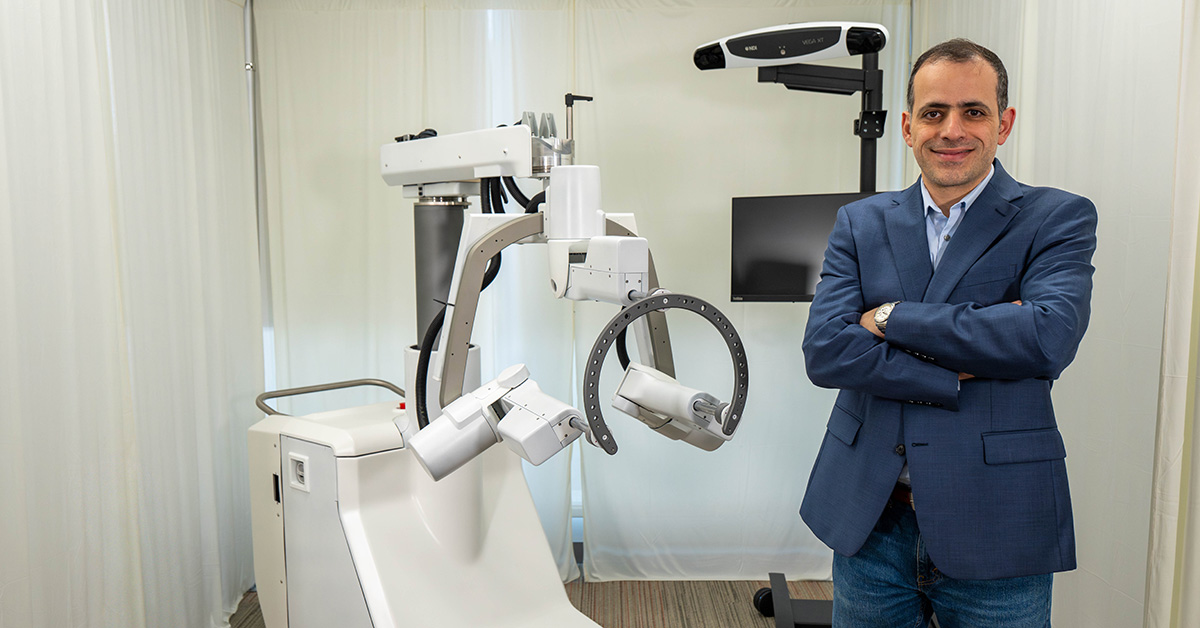
Mohammad Abedin-Nasab, an associate professor of biomedical engineering at Rowan University, stands with Robossis Alpha, the world’s first robotic surgical system designed for minimally invasive alignment of fractured long bones.
Mohammad Abedin-Nasab and his team of researchers at Rowan University have introduced Robossis Alpha, the world’s first robotic surgical system designed for minimally invasive alignment of fractured long bones. This advanced prototype, nearing clinical trials, addresses a critical challenge in orthopedic surgery: ensuring precise bone positioning to prevent complications such as malalignment, repeated operations, chronic pain, impaired mobility and extended recovery times.
Robossis Alpha combines unmatched strength with precision. The compact system delivers the huge force necessary for long-bone fracture surgery that is not currently available in other commercially available surgical robots. The system enables surgeons to reposition large bones accurately while reducing reliance on repeated X-rays. Once approved by the Food and Drug Administration, the technology has the potential to significantly shorten surgery time, minimize radiation exposure, reduce anesthesia use, and lower risks of blood loss and complications.
Led by Abedin-Nasab, founder and CEO of Robossis, and an associate professor of biomedical engineering in the Henry M. Rowan College of Engineering, the project is supported by the National Institutes of Health, the National Science Foundation, the New Jersey Commission on Science, Innovation and Technology, and the New Jersey Department of Labor & Workforce Development. Commercial development is backed by the Rowan Innovation Venture Fund and private investors, including orthopedic surgeons.
Under development for a decade, Robossis Alpha is intended to address a “huge clinical need” for improved patient outcomes, particularly among vulnerable populations, Abedin-Nasab said. Researchers interviewed more than 250 people to understand the scope of the problem, including trauma surgeons, patients and hospital executives.
“The first surgery I observed was a 2-year-old boy with a broken femur,” said Abedin-Nasab, editor of the forthcoming “The Handbook of Robotic and Image-Guided Surgery” (Elsevier, Second Edition, 2025). “The patient lost one liter of his blood and there were a lot of complications. After observing that surgery, I said there is a problem and I have to develop something to fix this problem.”
Key features of Robossis Alpha:
- Unique arm placement for a large surgical workspace
- Force capabilities more than 10 times higher than current surgical robots
- Real-time bone tracking with submillimeter accuracy
- AI-driven guidance for optimal positioning
The multidisciplinary team includes orthopedic surgeons from Virtua Health, researchers from Johns Hopkins University, industrial design engineers and students from Rowan’s engineering, science and medical programs, including Cooper Medical School of Rowan University, and the Rowan-Virtua School of Osteopathic Medicine and Rowan-Virtua School of Translational & Biomedical Engineering—both part of Virtua Health College of Medicine & Life Sciences.
With continued private funding, regulatory approval is anticipated within two to three years.
To learn more about Robossis, visit robossis.com
This research is supported by the National Institute of Biomedical Imaging and Bioengineering of the National Institutes of Health under Award Number R01EB036365. The content is solely the responsibility of the authors and does not necessarily represent the official views of the National Institutes of Health.