Student research and creativity recognized in 2026 Art of Rowan Research Contest
Student research and creativity recognized in 2026 Art of Rowan Research Contest
March 30, 2026
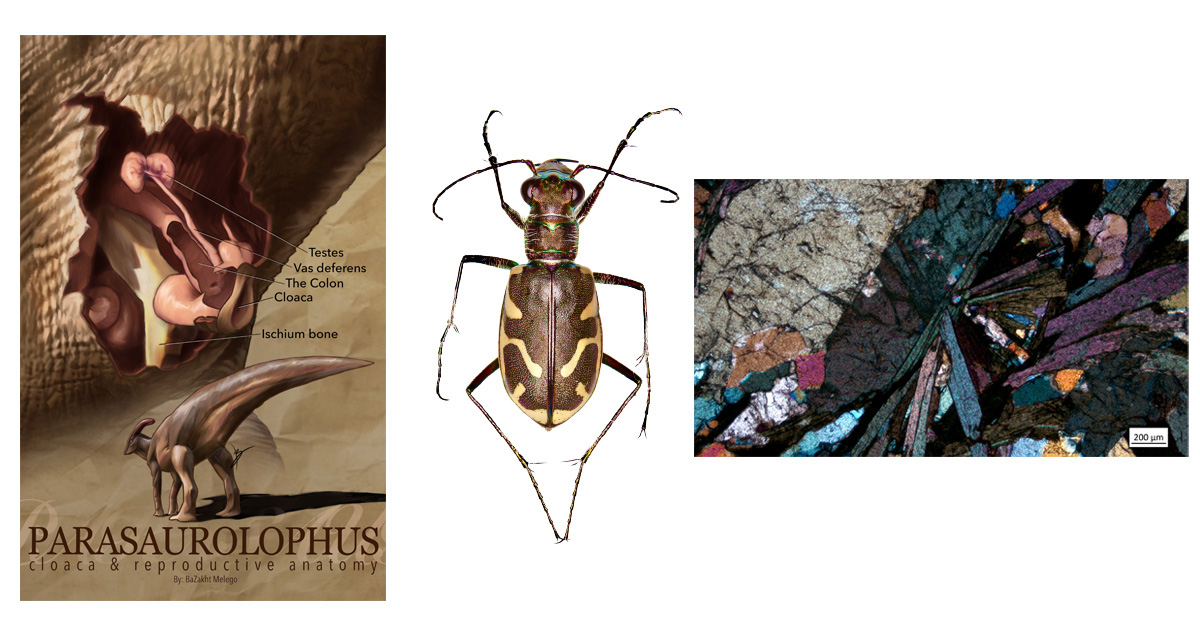
From left: "Parasaurolophus: Cloaca & reproductive anatomy," by BaZakht Melego; "Cicindela columbica" by Ryan Victor; and "Billion Year Butterfly" by Angelena Revas
Images of an endangered insect, a slice of Pennsylvanian bedrock and a creative depiction of an ancient dinosaur earned top honors in the 2026 Art of Rowan Research Contest. The contest was launched last spring to celebrate the student-created imagery revealing the artistry of scientific research and creative inquiry underway at Rowan University.
This year, Rowan students submitted 42 images for judges to weigh based on their artistic and scientific value. Students, faculty and staff voted to award the People's Choice from among the remaining qualified entries.
Select images may appear in University publications or displayed for public view.
First Place: Reconstructing dinosaur anatomy through biomedical visualization
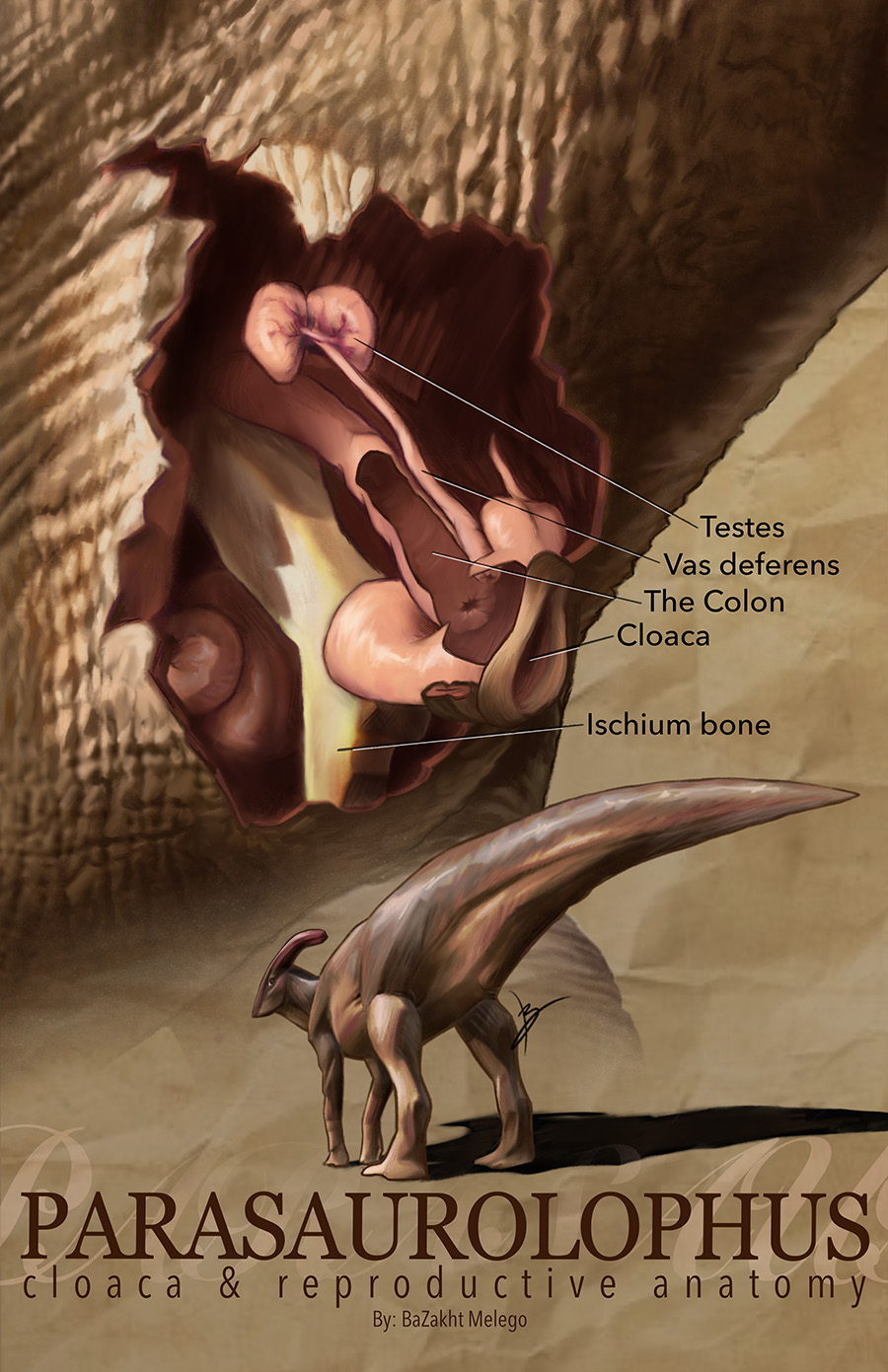 BaZakht Melego, a biomedical art and visualization major in the Ric Edelman College of Communication, Humanities & Social Sciences, submitted an unusual illustration that secured first place in this year’s competition.
Offering an “evidence-based reconstruction of the cloacal and reproductive anatomy of a male Parasaurolophus,” Melego noted the subject’s difficulty for some viewers.
“I initially chose this subject with a degree of humor, fully aware that dinosaur reproductive anatomy occupies an awkward space in both academic and popular discourse,” Melego wrote. “However, the topic is scientifically legitimate and arguably necessary. Given significant differences in body size, pelvic morphology and inferred behavior, Parasaurolophus may have exhibited distinct cloacal and reproductive adaptations.”
The artist used living relatives of dinosaurs such as birds and crocodiles, along with skeletal features, to create an informed reconstruction of what the male hadrosaurid’s anatomy likely looked like.
Calling the resulting artwork “so clever” and “bold,” judges appreciated Melego’s dramatic and theatrical presentation of the Late Cretaceous Period animal, as well as the sweeping arc of its tail and the allusion to its environment.
Second Place: Documenting an endangered insect through environmental photography
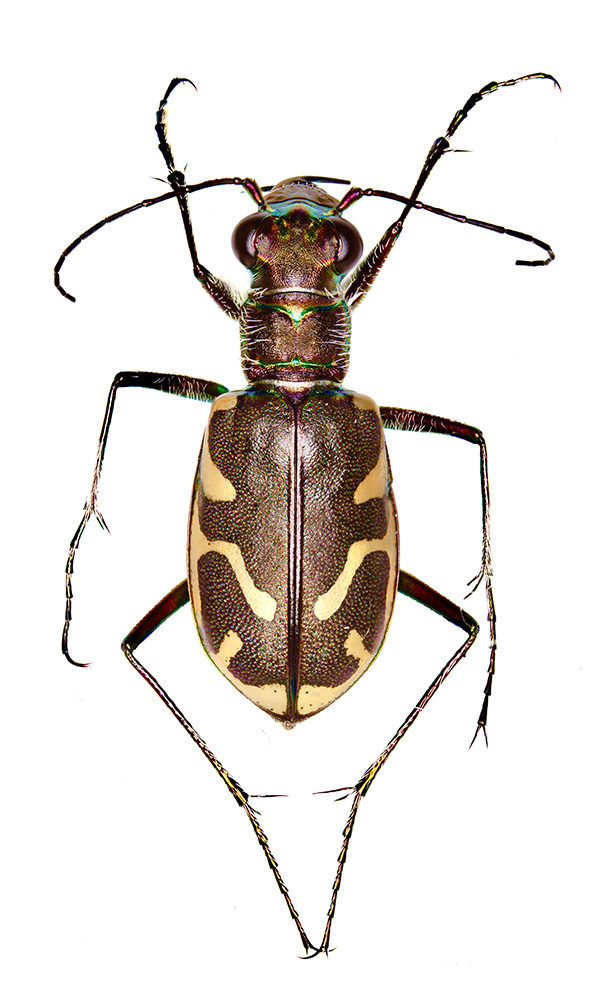
Ryan Victor, an environmental science major in the School of Earth & Environment, secured second place with a detailed photograph of Cicindela columbica, the Columbia River tiger beetle.
The photo was taken using a macro lens at multiple focal depths and then processed using focus stacking software, Victor explained.
“The high resolution of this macro photo allowed us to see key differences in size, shape and the presence of small hairs (setae) in specific places,” Victor wrote. “These subtle differences, which are difficult to see with the naked eye, separate the Columbia river tiger beetle from a common, nearly identical relative, the bronzed tiger beetle (Cicindela repanda). Due to this subtlety, field sightings of this threatened species often go unnoticed.”
Working under the direction of Daniel Duran, an assistant professor of environmental science, Victor confirmed the presence of the Columbia River tiger beetle in an area where it was thought to be locally extinct.
Judges appreciated the extraordinary quality of Victor’s image and the skill required to reveal the fine details of the tiny creature.
Third Place: Revealing geologic history through microscopic imaging
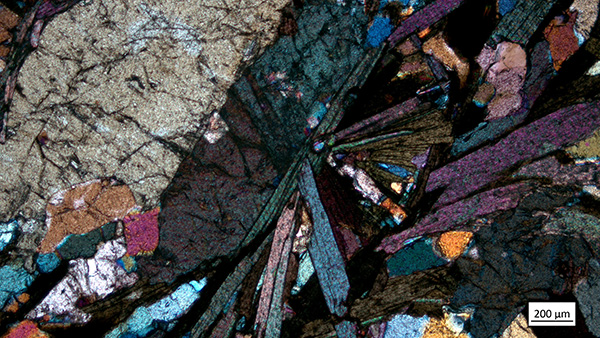
Angelena Revas, an honors geology major in the School of Earth & Environment, won third place for an image called “Billion Year Butterfly,” discovered within a sample Revas collected in the Appalachian Mountains under the direction of her geology professors, Lily Pfeifer and Aaron Barth.
“Minerals can be identified by key characteristics seen when cross-polarized light shines through the sample like a stained-glass window,” Revas wrote. “This image shows a microscopic view of the Wissahickon schist, a local geologic formation, under cross-polarized light. Mica crystals display a radial pattern emitting from another vertical crystal creating the image of a butterfly frozen in time.”
Judges said they appreciated the opportunity to see the “beautiful and stunning” natural colors and abstract forms Revas revealed from within the ancient rock.
People’s Choice Award highlights engineering research imagery
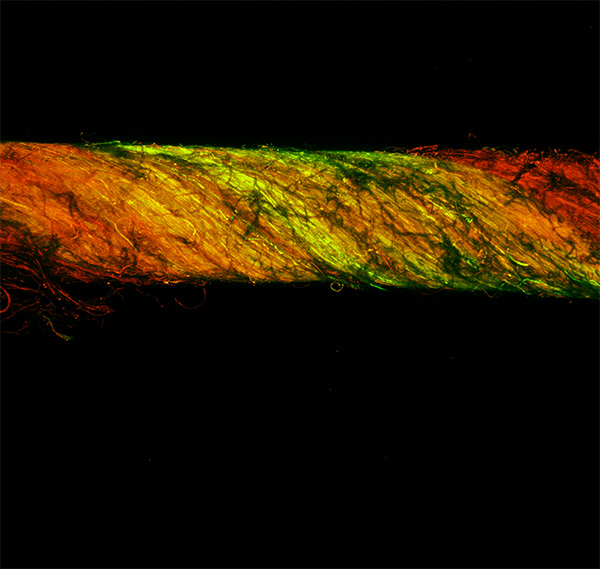 The overwhelming majority of votes for the People’s Choice Award went to Mohamad Keblawi, a biomedical engineering Ph.D. student in the Henry M. Rowan College of Engineering.
Entitled “Fluorescent Coalescent,” Keblawi’s image of nanofiber yarn was captured using a confocal microscope in the lab of Vince Beachley, Ph.D. The yarn was subjected to a laser beam that caused it to emit a green color, and another laser that caused it to emit a red color. Red and green images were composited together to produce the final image.
“The research established a new method of fabricating yarns using nanofibers as base filaments,” Keblawi wrote. “The yarn in the image was originally fabricated to demonstrate that multiple different yarn segments can possess an independent set of properties. In this case, one yarn segment fluoresces green while the other fluoresces red. However, the set of properties can be anything from filament density, filament diameter, or twist percentage.”
The contest’s panel of judges included: Tabbetha Dobbins, professor of physics and dean of the School of Graduate Studies; Lori Marshall, assistant vice president for University Communication; Mary Salvante, director and chief curator, Rowan University Art Gallery & Museum; and Andrew Hottle, professor of art history and communication studies in the Ric Edelman College of Communication, Humanities & Social Sciences.