Historian and author Steven Hahn presents Presidents Day Lecture
Historian and author Steven Hahn presents Presidents Day Lecture
February 13, 2026
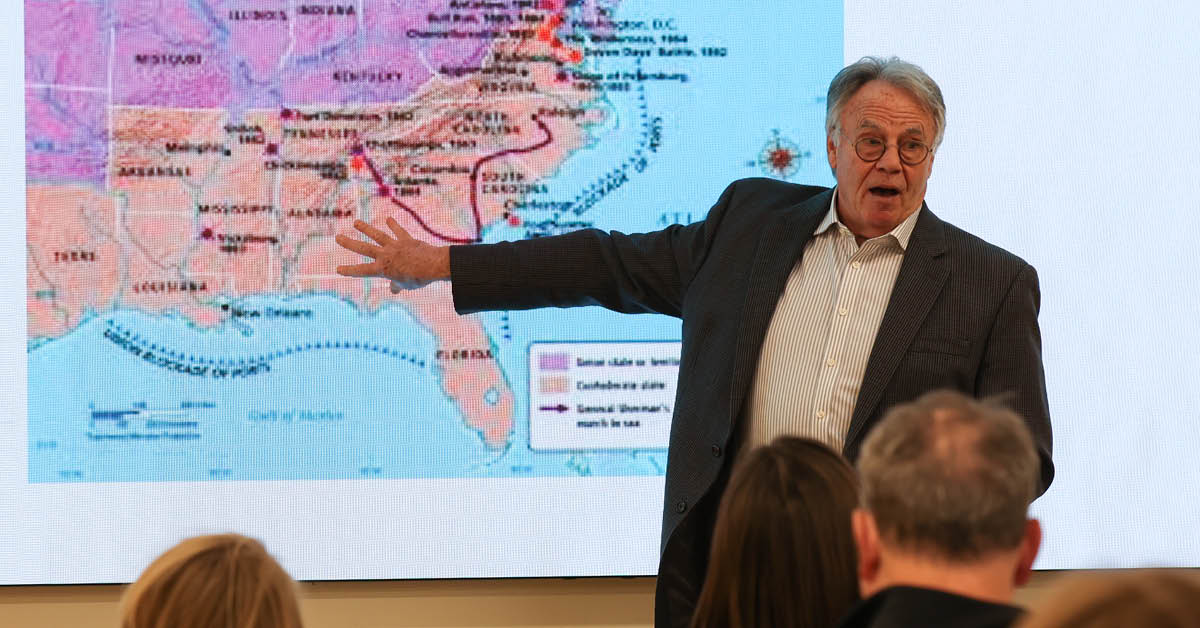
Historian and author Steven Hahn presents the annual Presidents Day lecture on Feb. 12
Pulitzer Prize-winning historian and author Steven Hahn addressed a room filled with students, faculty, staff and community members on Feb. 12 during Rowan University’s annual Presidents Day Lecture. Hosted by the History Department within the Ric Edelman College of Communication, Humanities & Social Sciences, Hahn’s lecture focused on President Abraham Lincoln and the enslaved population in a presentation titled, “What Enslaved People Thought of Lincoln and How That Ended Slavery in America.”
“Presidents Day invites us to think critically about leadership, democracy and the evolving meaning of the American nation,” said history professor Jennifer Janofsky in her opening remarks for the 18th annual event. Janofsky introduced Hahn by commending his extensive research and the ways in which it challenges audiences to reconsider who shapes history and whose voices are represented.
Author of “A Nation Under Our Feet,” Hahn is a history professor at New York University. His research focuses on 19th century U.S. history, slavery and emancipation, and the history of capitalism. Hahn chose his lecture topic to honor both Presidents Day and Black History Month. He began by outlining the circumstances of enslaved people leading up to Lincoln’s election, noting that many held elevated hopes and expectations that Lincoln intended to set them free.
Hahn explained that Lincoln ran for president on a platform opposing the expansion of slavery into new territories but did not call for abolishing slavery where it already existed. Lincoln’s goal, Hahn emphasized, was to uphold the Constitution and preserve the Union. Yet the hope that surrounded Lincoln’s election inspired enslaved people across the South to take action and resistance began escalating after he assumed office.
While many histories of the Civil War portray enslaved people’s actions as spontaneous responses to wartime chaos, Hahn argued otherwise. He said enslaved people had developed political consciousness long before the war and were actively interpreting events, sharing information, and teaching one another.
“It was the enslaved who drove the shift toward emancipation,” Hahn said, noting that their resistance and enlistment in the Union Army helped shape policies that influenced the outcome of the war. By 1864, nearly 400,000 enslaved people had reached federal lines, making them essential in the movement toward abolition.
Hahn concluded by stating the biggest advantage and disadvantage of being a historian is hindsight.
“We have to recognize and do the best we can to learn enough about the world we’re studying from people’s point of view,” he said, commending Rowan’s history students for their commitment to understanding and analyzing the past.
Before Hahn’s lecture at the Welcome Center, students hosted a poster session highlighting original historical research. Nominated by faculty, 23 students presented projects on wide-ranging topics including Japanese history, the American Revolution, Chernobyl and the Cold War, and African American history. Several students said their goal was to shine a light on lesser-known stories and figures throughout history.
Makye Sawyer-Smith, a sophomore history major, conducted research on African American liberators during the Holocaust, hoping to add broader African American perspectives to this period of history.
“African American history is often talked about in the context of slavery and the Civil War or the Civil Rights Movement, but there is still a large span of time in between,” Sawyer-Smith said. “There are major events that impacted the entire world that everyone knows about and we had a role in them.”
2026 marks the 18th annual Presidents Lecture Series. Previous speakers have included Doris Kearns Goodwin, Cornel West, Stephen Jay Gould, Jonathan Kozol, Scott Sagan, Sergei Khrushchev and Dan Rather.