Hands‑on healing: A conversation with Alex King, D.O.
Hands‑on healing: A conversation with Alex King, D.O.
February 13, 2026
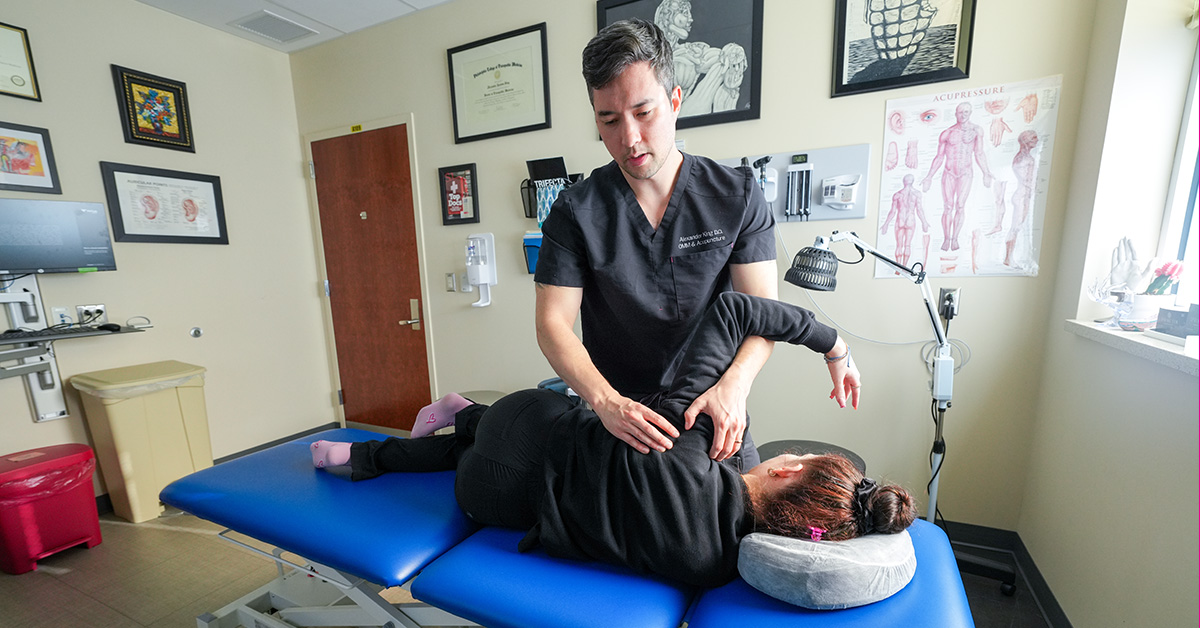
Some physicians reach for a prescription pad when a patient is in pain.
Dr. Alex King depends on his hands.
As a doctor of osteopathic medicine and an associate professor at the Rowan‑Virtua School of Osteopathic Medicine, King blends traditional osteopathic medical training, which includes manipulation, with medical acupuncture to help patients heal naturally. His approach is grounded in anatomy and neuroscience, and in the belief that the body has an innate capacity to repair itself when given the right support.
From treating herniated discs in competitive powerlifters to easing the strain of parents lifting toddlers all day, King’s work spans the full spectrum of musculoskeletal pain. He also trains the next generation of osteopathic physicians and shares his techniques widely through social media, making hands‑on healing accessible far beyond the clinic.
Below, he talks about his path into osteopathy, why he believes in the body’s natural resilience, and how he teaches others to tap into it.
Q&A
Q: For people who aren’t familiar, what makes osteopathic medicine different from other forms of medical care?
A: Doctors of osteopathic medicine are fully licensed physicians, but we approach care holistically. Instead of focusing on a single symptom, we look at how the entire body is functioning. Osteopathic manipulative medicine—our hands‑on diagnostic and treatment approach—may look like massage or physical therapy, but it’s grounded in deep anatomical and physiological knowledge. The goal is to help the body heal itself whenever possible.
Q: Some patients feel overwhelmed by the myriad of medications available. What do you tell them?
A: A lot of pain doesn’t respond well to medication alone. But the body is incredibly capable of healing when we remove barriers—tight muscles, restricted joints, impinged nerves. My job is to identify what’s preventing that natural healing process and address it directly with my hands, utilizing OMT and/or acupuncture, or by giving advice about diet, exercise, sleep hygiene, and supplementation when appropriate.
Q: Your background is unique—you studied sculpture and neuroscience before medicine. How did that shape your path?
A: Sculpture taught me to think in three dimensions and utilize my manual skills, which translates well to healing the human body with Osteopathy. Neuroscience gave me the framework to understand how pain works on a physiological level. Even though I grew up in a family of M.D.s, including a grandfather who used acupuncture, I didn’t discover osteopathic medicine until later. Once I did, it felt like the perfect fit.
Q: You’re also involved in research. What questions are you trying to answer?
A: We’re working on objective ways to measure the benefits of osteopathic manipulative treatment. Patients often tell us they feel better, but we want to quantify changes—such as muscle tone, elasticity, stiffness, and other physiological markers. The more data we have, the better we can refine our techniques and demonstrate their value for certain disease states.
Q: As the director of the osteopathic manipulative medicine residency program at Rowan-Virtua School of Osteopathic Medicine, you are directly training the next generation of physicians. Why do you invest so much time on social media?
A: Osteopathic medicine has given me so much, and I want to give back. Not everyone can come to medical school, so I create videos on Instagram, TikTok, and YouTube to introduce techniques and concepts to the general population and premedical students who will be the next generation of D.O.'s. You don’t have to be a medical student to learn something useful about how to heal your body. I've often been approached at conferences and on campus by admitted medical students who saw my YouTube videos before medical school, thus directly influencing their trajectory and passion for Osteopathic Medicine, which is the most fulfilling part of my social medical endeavor.
Q: How does acupuncture complement your osteopathic manipulative medicine approach?
A: Acupuncture, as a more "invasive" technique, activates nerves and modulates how the brain perceives pain. Osteopathic treatment restores motion and physiologic function of the entire body. When you put them together, you can address both the multifaceted components of dysfunction, which lead to eventual pain relief. Acupuncture is not standard curriculum included at osteopathic or allopathic medical schools, but it’s a training I invested in during my fellowship and incorporated into the care I provide. It adds depth to the treatment and often speeds up healing for very complicated patient presentations, when nothing else has worked.
Q: What do you hope patients take away from working with you?
A: That their bodies are capable of more healing than they realize, or have been taught. My role as an Osteopathic Physician is to guide that innate healing energy, not override it. When patients understand that, they feel empowered—not just treated. Patients feel like they are playing an active role in improving their function, and finally finding the answers to their pain, without depending on band-aid treatments that don't address the root cause of their ailments. As an osteopathic medical educator, this is the most important concept that I can pass on to my patients, students and residents.