Rowan researcher probes central Pa. for clues to 2nd mass extinction
Rowan researcher probes central Pa. for clues to 2nd mass extinction
January 22, 2026
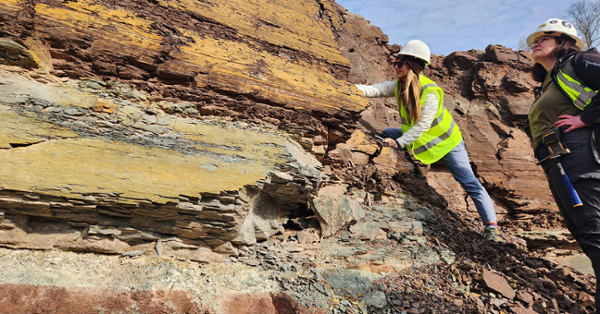
Pfeifer, left, seeks clues to mass extinction in deep earth samples
Imagine Earth 360 million years ago: towering mountains near the equator, lush landscapes dotted with early plants, oceans teeming with life. It was the Late Devonian period – a time of dramatic change – and coming ecological disaster.
The Devonian period ended with one of Earth’s “Big Five” mass extinctions, an event that killed off up to 85% of marine and land species. The climatic drivers of that extinction, and what it may teach us about our planet today, is a mystery that Lily Pfeifer, Ph.D., an assistant professor of Geology at Rowan University, hopes to help solve.
Backed by a National Science Foundation grant of more than $500,000, Pfeifer, the lead principal investigator, and a team of inter-university researchers are digging deep into the Appalachian Basin of central-western Pennsylvania to uncover clues about Earth’s ancient climate and a possible link to the end-Devonian extinction.
Importantly, the project will also afford hands-on research opportunities for many students, including Rowan undergraduates and Pfeifer’s first Ph.D. student.
Why the Late Devonian matters today
Most paleoclimate research focuses on the last 2.5 million years – just a blink in Earth’s 4.5-billion-year history – which may be a limited lens through which to study past global climate, Pfeifer said.
“To understand the full range of Earth’s natural variability, and the extremes that fall outside this range, we need to look deeper into time,” she said.
Study of the Late Devonian rock record offers a window into a period in Earth’s history with unique and potentially extreme climate conditions that could have impacted life.
Evidence suggests that during this period, the Appalachian Mountains – which were then forming near the equator – may have been covered by glaciers. (Scientists believe that land masses on early Earth featured a "supercontinent" called Pangaea that eventually broke apart. Over many millions of years, the continents drifted to their current locations, which could explain how the region known as Appalachia could have once been along the equator.)
“Glaciers in the subtropics could have triggered massive environmental changes, impacting evolving species in the nearby Appalachian Basin as they made the critical leap from fins to limbs,” Pfeifer said.
She said the work is especially important in the context of today’s changing climate and a related loss of biodiversity that some researchers feel is so severe it represents a sixth mass extinction. Many believe that, as the planet warms, sea level rise and desalination from freshwater incursion into the oceans may lead to even greater loss of life.
Digging for answers
Pfeifer and her co-PIs are analyzing ~360-million-year-old sedimentary rock from both marine and terrestrial environments. Collecting samples from the surface and from 1,000-foot-long earthen cores, they’re studying ancient layers of sediment from the planet’s distant past. That study includes a wide range of materials, from fossilized soils with chemical signatures of precipitation and CO₂ to prehistoric pollen, which can define the age of the rock.
So could sudden tropical glaciation have pushed Devonian fish and other species toward extinction? And what could this ancient climatic upheaval reveal about the future of life on Earth? Answers may lie far below Pennsylvania’s rolling hills, locked in rocks and soil particles for hundreds of millions of years.
“When we see evidence of climatic extremes in the past, we need to ask ourselves what the drivers were and how life responded,” Pfeifer said. “Answers to those questions can help us understand how Earth’s systems interact, which is relevant to understanding our modern (and future) climate.”
A Collaborative Effort
Pfeifer said the three-year project, newly funded through the NSF, is especially rewarding because of its collaborative and interdisciplinary nature, bringing together scientists from Rowan, Lycoming College, George Mason University, and Bucknell University (including Pfeifer’s own undergraduate advisor, geologist Jeffrey Trop, Ph.D.). The team is also working with Pennsylvania State Geological Survey scientists to access the rock cores.
“Rock core is a unique record, the most continuous and highest resolution record of the subsurface,” Pfeifer said.