Human-machine interactions could one day revolutionize fall prevention
Human-machine interactions could one day revolutionize fall prevention
January 22, 2026
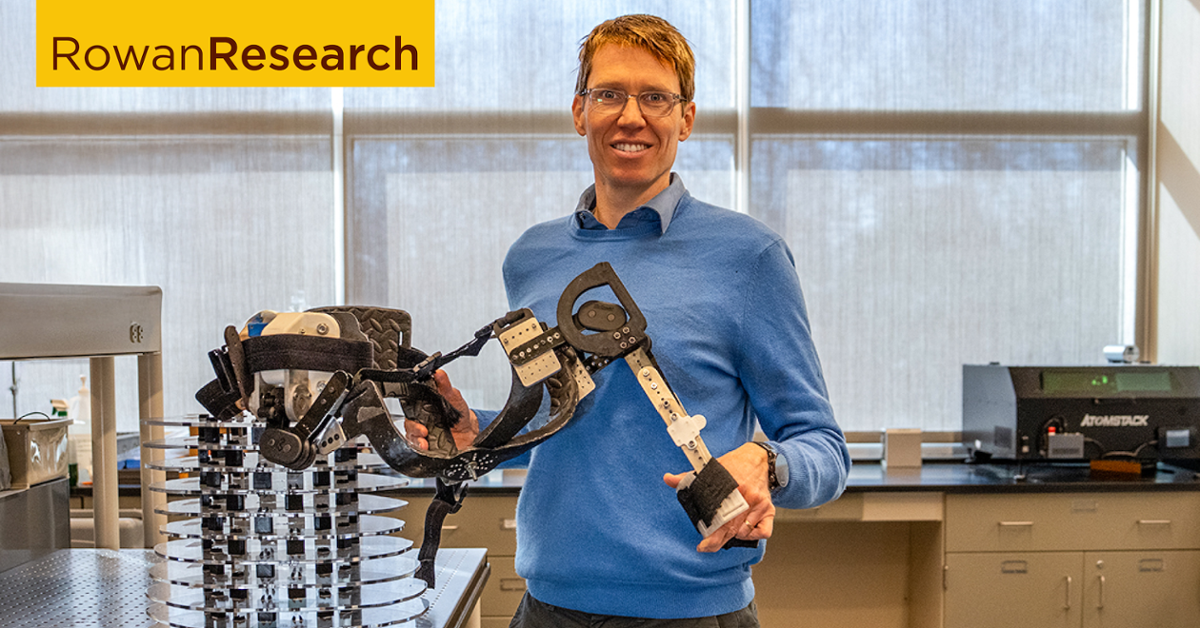
Mitja Trkov researches soft robotics and human-machine interactions.
Mitja Trkov, Ph.D.
Mechanical engineer
Areas of expertise:
Wearable robotics, exoskeletons, soft robotics, mechanical engineering, human biomechanics
Slip and falls among older adults and people in certain occupations can impact health and productivity and even risk permanent injury or death. What if there was a way to protect people from slips and falls using wearable devices?
Mitja Trkov, a mechanical engineer in the Henry M. Rowan College of Engineering, focuses his research on soft robotics and human-machine interactions in biomedical applications.
“I use analytical and experimental approaches that integrate dynamics and control, mathematical modeling, and use of experimental platforms with human subject testing,” he explains.
Supported by the National Science Foundation, the project seeks to demonstrate “that slip-induced falls can be prevented by using a wearable device that provides external mechanical assistance to assist subjects during balance recovery and lead to new resulting balance recovery strategies of subjects that would not be possible without the device.”
Trkov’s work aims to move hip and knee joints using instrumented wearable assistive devices to both sense and correct a slip or trip before it happens.
“We have to detect and provide assistance within less than 200 milliseconds,” Trkov said. “Development of active fall prevention strategies can shift the paradigm of fall prevention approaches that can result in a significant reduction of falls and fall-related injuries. The results of this research have the potential to impact the health care sector by improving the quality of life of the fall-prone population and reducing the associated economic and societal costs due to falls.”
In work with undergraduate and graduate students, Trkov’s lab is also creating new teaching modules for mechanical engineering students.
His long-term goal is to combine his two research areas of wearable devices and soft robotics to create soft robotic devices that replace the traditional brace.
“Replacing traditional electric motors with soft, flexible actuators allows machines to perform tasks more safely and in ways that closely mimic the natural movement and softness of human tissue,” he explains.
Rowan University researchers are passionate about what they do. Find more at Meet Our Researchers.