Smart drones could one day improve crop yields in South Jersey’s cranberry bogs
Smart drones could one day improve crop yields in South Jersey’s cranberry bogs
December 9, 2025
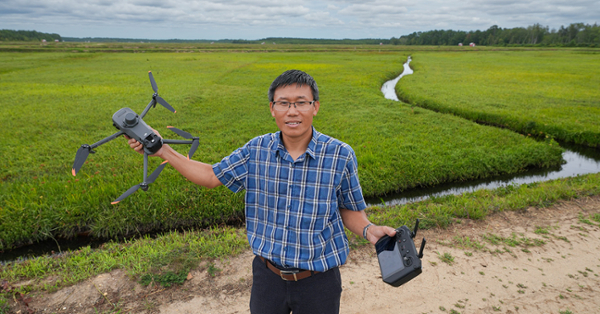
Thanh Nguyen, Ph.D., displays drones used in his research at a cranberry bog in the Pinelands.
The Pine Barrens of southern New Jersey are home to the state’s largest producers of cranberries, a native fruit that thrives in the region’s sandy, acidic soil. So, too, does a perennial weed called the Carolina redroot, another native plant whose flowering crowns of seedheads can quickly spread through a healthy cranberry bog, devastating crop yields.
With support from the U.S. Department of Agriculture (USDA) through the New Jersey Department of Agriculture, researchers at Rowan University spent two years working with Rutgers Philip E. Marucci Center for Blueberry and Cranberry Research to develop “intelligent” drones to seek out and spray affected areas for treatment.
“Currently, the farmers have to use a plane to spray the whole field,” said Thanh Nguyen, Ph.D., an associate professor of mathematics in the College of Science & Mathematics and the project’s principal investigator. “We want to develop an AI and an autonomous drone system that can detect and do the spot spraying autonomously.”
Using commercially available agricultural drones to capture images of the fields, the team mapped out specific locations of Carolina redroot to identify areas in need of treatment. Next, the researchers aim to integrate detection software in a spray drone, allowing it to detect and spray weeds on its own.
Precision spraying could reduce the amount of pesticides required to control the weed, as well as costs and labor, said Hieu Nguyen, Ph.D., a Rowan University mathematics professor and the project’s co-principal investigator.
The team recently received additional funding from the USDA for similar research involving smart weed detection and management in specialty row crops like corn and squash.
Funding for “Early Detection and Mapping of Carolina Redroot in Cranberry Bogs using AI and Autonomous Drones” was made possible by the U.S. Department of Agriculture’s (USDA) Agricultural Marketing Service through grant 23DCBPNJ1201-00. Its contents are solely the responsibility of the authors and do not necessarily represent the official views of the USDA.