Tracing Earth’s past to predict its future: The science of glaciers
Tracing Earth’s past to predict its future: The science of glaciers
December 11, 2025
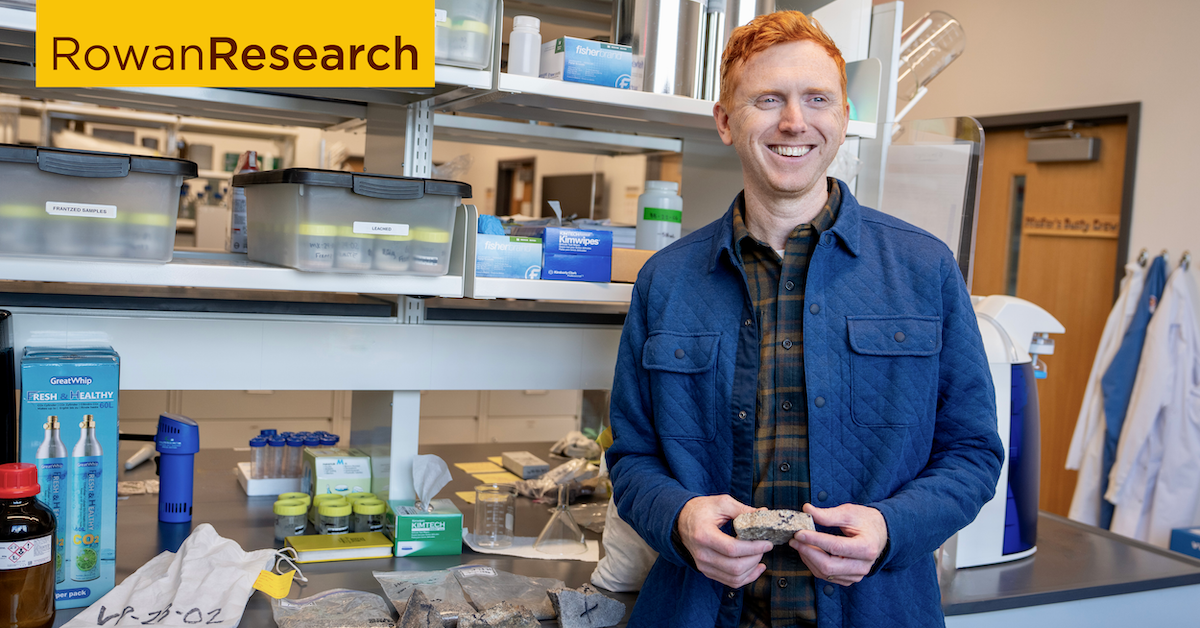
Aaron Barth analyzes rock and sediment samples from glacial deposits to assess past climate variability and long-term trends.
Aaron Barth, Ph.D.
Glacial geologist and paleoclimatologist
Areas of expertise:
Glacial geology, cosmogenic nuclide exposure dating, paleoclimatology, climate change, Quaternary Period
Aaron Barth, Ph.D., studies climate across millennia, starting with debris left by glaciers during the last ice age.
His goal: to expand a body of knowledge of Earth’s ever-evolving climate patterns for current and future generations.
“As an undergraduate, I took a geology class on a whim and thought, wow, there’s a story here,” said Barth, an assistant professor in the Department of Geology, from his lab in Discovery Hall.
Barth’s research centers on understanding how glaciers and ice sheets have responded to climate change throughout Earth’s recent geological past. As a glacial geologist and paleoclimatologist, he investigates the timing and dynamics of ice retreat and advance using cosmogenic nuclide exposure dating. This technique reveals how long rocks have been exposed at the surface following glacial transport.
Though much of his work focuses on rocky material deposited in mountainous regions like the Adirondacks, Barth said sediments left by glaciers, accumulations called moraines, are far more common—and often more expansive—than most people would imagine.
“Long Island is a moraine,” he said.
Barth’s work integrates a range of studies, including geochronology, geomorphology, sedimentology and field mapping to reconstruct glacial histories, particularly during the Quaternary period—which ranges from nearly three million years ago to today. The Last Glacial Maximum, or LGM, is believed to have ended roughly 11,700 years ago.
By analyzing boulders and other debris left by moving ice sheets, glaciers and ice-dammed lakes, he’s able to study the climatic conditions that shaped these events. His broader mission is to improve an understanding of past ice behavior so scientists may better anticipate future changes in Earth’s cryosphere—the totality of frozen planetary water—under ongoing climate shifts.
Scientists are concerned about melting ice sheets because their runoff causes sea level rise, which imperils coastal residents around the world.
Though geologists often rely on cores drilled from deep inside ice sheets at the Earth’s poles to gauge climate change across centuries, Barth said the effects of planetary warming on those sheets can be much more obvious, such as the 2002 collapse of the Larsen B ice shelf in Antarctica, a chunk as big as Rhode Island.
“Once that happens you can see the rate of sea level rise speeding up,” he said.
Rowan University researchers are passionate about what they do. Find more at Meet Our Researchers.