More than 600 attend Rowan online program to address racial injustice in America
More than 600 attend Rowan online program to address racial injustice in America
June 8, 2020
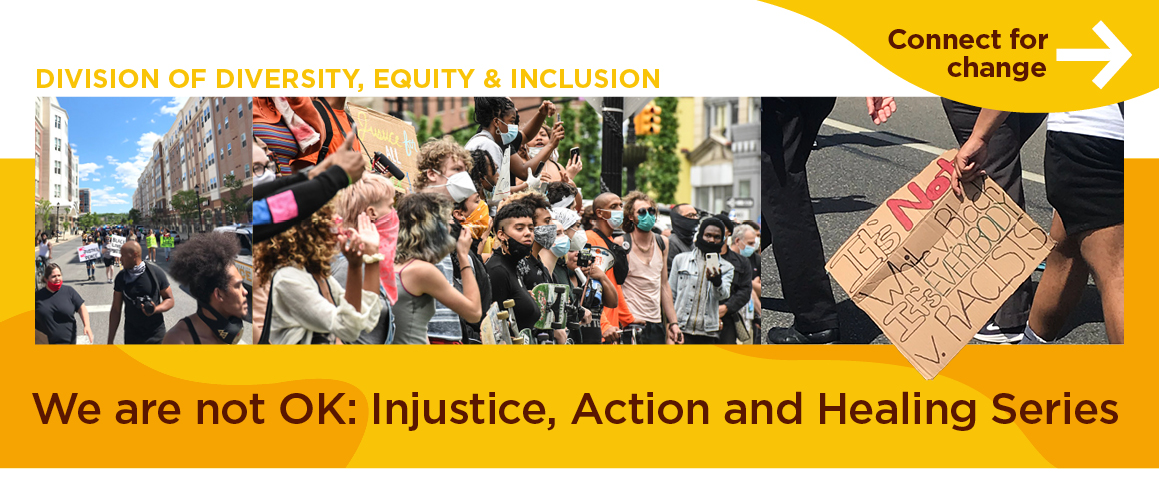
Rowan University held the first in a five-part online series to address racial injustice in America June 4 in which more than 600 attendees participated, some of whom queried panel members on issues ranging from the prevalence of excessive force by police to the role of social media in racial tensions.
Spurred by the May 25 killing by police of George Floyd, an unarmed black man in Minneapolis and the nationwide reaction to it, the series was convened to examine the many recent slayings by police of African Americans in the context of centuries-long racial discrimination and to consider paths forward.
“We’re here to talk about the realities in our country, but also about solutions,” said moderator Dr. Monika Williams Shealey, senior vice president for Rowan’s Division of Diversity, Equity and Inclusion, the program’s lead sponsor.
Founded in 2019, DEI was charged with helping to change ingrained attitudes about race, stereotypes and bigotry of any form at the University, and Rowan is among the first institutions in the nation to create an entire division to do so.
Unfortunately, Williams Shealey noted, America’s racist history with black people, from 150 years of slavery to Jim Crow laws to the harassment and shootings of unarmed citizens is alive and well. She also noted that Floyd, who pleaded for officers to let him breathe while he was pinned to the street with a knee to his neck, was the latest of more than a dozen African Americans to be slain by officers since the 2014 choke-hold death of Eric Garner in New York City.
“The murder of George Floyd was the match that lit the flame,” Williams Shealey said.
Joining the conversation were a variety of Rowan administrators and faculty as well as Student Government Association President Arielle Gedeon, the first black female SGA president.
The program We Are Not Ok: Injustice, Action, and Healing Series, was created to educate and offer guidance and support to an anguished Rowan community and members of the public in light of Floyd’s slaying and the continuing reaction to it.
Citing some of the African Americans killed by police since the Garner slaying, Dr. Shelley Zion, a professor of Language, Literacy, and Sociocultural Education, said that continuing to raise awareness about America’s ongoing racial struggle is key but more critical will be actions taken to address it.
“What’s important to talk about is the fact that there is nothing new here,” Zion said. “We have reached a tipping point.”
That said, she warned that despite a multi-racial response to Floyd’s slaying that has spread around the world, she is not completely hopeful that powerful change is imminent.
“I think what we are short on is the will, the commitment, the doubling down on our energy and effort,” Zion said. “It’s maybe the most visibly manifest element of privilege that you can choose to engage or not. Too often those with privilege engage momentarily and then dip out the moment something else comes along. What we need is for people who hold the most privilege to stay in the fight.”
Role of social media
Historian Dr. Bill Carrigan, who has written widely about racism and lynchings in America, said while racism was embedded in the nation since the beginning, many white Americans seem angry and possibly afraid of their country’s changing demographics, feelings that are amplified by and through social media platforms.
“Some are frustrated and easily manipulated by today’s social media,” he said.
Sociologist Dr. Sandra Joy, who, like Carrigan, said she was raised in the south and witnessed the effects of racism first hand, agreed that through social media President Donald Trump and others have fanned prejudices that long existed in America.
“Trump has tapped on a discontent in the white community,” said Joy.
But Gedeon, who among the panelists was the only one to grow up with social media, countered that as communication tools they can be an even stronger force for good.
“I’m grateful for social media,” she said. “My suggestion is for students to call out comments (that are offensive).”
Concluding the first session, Gedeon urged students to get involved if they want to see positive change.
“Register to vote. Vote in your local elections. Run for office too,” she said. “And if you haven’t spoken out during the last week, you need to ask yourself why.”
The series, which is open to the public, continues as follows:
I Can’t Breathe: Discussion of Racial Battle Fatigue, Trauma, and Self-Care, 3 p.m. Monday, June 8
Speaking Truth to Power through Pedagogy: Anti-Racist Teaching in Higher Education
3 p.m. Thursday, June 11
White People Do Something: A dialogue on Whiteness and Allyship
3 p.m. Friday, June 12
Where Do We Go From Here? Navigating Campus and Community
3 p.m. Monday, June 15