A Culture of Inclusion: New division builds on Rowan's mission of universal acceptance
A Culture of Inclusion: New division builds on Rowan's mission of universal acceptance
March 4, 2020
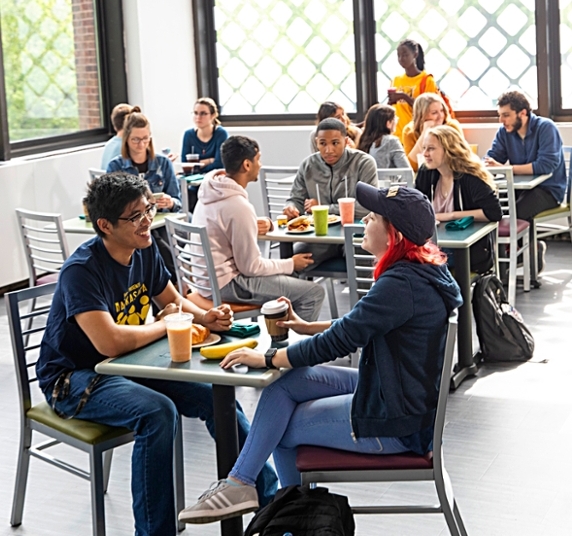
By almost any measure, Rowan University is an inclusive community, welcoming and supportive of students and employees alike.
And yet, as in society-at-large, there can be an uncomfortable feeling for some that bubbles below the surface.
Often sensed by members of groups who were disenfranchised in the past, it’s a feeling of being pre-judged based not on who they are and all they achieved to get here but on what group they are part of. It’s a sense that maybe, even if it’s unspoken, they’re considered an outsider. Not quite welcome. They don’t fit in.
Founded last year, Rowan’s Division of Diversity, Equity & Inclusion has a mission to change that. It is a mission of universal acceptance, of promoting inclusion and belonging regardless of race, gender, sexuality, age, faith, national origin, political perspective or ability.
“Members of our community want Rowan to be inclusive, diverse and accepting,” said Dr. Monika Williams Shealey, who as senior vice president helped launch the division in January 2019. “We’re taking concrete steps to make that ideal a reality.”
Institutional, social challenges to overcome
Shealey said staff conducted a detailed study last spring to determine what the Rowan community sees as the most pressing issues facing it and set out to address them.
Among the group’s findings was the belief that despite a years-long effort to make Rowan accepting of everyone, more can be done.
Ingrained attitudes about race, changing demographics, current events, even the evolving nature of social media complicate the bridge-building mission of DEI, at Rowan and elsewhere.
Yet while many colleges and universities seek to create welcoming and inclusive communities, Rowan is among the first in the nation to start an entire division working toward that end.
“Our structure is more comprehensive and far-reaching than that of any other college or university in the state,” Shealey said.
Located on the main floor of Savitz Hall, DEI includes the offices of Student Equity & Compliance (which addresses Title VI and Title IX issues); Social Justice, Inclusion and Conflict Resolution; Achieving Success through Collaboration, Engagement and Determination (ASCEND); the Creating Higher Aspiration and Motivation Project (CHAMP); and the Faculty Center for Excellence in Teaching and Learning, which is shared with the Division of Academic Affairs.
Rowan President Ali Houshmand, who felt the sting of bigotry as a college student in the United Kingdom, said Rowan is committed to eliminating it here.
“We should not even have to have a conversation about equity and inclusion for everyone but the fact remains that people are not always inclusive,” Houshmand said. “They are not necessarily welcoming to people of color, or to people of a sexual orientation or religion that differs from their own, who do not recognize that people are people.”
Following a blueprint
Shealey said data collected during an extensive listening tour last spring enabled the creation of a blueprint of sorts for the new division to follow.
Among its first steps was seating a DEI Council with representatives from across the University that meets monthly to review current issues and is working with departments on setting DEI-related goals.
In its first year, the Division also launched a DEI blog to share activities and document goals and progress; restructured the Title IX Office to address additional bias and harassment claims; created a DEI Certificate Program; developed unconscious bias training; and launched a Neurodiversity Taskforce to ensure that students and employees with neurological differences are recognized and respected.
“Our belief in developing Rowan as a place of acceptance and diversity goes well beyond a clichéd perception that this is just about race,” Shealey said. “We’re focused on every student, faculty member and staff member on campus, every one of whom wants to be valued for who they are, without having to worry about identity being an issue.”
“Prejudice exists”
Student Government Association President Arielle Gedeon, a Haitian-American, first-generation student, said though she absolutely feels accepted at Rowan, by her teachers and by her peers, there have been times when she’s felt excluded, even pre-judged, because of her skin color and/or her sex.
But Gedeon, who is not only Rowan’s first black female SGA president but also president of the Lambda Rho Chapter of Alpha Kappa Alpha Sorority, Inc., said what’s important is that Rowan works hard to make everyone feel welcome and the new Division of DEI centralizes that effort.
“Prejudice exists,” she said. “It’s not like it doesn’t exist just because Rowan wants it not to. But Rowan works very hard to create a sense of community.”
Gedeon said it’s that sense of community, the feeling that everyone belongs, that is at the heart of what DEI seeks to expand.
“Whether it’s your classroom, your sports team, your club or your sorority, it’s crucial to feel you belong,” she said. “At the end of the day it’s a matter of students understanding that there’s a place for them here. That they belong here.”