Stunning 301 W. High redesign recognized
Stunning 301 W. High redesign recognized
November 16, 2016
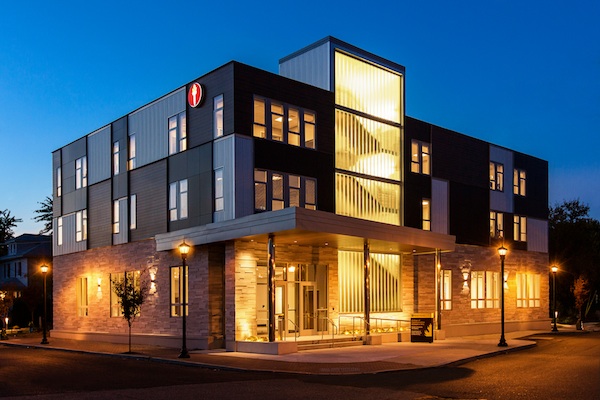
A scant three years ago, 301 W. High Street was an eyesore, an unfinished, abandoned townhouse project, empty, cold and foreboding at the edge of campus.
Today, it is an award winner.
 The property, home to the Rowan University Art
Gallery and the Department of Public Relations & Advertising
within the College of
Communication & Creative Arts, has won a prestigious design
award, Outstanding Project 2016 from Learning by Design,
an architecture magazine.
The property, home to the Rowan University Art
Gallery and the Department of Public Relations & Advertising
within the College of
Communication & Creative Arts, has won a prestigious design
award, Outstanding Project 2016 from Learning by Design,
an architecture magazine.
“301 W. High Street is a wonderful example of adaptive re-use,” said Donald Moore, senior vice president for facilities and operations.
Initially designed to contain five large townhouse units, construction of the building by a private developer started in 2006 but stalled. Rowan bought the vacant property in 2013 for $440,000 and spent more than $6 million redesigning and reconstructing it.
 Rowan in September 2015 formally opened the new
facility, a three-story, 17,000 square-foot structure with the
gallery on the first floor and classrooms, offices, computer labs
and student lounges on the floors above.
Rowan in September 2015 formally opened the new
facility, a three-story, 17,000 square-foot structure with the
gallery on the first floor and classrooms, offices, computer labs
and student lounges on the floors above.
Among the building’s most striking features is a wall of glass that rises from street level above the roofline and showcases the building’s stairwell. The stairwell is lighted at night, as is a distinctive Rowan torch emblem on the building’s High Street side that, taken together, adds to the borough’s developing cityscape and helps build a sense of place.
“It serves as a kind of beacon,” Moore said. “We wanted the building itself to be something of a work of art and I think we accomplished that. The other thing we wanted was for it to be easily accessible, both to students and the general public.”
The building, completely redesigned by SOSH Architects of Atlantic City, was recognized by Learning by Design in its Fall 2016 issue. Published twice a year with features on educational architecture, the magazine included 301 W. High Street among 10 “outstanding” college or university projects.
The building serves as an anchor on the west end of a budding Arts & Entertainment district. The east end is anchored by Let’s Dance Studio near the Glassboro Post Office and an outdoor art space was created in the just-opened Town Square at High and Main streets as part of the $350 million Rowan Boulevard project.
In addition to the Learning by Design award, Moore said a recent landscape redesign featuring seasonal plantings and discreet wastewater management around Linden and Memorial halls won an award from the Society for College and University Planning International.
 The awards are significant because they reflect the
special attention being paid, often at great cost, to building and
property aesthetics throughout the University. Examples include the
recently-opened
Holly Pointe Commons residence hall, the renovated Camden
Campus Academic Building and new buildings for the Rohrer College
of Business and the Henry M. Rowan College of Engineering, both of
which will open in January.
The awards are significant because they reflect the
special attention being paid, often at great cost, to building and
property aesthetics throughout the University. Examples include the
recently-opened
Holly Pointe Commons residence hall, the renovated Camden
Campus Academic Building and new buildings for the Rohrer College
of Business and the Henry M. Rowan College of Engineering, both of
which will open in January.
“A facility can in fact be a refuge, it can have an impact on people,” Moore said. “The fact is that poorly designed facilities are not inspiring to students. As we touch people on and about our campuses, part of our job is to make sure the environment is inspiring.”