Rowan business professor contributes much to West African homeland
Rowan business professor contributes much to West African homeland
April 24, 2008
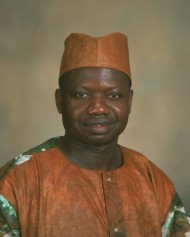
Two or three times a year, Dr. Michael Ba Banutu-Gomez treks home,
traveling roughly 4,000 miles, crossing an ocean, flying anywhere
from seven to 14 hours to reach The Gambia, the West African
coastal country where he was born and raised.
He has family in the nation - the smallest country in Africa, one that is practically surrounded by Senegal - and that's part of the draw, of course.
But there's more.
He has family in the nation - the smallest country in Africa, one that is practically surrounded by Senegal - and that's part of the draw, of course.
But there's more.
Banutu-Gomez, 42, a professor of management in Rowan University's
Rohrer College of Business, is committed to bettering his homeland,
even while he is a well-respected professional, husband and father
living in a middle-class community in Washington Township,
N.J.
The land of his youth - where, according to the CIA, life
expectancy at birth in the largely agrarian country is around 55
years - is a far cry from South Jersey, but it is a place he holds
dear.
"I still see The Gambia as my home, but I also see America as my
home as well," said the father of one, who - along with his
daughter, Nyima, 4, holds citizenship in both countries.
That love for his first home is what regularly propels him into
another world and will spur him back this May through August to
once again assist leaders from the government, military, police,
religious organizations, financial institutions, the private sector
and non-government organizations. This spring and summer, he'll
train 40 to 50 Africans on leadership and management, including
tribal chiefs in their local language. His wife, Shandra, a health
educator, trainer and professor, will accompany him, along with
their daughter. And during June, Rowan business professor Dr. Berhe
Habte-Giorgis will join Banutu-Gomez in training people in
appreciative inquiry, the process of looking at the good in people
as a way to counteract the bad and using that good to help empower
people to do better.
Most of the time, Banutu-Gomez said, people only see Africa on a
television screen, and what they see is the negative: war, poverty
and famine. "We're looking at evaluating what's good in society and
how to use it to change things for the better," he said.
Banutu-Gomez also raises funds for his homeland and solicits
donations of educational materials for the country's children.
Recently, he sent close to 3,800 books donated by the Rowan
community and contacts of his wife and opened one of only a handful
of libraries in The Gambia.
Perhaps Banutu-Gomez's largest contribution can be found in Lamin,
a town in which he and his family built a second home about 10
minutes from the Banjul International airport in Yundum. That's the
town in which Banutu-Gomez in 2007 founded the Banutu Business
College, with the goal of educating Gambians and other Africans who
may have no other chance to obtain a higher education. He serves as
chair of the business college, and his wife is academic dean.
The Banutu-Gomez family also created the "I HEAR U (Improving
Health, Education and Acquiring Rights for the Underserved)"
Foundation to address many social issues and to raise funds and
sponsor disadvantaged students to pursue their college education in
The Gambia.
"When you provide quality education, you are developing the
country," he said of his initiative. "Having opportunities to have
education in our country is a blessing to everybody else."
"My parents were both teachers, inside of the classroom and outside
the classroom, and I saw them both giving back. I believe growing
up with that point of reference has influenced me to pursue a
career that allows me to give back and to educate. I pray that this
legacy of giving and helping those in need extends to our daughter,
and she will learn just as I have, that what I have given pales in
comparison to what I have received."
When he returns to The Gambia it's to mixed reactions. He spends
time with old friends, and they pick up where they left off --
there is no separation. Younger people, though, show him respect,
but more for his age than his education, calling him "Uncle" and
"Dad." Some people perceive him as a "rich American," but then to
many in The Gambia, any American is rich, Banutu-Gomez said.
Banutu-Gomez - Michael is the Christian name he was given at
baptism, Ba is the African name given him at his naming ceremony,
Banutu is his family name and Gomez comes from Portuguese
colonizers who "gave" it to his great-grandparents when they lived
in Guinea Bissau, West Africa - looks to his origins for the
reasons he gives so much. "I can go back to my parents," he said.
"Both my parents were farmers. My father also took in kids from
people unable to care for them, to live with us and raise them as
his kids. I grew up in that type of family, helping other people,
assisting other people."
He also attributes where he is today in part to his family. One of
11 children, Banutu-Gomez was born in a village called Bakalarr
with no elementary school, and he left home on Sundays to travel 20
miles and board with a family that spoke a different language and
lived near his school, St. Michael Elementary School in Njongon.
Seven of his siblings also attended school, and in his village that
was rare -- only one other family sent its offspring to class. He
attributes his and his siblings' education to his father, who also
worked as an importer and traveled a great deal through Africa,
gaining exposure to different ideas.
Banutu-Gomez attended a teachers' training college in The Gambia,
and two of his siblings also attended college. He taught elementary
and secondary school briefly in his homeland before coming to
America at age 20, the first in his family to do so.
Banutu-Gomez, an Eagle Scout who worked in Scouting in The Gambia,
left home to work for the Boy Scouts in Connecticut. At the end of
his one-year stint there, he returned to school in Connecticut,
Boston and Cleveland. He later moved to Chicago to work at Illinois
Institute of Technology-Stuart School of Business and also at
Robert Morris College, and it was there that he met his wife. In
Chicago he helped build the Gambian Association of Chicago, a group
that worked with Gambians to discuss development issues here and at
home, and did the same when he was in Boston with the Gambian
Association of Massachusetts.
He earned a B.A. in sociology and applied social relations from
Eastern Connecticut State University, an M.S.W. from Boston
University and a Ph.D. in organizational behavior from Case Western
Reserve University, and he joined the Rowan faculty in 2000. Today,
helping others comes naturally to him.
"It's not enough having an education," he said. "Education can only
be meaningful when you reach out and share what you have with
people who don't have access to what you had. The best thing I can
provide the African people, especially the Gambian people, is
sharing my knowledge and experience with them," he said.
Most of the people in his homeland, he said, will never have the
opportunities he had. "I want to give back to the people in The
Gambia," said Banutu-Gomez, who often dresses in native garb.
"It was not even a question of giving back," he said. "It was a
natural instinct."
(Banutu-Gomez welcomes book donations, including used and new
textbooks and novels, as well as computers, to bring to The Gambia.
He can be reached at 856/256-5425 or at Banutu-gomez@rowan.edu)